
2025-2026 Annual Report
Ombudsman's message - Here for you: Helping more Ontarians than ever - It is my privilege to release this report as Acting Ombudsman, detailing how Ombudsman Ontario once again helped a record number of people across this province over the past year.
Table of contents
Office of the Ombudsman of Ontario
We are dedicated to being an effective agent of positive change for everyone in Ontario and ensuring that their rights are respected and that public services are delivered with professionalism and fairness.
Acknowledgement of Territory
Ombudsman Ontario acknowledges that the province of Ontario is situated on the lands and territory of more than 130 unique Indigenous Nations, each with its own distinct cultures, languages, and histories that long predate the existence and boundaries of the province.
We acknowledge the existence of political confederacies on these lands that predate both Canada and Ontario, such as the Three Fires Confederacy and the Haudenosaunee Confederacy, who among themselves have treaties and relationships that make up the dynamic landscape of this province.
We humbly recognize that we have collective responsibilities and obligations within the more than 40 treaties in Ontario, including the Dish with One Spoon, Treaties 3 and 9, the Robinson Treaties, and the Williams Treaties. We are committed to the moral and legal responsibilities these treaties continue to carry.
We acknowledge that Indigenous peoples who have stewarded these lands for millennia have been subjected to dispossession and colonial injustices, and we are committed to supporting efforts to address both historic and ongoing harms.
We are grateful to have travelled and worked in First Nation territories and with Métis and Inuit peoples in Ontario since the inception of the Ombudsman more than 50 years ago.
As stated in the core commitments in our Indigenous Services Plan, Ombudsman Ontario will work to build respectful relationships with Indigenous communities and organizations, integrate reconciliation into our work and make our processes more culturally informed, responsive and accessible for a shared better future.
Video
Annual Report Highlights
Ombudsman's message
Here for you: Helping more Ontarians than ever
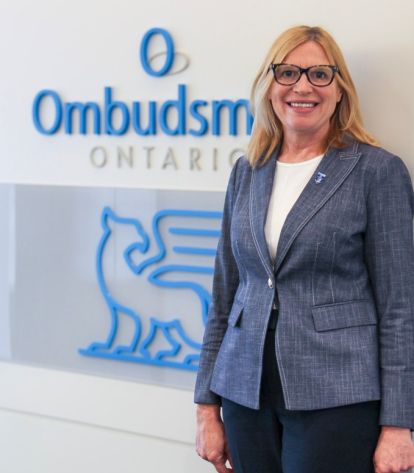
It is my privilege to release this report as Acting Ombudsman, detailing how Ombudsman Ontario once again helped a record number of people across this province over the past year.
This report covers the 2025-2026 fiscal year – April 1, 2025 through March 31, 2026 – and summarizes the highlights of the 35,023 public complaints and inquiries we received about provincial and public sector services.
This number represents a new record in case volume – more people seeking our help across more of the public sector than ever before. Not only that, it comes on top of successive year-over-year increases: 43% in the past three years alone.
In other words, more and more people are turning to their independent, impartial Ombudsman to help them navigate public services and make sure their rights are respected. I can attest that in my more than 20 years with this Office, we have never seen such broad demand for our services. Our role as a non-partisan democratic institution – with expertise in navigating bureaucracy and promoting fairness – has never been more important.
Of course, case numbers alone do not fully describe the impact of our work – people do. Throughout this report, we have highlighted the stories (anonymized to protect confidentiality) of how we helped the people who came to us to resolve their issues – and often prompted lasting service improvements.
A decade of building trust
The year covered by this report was the final year of Paul Dubé’s term as Ombudsman – a decade in which our Office’s jurisdiction was expanded twice; first to municipalities, universities and school boards, and then to child protection services and French language services.
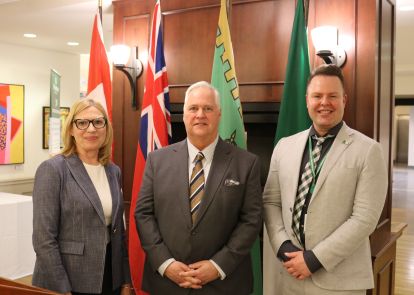
As he noted in the special end-of-term report he published in late March 2026 just prior to his departure, the challenges of these expansions allowed us to strengthen relationships across the province with the public and public sector bodies alike – and build new ones based on our credibility as an independent democratic institution.
The relationships and initiatives that Ombudsman Dubé undertook are a legacy that we are honoured to continue in what is now Ombudsman Ontario’s 51st year.
Indigenous services
Also in March, we published Ombudsman Ontario’s Indigenous Services Plan, co-developed with Tawi:ne, a First Nation woman-owned and operated consulting firm, through a series of engagements with Indigenous groups and individuals across the province. It sets out five core commitments that will guide our work and that we will report on in future reports like this one.
Throughout the year, the then-Ombudsman, myself and many of our staff also visited Indigenous communities, participated in Indigenous conferences and Pow Wows, and met with Indigenous leaders. We heard a broad range of concerns through these activities, and this year for the first time, we are able to report that we assisted some 674 people who self-identified as Indigenous.
Children and youth
Our Children and Youth Unit helped a record number of young people this past year, and continued to expand their efforts to speak directly and in person with as many as possible. Specialized teams visited youth justice centres and provincial schools, travelled to Indigenous communities, and participated in events for Black youth as well as 2SLGBTQIA+ youth. The Unit also created new resources to ensure youth are informed about their rights and how to reach us for help, and hosted a Youth Rights Conference for 2SLGBTQIA+ youth.
French language services
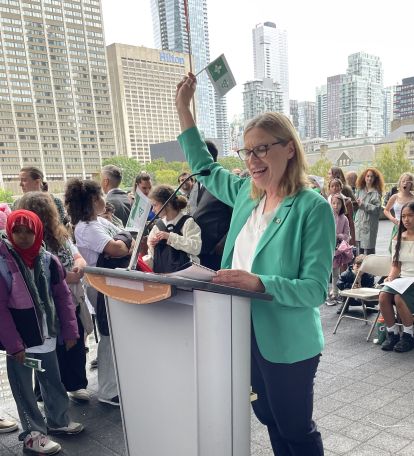
Our entire Office supports the work of the French Language Services Commissioner and our dedicated French Language Services Unit. This year, they engaged with more French speakers than ever, including many newcomers to Ontario, to promote their right to access provincial services in French. The sustained impact of the Commissioner’s recommendations and investigations was also evident in ongoing improvements, through individual case resolutions and systemic improvements to government services in French.
We are proud to work in a bilingual environment, with staff throughout our Office who provide help to French speakers across all areas of our mandate, in addition to questions about French language services. Along with the 266 cases we handled this year regarding compliance with the French Language Services Act, we also helped some 460 people in French with a variety of other issues.
Correctional services
Our specialized staff who handle thousands of cases about correctional services every year visited more facilities in person and initiated regular meetings with the senior staff of the province’s “mega” facilities in addition to our ongoing quarterly meetings with the Ministry of the Solicitor General. We continued to call attention to the ongoing crisis of overcrowding in correctional facilities and its deleterious effects on inmates and staff. Although we saw a decline in complaints about correctional facilities this year from last year’s all-time record, we raised numerous concerning issues to the Ministry and assisted thousands of inmates.
Social services
The release in November of our report Lost in Transition, about our investigation into adults with developmental disabilities being inappropriately housed in hospitals, prompted the Ministry of Children, Community and Social Services and the Ministry of Health to commit to working together to find solutions – and report back to us regularly on their progress. Our Special Ombudsman Response Team has also shared learnings from this important investigation in several presentations throughout the developmental services sector.
Our team dealt with high case volumes in several areas of this sector this year, notably in relation to the Ontario Disability Support Program and other benefits. Thanks to their expertise in navigating often challenging systems, they were able to help hundreds of people address errors, reach case workers and access benefits to which they were entitled.
Education
This was our 10th year of handling cases about school boards and universities and also a record year for complaints across the education sector. We listened to concerns from parents, students, families and school trustees and resolved hundreds of individual cases about school boards, post-secondary institutions and the Ontario Student Assistance Program.
The Ministry of Education also accepted all of our recommendations for improving any future direct payment programs for families in the wake of our investigation into complaints that some parents and guardians were unfairly denied payments to which their children were entitled.
Good governance
In keeping with the spirit of the Good Governance Awards that then-Ombudsman Dubé launched and presented throughout our 50th anniversary year, our team worked proactively with many public sector bodies to resolve cases, to suggest best practices for improvements, and to recognize exemplary administration. We also shared resources, such as our “tip cards” and guides in the municipal sector, as well as a dedicated section of our newly designed website (launched last June) specifically geared to helping public sector bodies improve fairness, transparency and accountability.
No wrong door
In all of our day-to-day work, we seek to raise awareness of Ombudsman Ontario’s unique ability to resolve issues quickly, make sure people are treated fairly, and address broad systemic issues with a view to averting future complaints. This past year, even when dealing with a record number of cases, we resolved most cases – 60% – within two weeks.
We take a “no wrong door” approach: Even if your case is not within our jurisdiction and we’re not able to handle it, we will point you in the right direction to someone who can, by providing information and referrals. This approach is part of the Service Excellence Principles we developed this year and published on our website as part of our Strategic Plan commitments.
All Ontarians can rely on us as a stable, independent voice that they can turn to in uncertain times. We are here to listen, to get to the root of problems, to find fair solutions, and to promote good governance.
“I wanted to take a moment to share my deepest appreciation for [your staff member] who has been nothing short of a blessing to me. As a single mom, I’ve faced many challenges, but during one of the hardest times in our lives, [her] support made all the difference.
From the very first moment, [she] treated us like people—not just a case. [She] listened patiently, answered every question, and explained every step of the process with care. She made sure we felt informed, supported, and above all, seen and valued.
She spoke with kindness, acted with genuine concern, and followed up to make sure everything was done correctly. She reminded me that even in hard times, there are people who truly care.
She reflects the values of your Office in every way—compassion, professionalism, and heart.
Her work doesn’t just resolve issues; it restores hope and gives families like mine the confidence to keep moving forward.
I thank [her] for seeing us as people first, and for making a lasting difference in our lives.
I also thank you and your team for the important work you do every day.”
— Email from a complainant (anonymized to protect confidentiality), December 2025
2025-2026 at a Glance
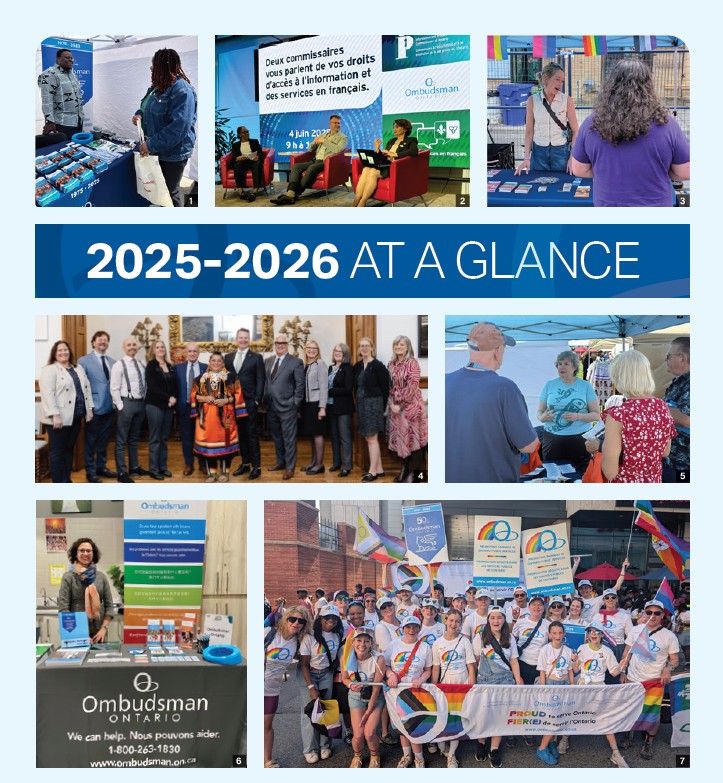
2. June 4, 2025: French Language Services Commissioner Carl Bouchard onstage with Information and Privacy Commissioner Patricia Kosseim during the joint event they organized for Francophones, in Toronto and online.
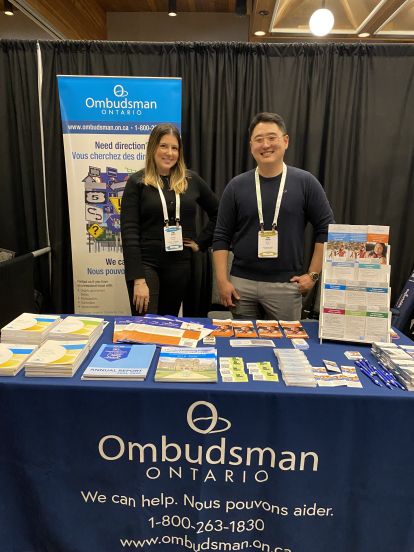
3. June 28, 2025: Ombudsman staff at our booth at Toronto Pride Streetfair, Toronto.
4. October 29, 2025: Members of Ombudsman Ontario’s Executive Management Team with Grandmother Kim Wheatley (centre), at 50th anniversary celebration hosted by Lieutenant Governor Edith Dumont, Queen’s Park, Toronto.
5. June 21, 2025: A member of the Children and Youth Unit Indigenous Circle team at the Summer Solstice Indigenous Festival and Pow Wow, Ottawa.
6. November 14, 2025: Our booth at the Seniors Active Living Fair, Toronto.
7. June 29, 2025: Our Office’s presence in the Toronto Pride Parade, Toronto.
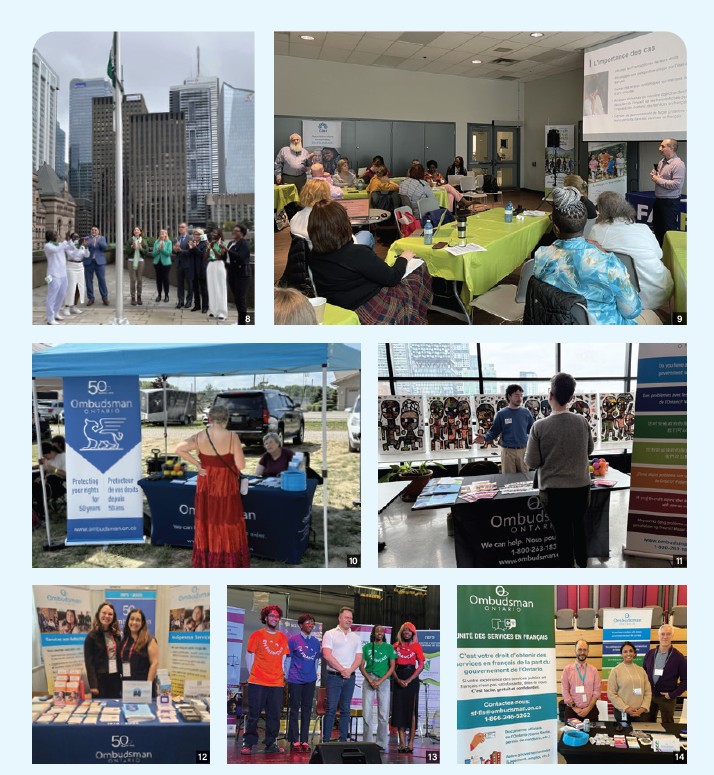
9. April 15, 2026: French Language Services Unit staff presentation for seniors organized by the Fédération des aînés et des retraités francophones de l’Ontario, Mississauga.
10. July 27, 2025: Ombudsman staff at our booth at the Grand River Pow Wow, Ohsweken.
11. February 27, 2026: Our booth at the Queer Joy and Resistance Human Rights Day Symposium hosted by Hope for Refugees, Toronto.
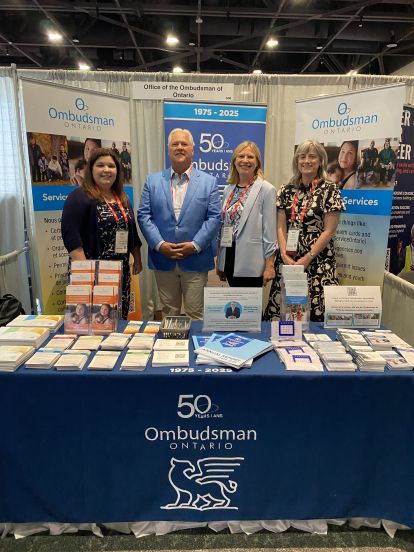
12. August 18, 2025: Our booth at the Association of Municipalities of Ontario annual conference, Ottawa.
13. March 28, 2026: French Language Services Commissioner Carl Bouchard (centre) with students at an event organized by Conseil des organismes francophones de la région de Durham, Whitby.
14. February 20, 2026: Staff from the French Language Services Unit at a career fair at the Université de l’Ontario français, Toronto.
Indigenous Services
“A new chapter” in serving Indigenous Peoples
Our Indigenous Services Plan, released in March 2026, was co-developed through engagement with Indigenous leaders, groups and individuals across Ontario. In 2025-2026, we worked with Tawi:ne Consulting Inc., a First Nation woman-owned and operated firm, to co-develop the plan. This included holding engagement sessions with more than 100 Indigenous participants from across Ontario.
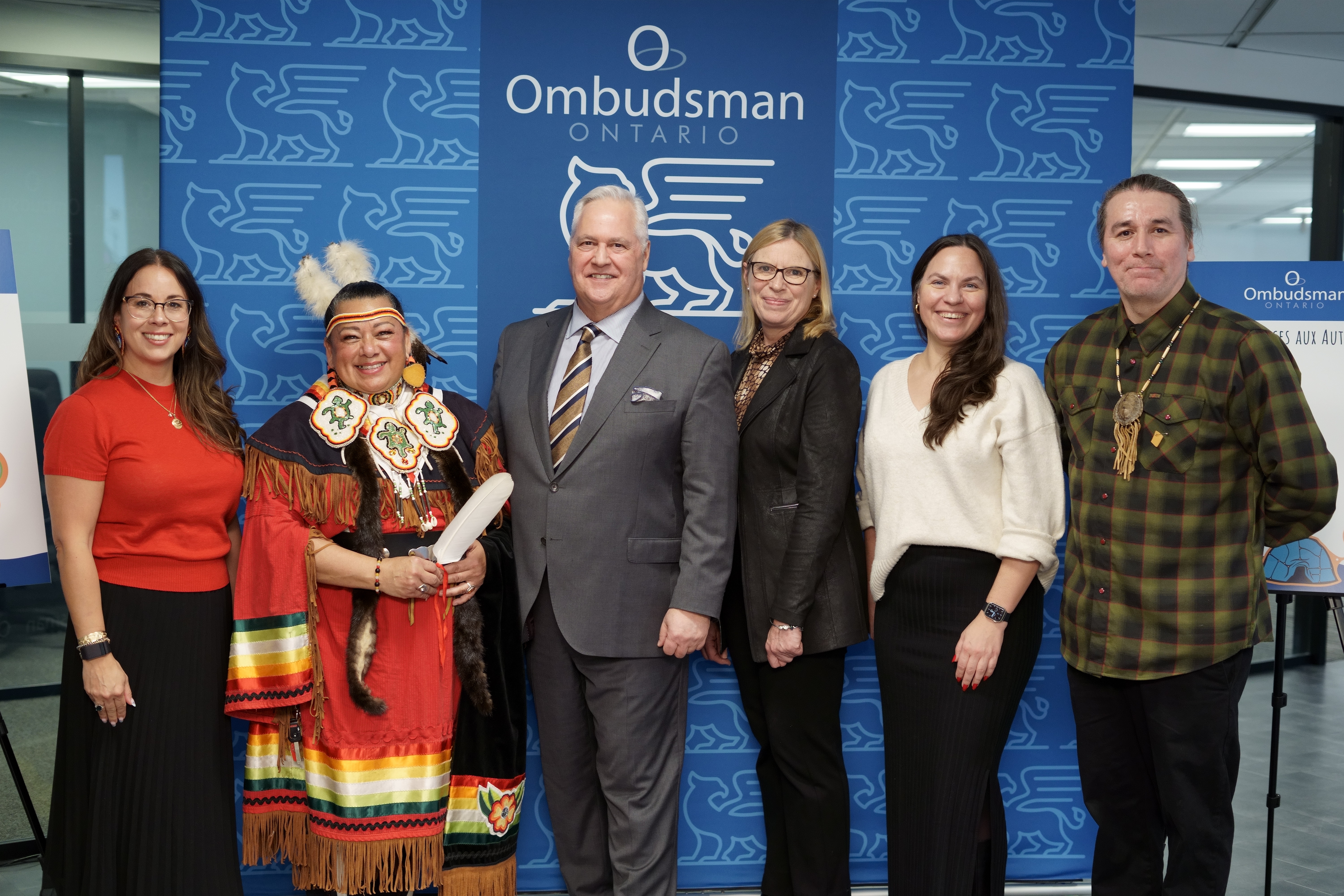
The plan aims to increase awareness of our services and ensure they are accessible, relevant and meaningful to Indigenous Peoples.
It is a living document that will reflect our ongoing consultation, engagement and action on its five core commitments, which are:
- Prioritizing continuous learning and the expansion of Indigenous cultural competencies across our personnel.
- Building reciprocal relationships with First Nations, Inuit and Métis individuals, governments, communities and organizations.
- Enhancing our service accessibility and experience for Indigenous Peoples.
- Contributing our voice and expertise to addressing systemic issues in support of reconciliation.
- Measuring the impact of the plan and reporting on our progress in implementing it.
In releasing the plan, then-Ombudsman Paul Dubé explained how it is the product of years of learning about Indigenous history and experiences, relationships and engagements, and the concerns that we heard from Indigenous individuals and groups who do not feel reflected or understood by public institutions. “We feel strongly that Ombudsman Ontario has a responsibility to help change that,” he said.
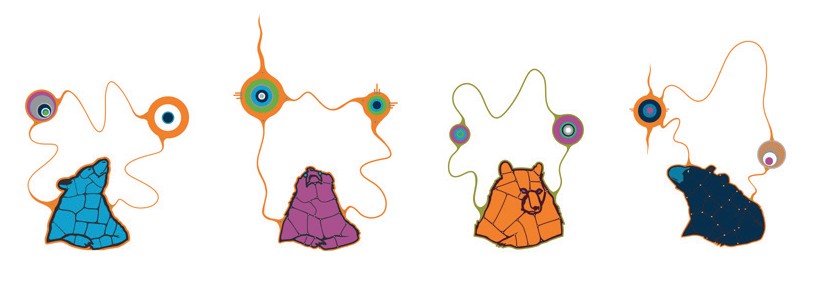
It is illustrated by Anishinaabe artist Que Rock, who chose four images of the Bear to represent the four directions of the Medicine Wheel, and images of lodges to underline the importance of building strong communities.
“This moment represents the culmination of several years of dedicated effort, reflection and relationship-building. It also marks the beginning of a new chapter in how our Office serves Indigenous Peoples and communities across Ontario, building on stories shared and lessons learned.
“Our goal is simple but ambitious: To ensure that Indigenous Peoples see Ombudsman Ontario as a place they can turn to with confidence – an institution that listens, that understands, and that helps make government services more fair, more inclusive, and more respectful.”
— Then-Ombudsman Paul Dubé, releasing the Indigenous Services Plan, March 12, 2026
What we heard
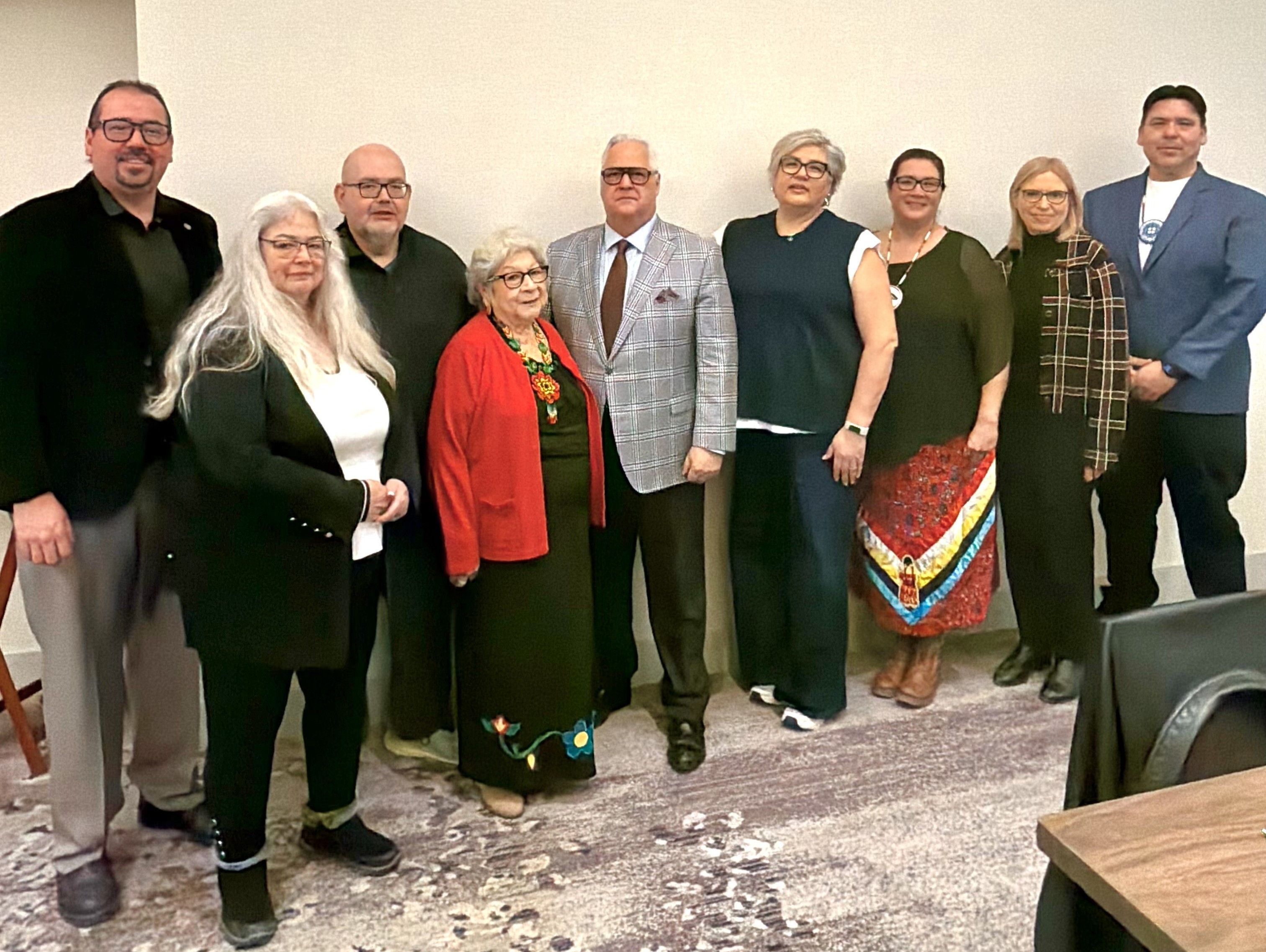
The plan reflects what we heard from Indigenous leaders, community members and service providers: That administrative barriers and poor service experiences are embedded within systems shaped by historical and ongoing colonial processes and continue to reinforce anti-Indigenous racism, exclusion and socio-economic inequality.
These systems drive the over-representation of Indigenous children in child welfare and disproportionately high rates of policing and incarceration, alongside inconsistent decision-making in social services, with lasting impacts on individuals, families and communities. Gaps in culturally appropriate supports and complex, fragmented systems limit access to essential services, particularly for youth and those without strong support networks, perpetuating intergenerational trauma and ongoing cycles of involvement with child welfare and justice systems.
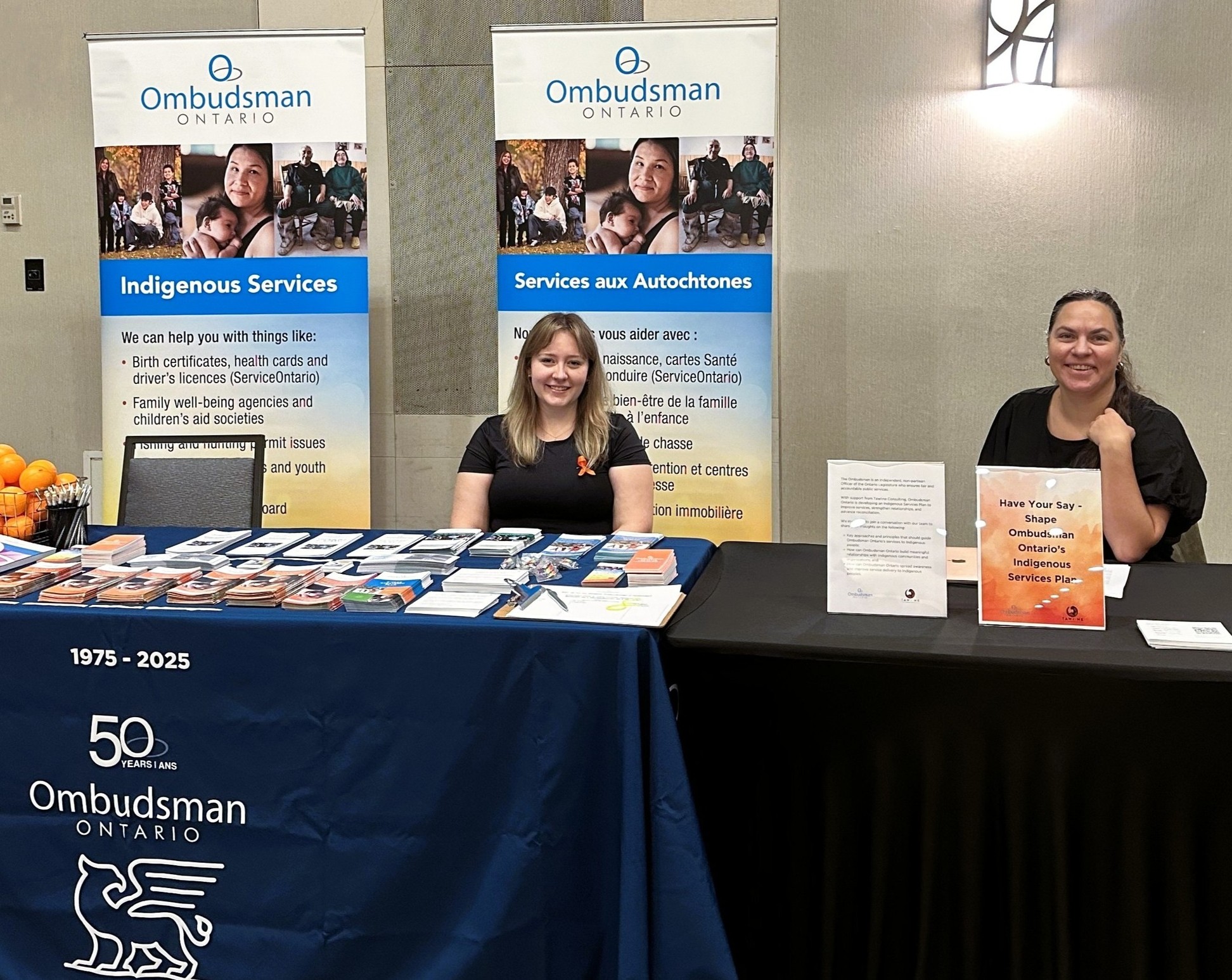
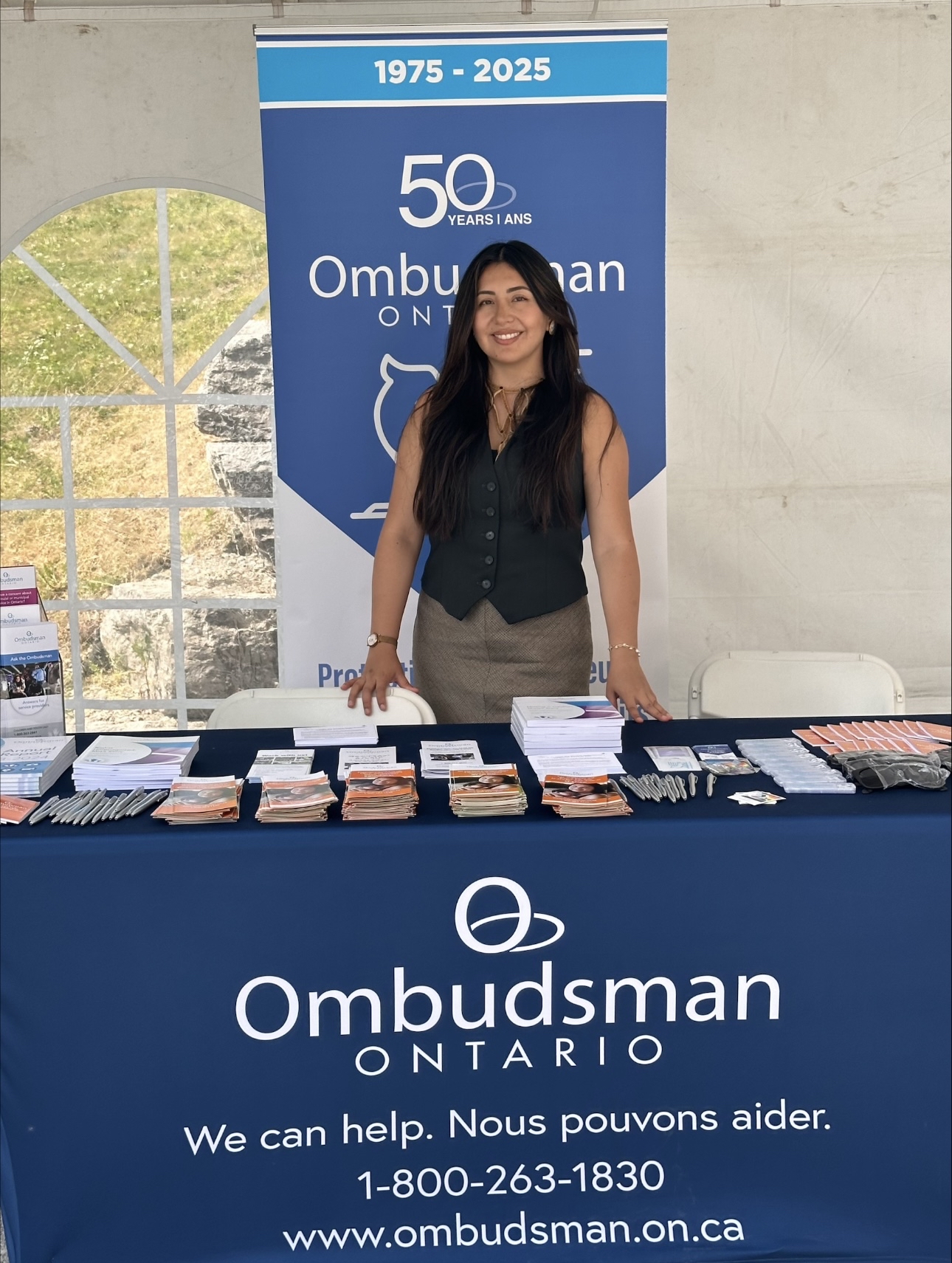
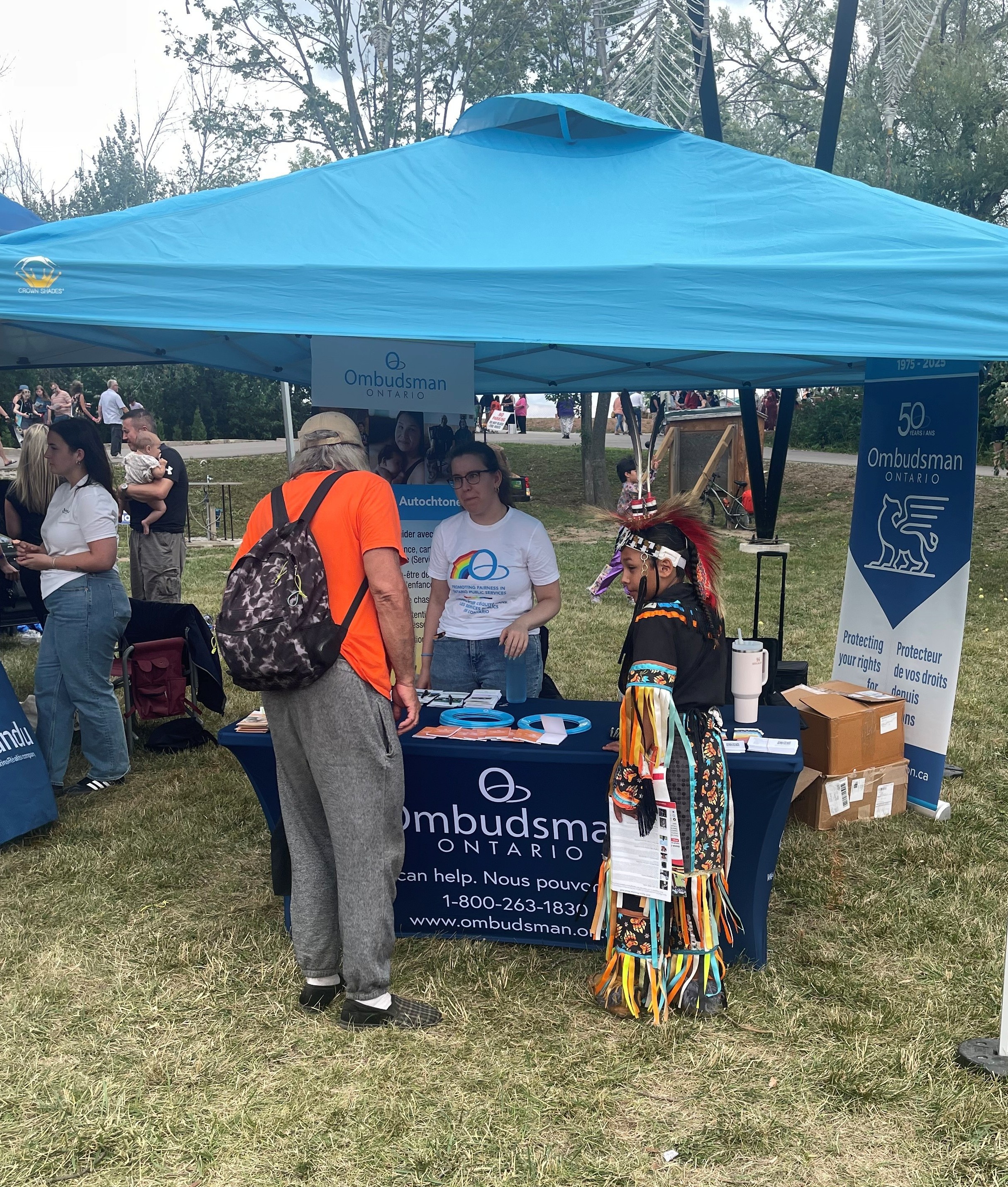
Our listening, outreach and engagement activities continue, including meetings with individual Indigenous leaders and groups, attending and hosting booths at conferences, and participating in Pow Wows and other community events. We also visit communities and engage Indigenous leaders in the course of our work on complaints and inquiries.
Next steps
Over the next year, we will continue our work on all five commitment areas including educating our team and building their capacity to help Indigenous individuals and groups with issues within our jurisdiction.
Our plans include creating a staff toolkit to support community engagement, outreach and sustained cultural competency. Training on topics such as trauma and culturally informed interviewing and complaint handling will support our continuous learning and capacity building commitments, while enhancing service accessibility and overall experience for Indigenous Peoples.
We are working towards a pilot program of community-based intake and education clinics in partnership with Indigenous organizations to increase awareness of the Ombudsman’s role and services and will continue to attend Indigenous-led events to promote our services, connect with communities and consult with Indigenous leadership and organizations. We are also moving forward on recruitment for an Indigenous Services Coordinator, an Indigenous-specific role providing support and guidance in advancing the commitments of our plan, and supporting staff in fortifying sustained, culturally relevant Indigenous services. This progress will be updated in our next Annual Report.
How we helped – cases received in 2025-2026
In 2025-2026, we received 674 cases (complaints and inquiries) that were specifically about Indigenous issues, programs or services, and/or were brought to us by Indigenous leaders on behalf of their communities or individuals who self-identified as Indigenous.
In many of these cases, we were able to achieve positive, impactful outcomes. In others, we helped people navigate complex systems and figure out where to turn. Making these cases public – while protecting the confidentiality of complainants – is a powerful way to make more people aware of how we can help them. We have included examples of several such cases throughout this report.
“No wrong door” approach
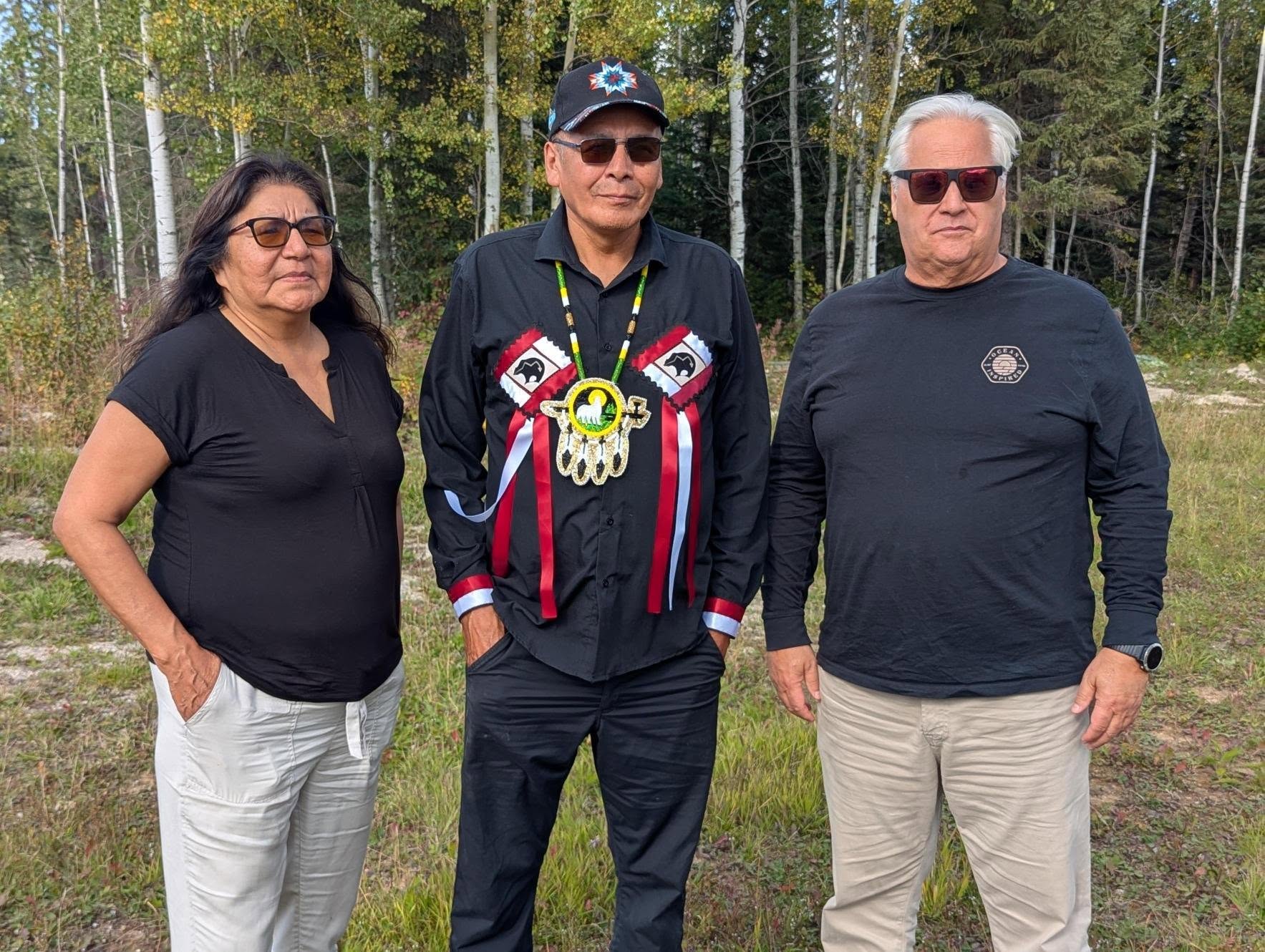
Our “no wrong door” approach goes beyond providing referrals by actively helping people navigate complex systems, reduce barriers to access, and connect them directly to the right services, ensuring people feel supported, rather than passed between systems. Grounded in trauma-informed and culturally responsive service, “no wrong door” recognizes that administrative systems can be overwhelming and, at times, retraumatizing. By providing clear explanations, continuity of support and direct connections with relevant bodies that can assist, we help build trust and strengthen the ability for individuals to access help.
Some 20% (137) of the 674 cases involved matters outside of our authority, such as programs administered by Indigenous Services Canada. Common concerns relate to delays and decisions under Jordan’s Principle, as well as Indian status registration applications, which can significantly affect children and families. Although we cannot review these complaints, we provide clear and supportive information, ensuring concerns are respectfully heard, explaining why the matter falls outside of our jurisdiction, and referring people to the appropriate federal contacts.
We also connect people with community supports such as Indigenous Friendship Centres, and share relevant public information about programs outside our jurisdiction. This helps individuals better navigate these systems and pursue their concerns, while also enabling us to stay informed about emerging issues and trends.
We received 46 cases about Indigenous governments, including band councils, First Nations police services, social assistance programs and other services administered on reserve. In these cases, we provided individuals with meaningful referrals to complaint mechanisms within their communities and governments to address their concerns. We recognize Indigenous sovereignty and the important role Indigenous governments play in managing and delivering services in their communities.
Trends in cases
The Indigenous individuals who sought our help about issues within our jurisdiction often faced barriers accessing services, experienced delays or unclear communication, or told us they felt decisions affecting them were unfair or not in accordance with established policies. These concerns span a range of issues, including unanswered questions about Ontario Disability Support Program or Ontario Works eligibility and the treatment of land claim settlement funds, as well as delays in obtaining essential documents such as birth registrations, birth certificates, name changes and driver’s licences. (For more on these cases, see the Social Services and Certificates and Permits chapters of this report.)
We have also supported students and families within the public education system where appropriate academic supports were not provided, or where Indigenous-specific policies were not applied or considered. This has also included assisting post-secondary students with Ontario Student Assistance Program (OSAP) matters and helping them navigate academic appeal processes. (See the Education chapter.)
In matters relating to natural resources and the environment, which often engage Indigenous rights such as hunting, fishing and land use, we have worked with the relevant ministries and communities to clarify obligations and promote fair and respectful practices. (See the Energy and Environment chapter.)
In provincial correctional facilities, where Indigenous people are over-represented, we heard from many Indigenous individuals who sought our help in accessing culturally appropriate services and fair treatment. These concerns frequently related to limited or inconsistent availability of cultural and spiritual supports, including smudging ceremonies, traditional medicines, and the services of Native Inmate Liaison Officers. We also heard concerns about the application of assessment tools that may have disproportionate impacts on Indigenous and Black inmates, as well as complaints about the adequacy of living conditions and access to health care. (Find more in the Law and Order chapter.)
Indigenous children and youth also remain significantly over-represented in Ontario’s child welfare system, and we have received complaints that reflect the complexity and vulnerability of their circumstances. Our Children and Youth Unit includes a specialized team, the Indigenous Circle, which regularly interacts with Indigenous children and families and Indigenous Child and Family Well-Being Agencies, and participates in Pow Wows and other outreach events. (See the Children and Youth chapter.)
We will continue to report on case trends and individual issues and resolutions to illustrate the many ways we support Indigenous individuals and communities by resolving concerns, restoring access to services, and promoting fair, consistent and responsive decision-making across the public sector.
Strategic Plan Update 2025-2026
Our strategic plan, created in 2023-2024 and available on our website, sets our strategic priorities to support our vision and mission through fiscal 2026-2027. Here is a summary of the progress we have achieved in our second year.
Pillar 1 - Prioritize service excellence and value for all Ontarians
Prioritize innovative solutions and commitment to meeting the diverse needs of Ontarians.
Progress
- Continued public outreach activities reaching thousands of people, including Indigenous and Francophone communities.
- Completed 50th anniversary engagement campaign, including explanatory video.
- Recorded a 14% increase in cases from last year, and 40% in the past five years.
- Rolled out an office-wide governance framework for the responsible use of AI.
- Created resources for older youth seeking continued CAS care.
- Launched Indigenous Services Plan with 5 core commitments to action.
- Published special report on Office’s historic growth and impact in the past decade.
- Launched (June 2025) new, user-friendly website with targeted resources.
Pillar 2 - Strengthen and improve public services through exemplary ombudsmanship
Promote accountability, transparency, fairness and a respect for rights.
Progress
- Announced three Good Governance Awards to public sector bodies.
- Shared best practices with organizations across our mandate.
- Conducted visits to correctional facilities, youth justice centres, provincial schools, group homes.
- Collaborated with other Offices of the Legislature on support services, outreach to Francophones and youth.
- Engaged with municipalities, school boards, Francophone and Indigenous organizations at conferences.
- Hosted an international Ombudsman symposium and a 2SLGBTQIA+ youth rights conference.
- Released new systemic investigation report, Lost in Transition.
Pillar 3- Foster a workplace that empowers and unifies our team
Foster an environment where our valued, empowered team has a shared sense of purpose.
Progress
- Engaged in ongoing recruitment to ensure capacity across all units and successfully increased the number of bilingual staff.
- Conducted staff training in responsible use of technology, cultural safety and awareness, and trauma-informed practices.
- Continued cultural awareness training and began development of staff toolkits as part of Indigenous Services Plan.
- Published Service Excellence Principles.
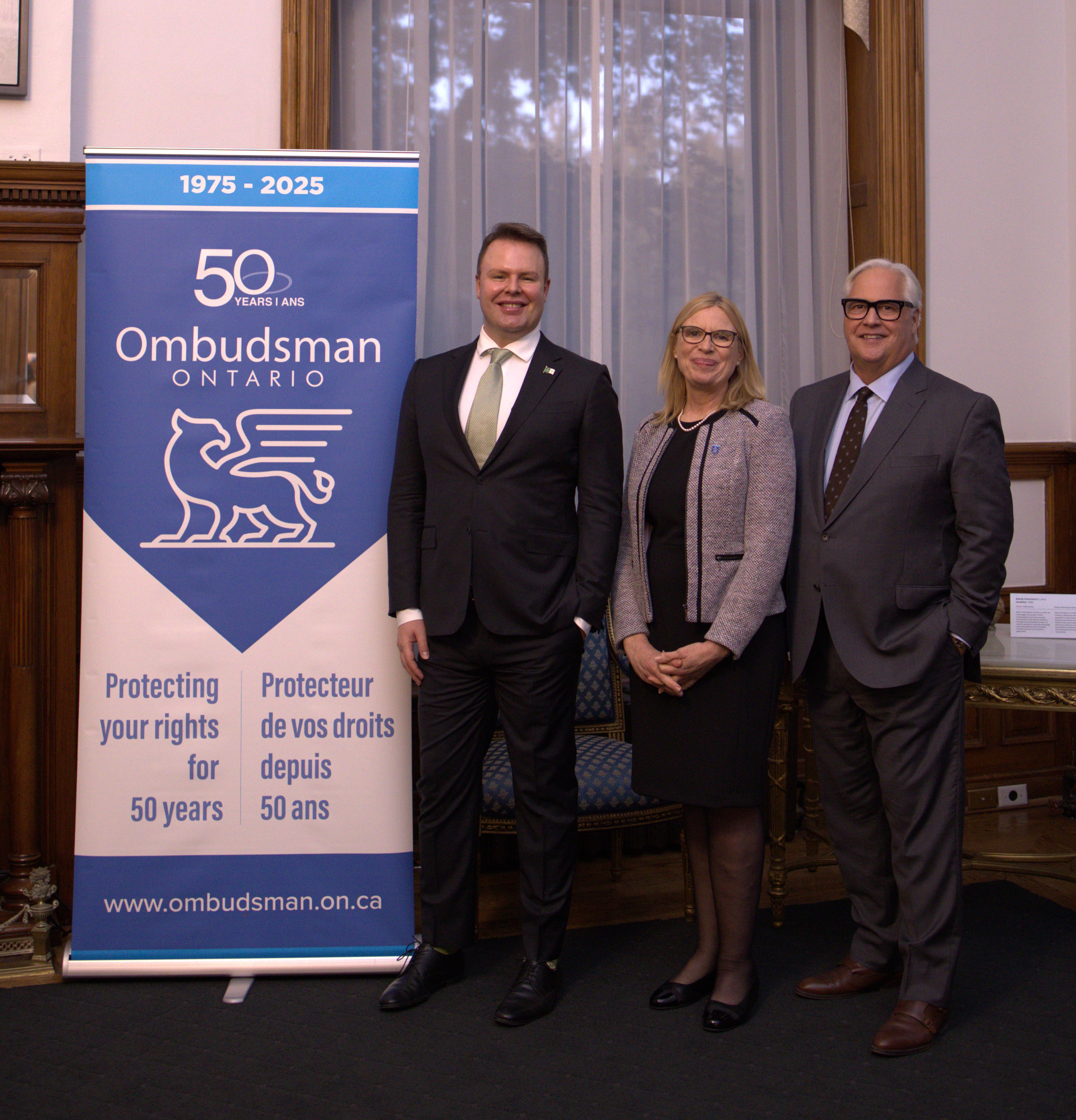
Our 50th anniversary – October 2025
Celebrating “a great force for good in Ontario”
October 30, 2025 marked the 50th anniversary of the establishment of our Office. This milestone capped a year of activities to raise awareness of our work over five decades and our important role as an essential democratic institution. Among the highlights were speeches by members of all parties in the Legislative Assembly, and tributes from the Lieutenant Governor, Speaker, and Chief Justice of Ontario:
Lieutenant Governor Edith Dumont: “There is no question that your office continues to be a great force for good in Ontario. I offer my sincere and enduring gratitude for everything you do to keep our democracy working and to keep our public services and public sector organizations accountable, accessible, and of course, fair.”
Speaker Donna Skelly: “Since its establishment, the Office of the Ombudsman has become an essential part of the province’s democratic system, thanks to its independence, its neutrality and commitment to protecting citizens’ rights.”
Chief Justice Michael Tulloch: “The Ombudsman ensures accountability through investigation and persuasion, by identifying unfairness, recommending remedies, and fostering reform. The Ombudsman extends the rule of law beyond the courtroom, ensuring that public power is exercised fairly, transparently, and with restraint.”
As noted in our last Annual Report, we also commemorated this anniversary with a historical display case at Queen’s Park, the launch of the Ombudsman’s Good Governance Awards, and several engagement activities. In November 2025, these wrapped up with two events:
- An international (virtual) Ombudsman symposium on complaint handling, attended by nearly 200 participants from oversight bodies around the world. The event featured speakers from Ombudsman offices across Canada and was moderated by Nadine Mailloux, Ombudsman of the City of Montreal and President of the International Ombudsman Institute.
- A 2SLGBTQIA+ youth rights conference in Toronto (read more on this in the Children and Youth chapter of this report).
Good Governance Awards
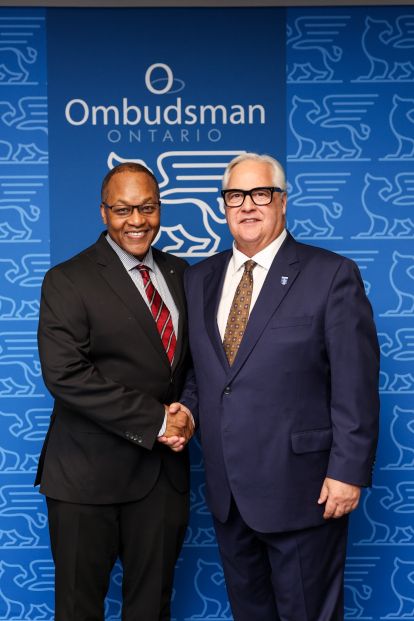
Launched in early 2025, the Ombudsman’s Awards for Good Governance recognize public sector bodies that have demonstrated exemplary administrative practices. Awards were presented to three recipients between February and November 2025:
- February 2025: The Ontario Provincial Police, for enhancing its provision of French language services.
- August 2025: The City of Hamilton, for removing the barrier of a fee to complain to its integrity commissioner
- October 2025: The Ministry of Transportation, for eliminating the massive backlog of driver road tests that accumulated during COVID-19 lockdowns.
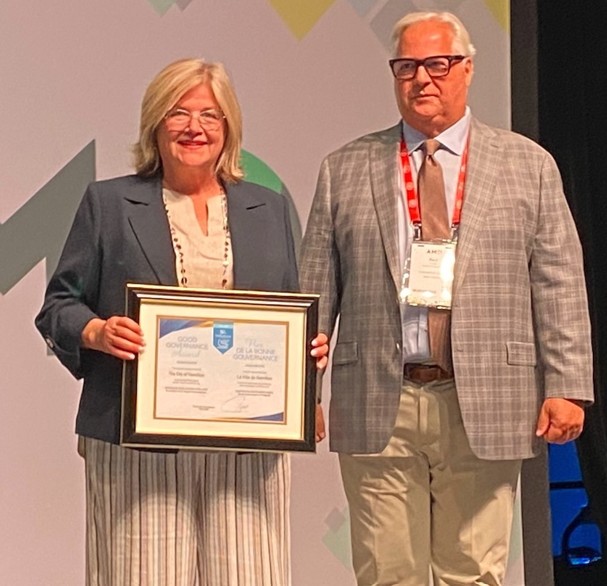
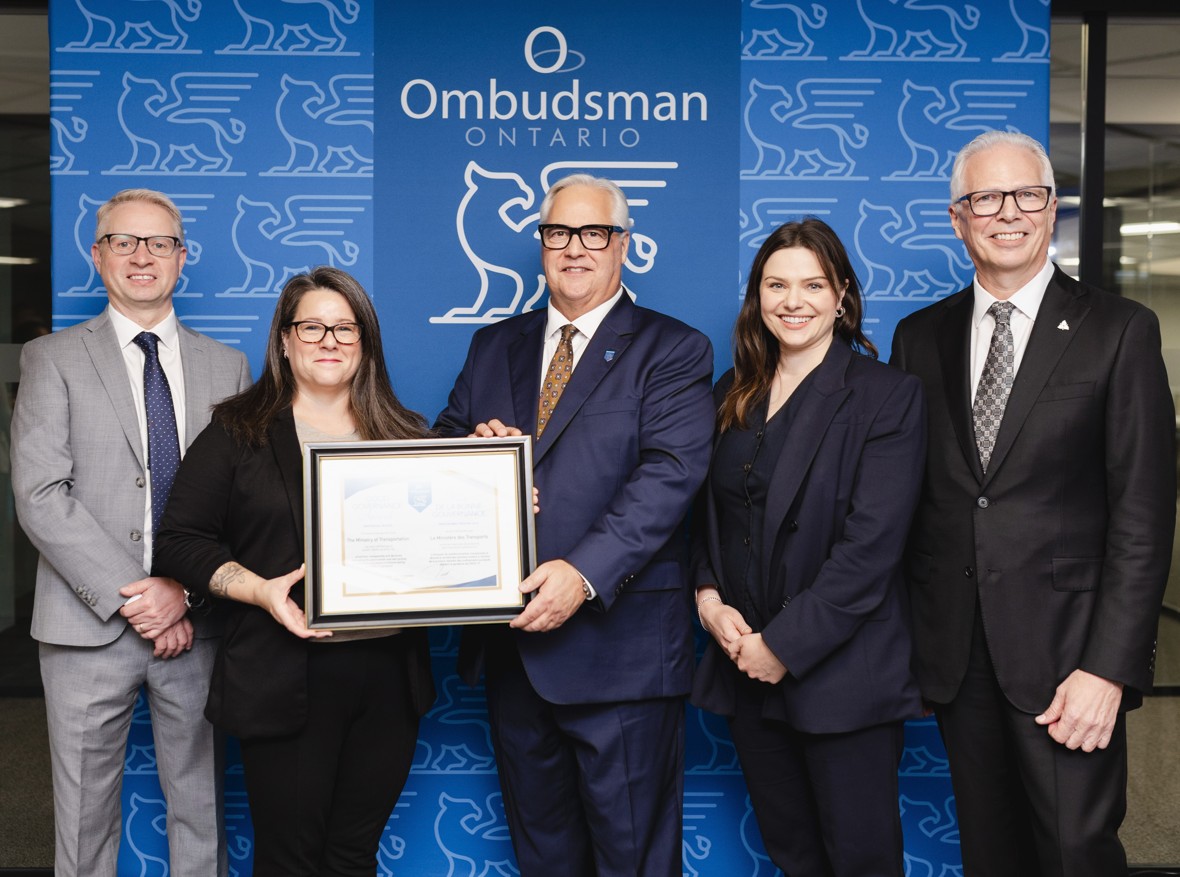
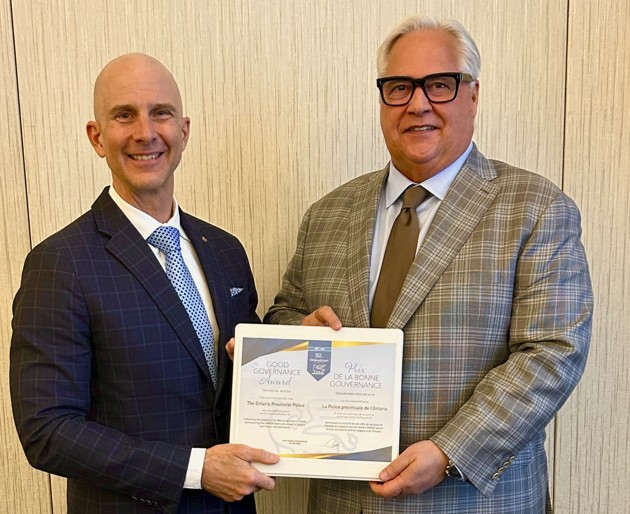
The awards recognize good administration, fair treatment and the adoption of best practices. Recipients are selected by the Ombudsman from nominations made by our staff, based on their interactions with public sector bodies in the course of their work in investigating and resolving complaints from the public (see our website for more information). We look forward to presenting the next round of awards in the coming year.
Ombudsman’s end-of-term report
As Ontario’s seventh Ombudsman, Paul Dubé oversaw the historic expansion of our Office during his 10 years in the role - from April 2016 through March 2026. Fittingly, he ended his term with an historic special report: A Decade of Promoting Fairness: Expanding Access, Impact and Value.
In the report, he highlighted positive achievements and outstanding challenges. For example, he called attention to the ongoing “crisis” of overcrowding in provincial correctional facilities, as well as difficulties faced by some of the province’s most vulnerable people in accessing social services and supports for special needs. He shared the work that went into taking on expanded responsibilities for new and complex areas of the public sector, which enabled us to help more Ontarians than ever and promote fairness and good governance across more public bodies.
Overall, he emphasized the positive impact that the Ombudsman model has had in all areas of our mandate, which was extended to municipalities, universities and school boards in 2015-2016 and French language services and child protection services in 2019.
“My hope is that Ontarians come to see their Ombudsman as more than useful or helpful, but as truly indispensable. No other institution in Ontario has the mandate, the independence or the capacity to promote fairness and respect for rights in public services in the way we do. At a time when confidence in public institutions cannot be taken for granted, that role has never been more important.”
— Then-Ombudsman Paul Dubé, releasing his end-of-term report, March 26, 2026
About our Office
Who we are
The Ombudsman is an independent, non-partisan Officer of the Ontario Legislature, appointed by all parties. Our role is to ensure that the provincial government and public sector serve people in a way that is fair, accountable, transparent and respectful of their rights.
The Ombudsman is a democratic institution, not a government department.
What we do
We receive complaints and inquiries from the public about the administrative decisions and actions of more than 1,000 public sector and government bodies in Ontario, as well as French language services and services provided in the child protection sector.
We intervene to resolve or investigate issues involving government and public sector administration and make evidence-based recommendations for corrective action when necessary.
We provide free assistance to people who need help accessing public services or having their rights respected.
What we don’t do
There are some things we can’t do. For example, we cannot take complaints about private businesses, federal government bodies, decisions of judges, the conduct of elected officials, or hospitals and long-term care homes. But if we can’t help, we’ll let you know who can.
Our vision
A public sector that serves Ontarians in a way that is fair, accountable, transparent and respectful of their rights.
Our mission
To be an effective agent of positive change for the people of Ontario by enhancing government and public sector fairness, accountability and transparency, as well as promoting a respect for rights.
Our principles
- Impartiality
- Independence
- Confidentiality
- Fairness
Our values
- Trust
- Respect
- Accessibility
- Excellence
Our affiliations
Our Office works collaboratively with many other provincial, national and international oversight bodies to share insights, strategies and best practices. Participation in organizations related to our jurisdiction optimizes our knowledge and skills and enables us to better serve Ontarians. They include:
- International Ombudsman Institute (IOI) - Represents 205 independent ombudsman institutions from more than 100 countries
- L’Association des Ombudsmans et Médiateurs de la Francophonie - Represents independent ombudsman and human rights institutions throughout the French-speaking world
- Canadian Council of Parliamentary Ombudsman - Represents provincial and territorial parliamentary ombudsman offices across Canada.
Plus:
- Forum of Canadian Ombudsman
- International Association of Language Commissioners
- Canadian Council of Child and Youth Advocates
- United States Ombudsman Association
- Canadian Association for Civilian Oversight of Law Enforcement Nati
- onal Association for Civilian Oversight of Law Enforcement
- International Corrections and Prisons Association
“I have been feeling like I have nowhere or no-one to turn to. I didn’t realize that there was an Ontario Ombudsman and how it could help me. I found a lot of very good information here. Thank you!”
How we work
Complaint intake
We take complaints via the complaint forms on our website, by email, phone or letter, or in person by appointment. Our staff will contact you for more details to review your complaint. We will not divulge your name or information to anyone without your consent, and there is no charge for our services.
Not a complaint? No problem – we also handle inquiries. Our staff can answer general questions or point you in the right direction.
Referrals
If your complaint is not within the Ombudsman’s jurisdiction, we will refer you accordingly. If you haven’t tried existing complaint mechanisms, we’ll suggest you do that first – and return to us if the issue isn’t resolved.
Review and Resolution
We always seek to resolve complaints at the lowest level possible. To do so, we often make inquiries and requests for information with the relevant bodies. Our review might determine the organization acted fairly. If we find problems, we might also share best practice suggestions to improve services to the public.
Investigation
If we are unable to resolve the matter, the Ombudsman may decide to conduct an investigation. Some investigations involve multiple interviews and extensive evidence gathering. The Ombudsman may also launch a systemic investigation if there is a potential systemic issue of significant public interest underlying a complaint or group of complaints.
Findings and Reports
When an investigation is completed, the Ombudsman provides the findings to the organization in question for a response before they are finalized. Our findings and recommendations are published in investigation reports and/or in our Annual Reports, and shared publicly on our website, via social media, news media and our e-newsletter. Copies are also available from our Office.
Results
We communicate the outcome of individual investigations and most reviews and resolutions to complainants and the relevant public sector bodies, as warranted. Summaries of many such cases are published in our Annual Reports and other communications. When the Ombudsman’s recommendations are accepted, our staff follow up until they are implemented, and we monitor in case problems recur.
Who we are
Ombudsman
Barbara Finlay (acting)
French Language Services Commissioner
Carl Bouchard
Deputy Ombudsman
Barbara Finlay
French Language Services Unit
Director: Anne Sophie Leduc
Early Resolutions
Director: Eva Kalisz
Investigations
Director: Adam Orfanakos
Children and Youth
Director: Diana Cooke
Special Ombudsman Response Team
Director: Domonie Pierre
Organizational Strategy and Operational Support
Director: Andrea Dobi
Legal Services
General Counsel: Joanna Bull and Valerie Jepson
Communications
Director: Linda Williamson
People and Culture
Executive Director: Richard Mendonca
Chief Financial Officer
Tim Berry
Finance and Facilities
Information Technology
Director: Ben Green
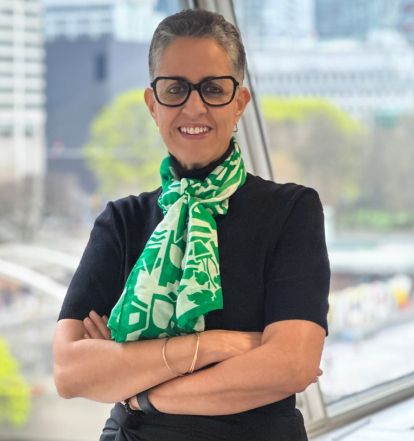
“Language is at the heart of access to rights. Being able to work and speak and be understood in French builds trust and makes us more effective at early, informal resolution. The most meaningful moments of my time at the Ombudsman’s Office have been when I’ve helped Francophones reach concrete resolutions when their language rights weren’t respected.”
— Aziza, Early Resolution Officer, French Language Services Unit
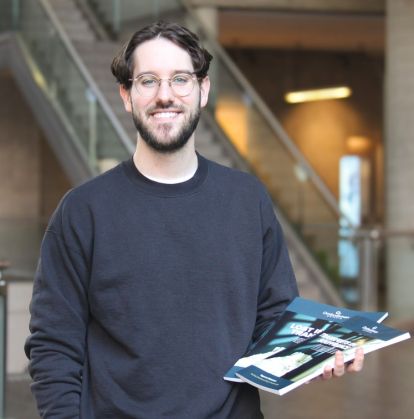
“Working as a Counsel at the Ombudsman’s Office gives me a real window into Ontario that I don’t think I’d get anywhere else. Every day brings something new – whether it’s learning about a different municipality, working through a complex governance issue, or contributing to systemic work that can lead to real change. If you’re curious, adaptable, and motivated by work that has a tangible impact on people’s lives, this is a place where you can thrive.”
— Ethan, Counsel, Legal Services Unit
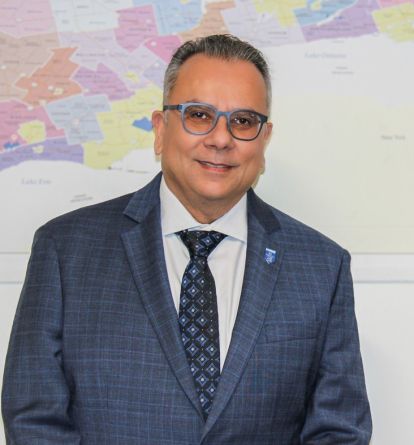
“What I enjoy most about this work is helping build the team that supports such an important public service mandate. We look for people who care about fairness, who listen carefully, who bring good judgment, and who want their work to make a difference. There is a strong sense of purpose here, and you see it in the way people support one another and serve the public.”
— Richard, Executive Director, People and Culture
About this report
Cases discussed in this report were received between April 1, 2025 and March 31, 2026. Significant events occurring between March 31, 2026 and the time of publication may also be included.
We use “cases” to mean individual complaints and inquiries. Individual cases sometimes involve multiple issues or complainants and several different public sector bodies.
This report is organized by topic area, rather than by government body. The chapters are arranged in order of case volume, as shown in the accompanying pie chart. Each topic chapter discusses the main complaint trends and significant cases of the past year.
We recognize people of all gender expressions, and we do our best to use accurate pronouns. In anonymized case descriptions, gendered and non-binary pronouns are sometimes randomly assigned, or changed to protect the person’s identity.
We’re grateful for the feedback we receive from the people we help, and have included some of their comments throughout this report, while preserving their confidentiality.
A breakdown of complaints by ministry, program, municipality, etc. can be found in the Appendix.
Good to know
Watch for “Good to know” boxes throughout this report for explanatory notes.
Cases by type
Within each topic area, the most common complaint – by far – is service delivery. Here are the 10 most common types of complaints we receive.
- Service delivery
- Administrative decisions
- Communication
- Delays
- Legislation and/or regulations
- Enforcement of rules or policies
- Broader public policy matters
- Procedures
- Internal complaint processes
- Fees or funding
Cases by topic
- Law and Order 37%
- Municipalities 16%
- Social Services 13%
- Education 10%
- Children and Youth 9%
- Money and Property 6%
- Transportation 2%
- Employment 2%
- Health 2%
- Certificates and Permits 1%
- French Language Services 1%
- Energy and Environment 1%
2025-2026 Highlights
Total cases received: 35,023*
- 48% resolved within one week
- 60% resolved within two weeks
- 49% received online
- 45% received by phone
- 6% by mail or fax
- 726 cases handled in French**
- 674 cases from people who identified as Indigenous or about Indigenous services or programs***
*See more statistical breakdowns in the Appendix
**Cases about all topics, including French language services
***More info in Indigenous Services section
Submissions to government: 4
- February 2026: Local police services' access to school premises and programs
- August 2025: Bill 9, Municipal Accountability Act, 2025
- August 2025: Long-term case inspection reports
- April 2026: Police reporting on use of force
Reports on investigations
- Lost in Transition - November 2025 - Investigation into the inappropriate hospitalization of adults with developmental disabilities
- Municipal open meetings - 33 reports and letters issued in fiscal 2025-2026
Communications
- 195,483 website visitors from 184 countries
- 945,298 pageviews
- 220,200 people Facebook reach
- 6,500 YouTube views
- 500,003 X impressions
- 168,010 LinkedIn impressions
- 538 print and digital media articles
- 209 broadcast media stories
Outreach
- 180 consultations and responses to requests from bodies we oversee
- 153 events (in-person and virtual presentations, speeches, conferernces, meetings, etc.)
Top 15 case topics
- 5,960 Correctional facilities
- 4,898 Municipalities and municipal meetings
- 2,552 Children and youth
- 1,599 Ontario Disability Support Program
- 1,346 School boards
- 1,104 Tribunals Ontario
- 864 Universities and colleges
- 618 Ontario Works
- 616 Family Responsibility Office
- 450 Workplace Safety and Insurance Board
- 407 ServiceOntario
- 316 DriveTest
- 266* French language services
- 257 Registrar General
- 228 Office of the Public Guardian and Trustee
* These cases will be detailed in the Annual Report of the French Language Services Commissioner in late 2026.
Year in review
Law and Order
Overview
This topic area – covering all areas of the justice system, from policing to jails, as well as adjudicative bodies like administrative tribunals – is consistently (and understandably) a top source of complaints and inquiries to our Office.
In 2025-2026, after a concerning 55% surge in cases about correctional facilities over the previous year, we met regularly with the Ministry of the Solicitor General and leaders in the provincial corrections sector to identify and address systemic issues. While we have seen a decline in cases, problems persist across many facilities with overcrowding, lockdowns, staff shortages and access to health care.
Our visits to correctional facilities – to witness conditions and hear from inmates and staff directly – continued, as did our investigative work and resolution of individual complaints from inmates.
In the policing sector, we resolved cases about police oversight bodies like the Law Enforcement Complaints Agency (established in 2024) and Special Investigations Unit, and saw continued progress on our past investigations related to police de-escalation training and operational stress injury.
We also worked with the Ministry of the Attorney General to address ongoing issues like delays and backlogs at administrative tribunals like the Human Rights Tribunal of Ontario, among others.
Trends in cases – correctional services
We received 5,960 complaints and inquiries about Ontario correctional facilities, down from last year’s record of 6,870, but still considerably more than the 4,444 we received in 2023-2024. The most common issues we heard about were overcrowding (three or more inmates in cells built for two), lockdowns, access to health care, and use of force by correctional officers and crisis response teams.
Some 80% of the people in provincial jails are awaiting trial on criminal charges but have not been convicted, while the rest are serving sentences of less than two years. The province has acknowledged that its facilities are overcrowded and is working to increase capacity, but other factors – including legislation introduced in 2025 to tighten bail restrictions and justice system delays – contribute to the challenges of managing this population.
In his special end-of-term report in March 2026, then-Ombudsman Paul Dubé called for urgent reform of the correctional system, as he did in our past two Annual Reports:
“Too many inmates are housed in facilities with too few staff. Overcrowding remains chronic, staffing shortages lead to cancelled programs, and prolonged lockdowns confine people to cells for excessive and dangerous periods. Conditions continue to deteriorate, creating growing safety risks, both for staff and for those in custody.”
— Then-Ombudsman Paul Dubé, A Decade of Promoting Fairness, March 2026
To help address these issues, we undertook several initiatives in addition to visiting facilities. These included meeting regularly with senior staff from the four largest facilities, sharing detailed complaint trends with the Ministry of the Solicitor General, and identifying and addressing systemic issues through focused reviews.
Despite the good collaboration we receive and the efforts of dedicated Ministry staff, it is clear that while progress continues to be made, compelling issues with the conditions in correctional facilities across Ontario persist and will likely continue for some time. Working with the Ministry through proactive ombudsmanship and systemic reviews and investigations will continue to be a priority focus for our Office, and we will continue to prioritize health and safety concerns and matters affecting the human rights of detainees.
Systemic issue reviews
Along with common, persistent complaints about conditions in jails, we identified several systemic issues affecting large numbers of inmates and their families in 2025-2026. These included concerns about how serious incidents are investigated, a digital tool that assesses where inmates should be housed, and bans on some visitors.
Risk assessment tool
We received 126 complaints from inmates about the Ministry of the Solicitor General’s Security Assessment for Evaluating Risk (SAFER) tool. SAFER is a security risk assessment tool used by Ontario correctional facilities to estimate the risk an inmate poses of engaging in violent and/or frequent misconducts. It uses an algorithm to assess the security risk posed by inmates, which in turn determines whether they should be housed in higher or lower security settings. Although the Ministry maintains that this program has improved consistency across facilities in how inmates are assessed and provides incentive for them to engage in programming and follow behavioural guidelines, it has raised some broader issues.
For example, we heard that the SAFER “score” assigned to inmates was unfair or that they could not have it changed even after participating in programs. We learned that only certain programming can be applied towards improving the score and inmates do not always know which ones are excluded. We also heard concerns about the disproportionate impact of this tool on Black and Indigenous inmates.
We discussed our review and concerns with senior Ministry officials, who are conducting an evaluation of SAFER as it is implemented across the province. We will continue to engage with the Ministry on this and monitor the outcome of its review.
Investigation of serious incidents
Serious incidents inside jails – physical or sexual assaults, excessive use of force and inmate deaths – must be investigated by the Correctional Services Investigations and Intelligence (CSII) unit. We reviewed complaints about failures to refer serious incidents for investigation as required by regulation or policy, delays of months or even years in investigations, and inconsistent communication of investigation results. We shared our broader concerns with senior Ministry officials and resolved individual cases. We are monitoring the Ministry’s response to our concerns and the implementation of future improvements.
Visitor bans
After receiving complaints from family members who felt they were unfairly banned from visiting loved ones in jail, we discovered that although the Ministry requires facilities to have policies to administer visitor restrictions, many had not created a policy or had inconsistent policies that lacked clarity. We shared best practices for communicating and implementing such bans, similar to those we recommend for fair trespass orders: There should be clear information about what conduct can result in a visitor ban, how people will be notified, the timeframe for the ban, and how affected individuals can appeal.
Site visits and mega facility review
We visited eight facilities across the province in 2025-2026: Central North Correctional Centre, Maplehurst Correctional Complex, Niagara Detention Centre, North Bay Jail, Ottawa-Carleton Detention Centre, Sudbury Jail, Thunder Bay Jail and Toronto South Detention Centre.
We also closely reviewed case trends from the four “mega” facilities (more than 1,000 inmates) – Central East Correctional Centre, Central North Correctional Centre, Maplehurst Correctional Complex, and Toronto South Detention Centre – which accounted for some 60% of the record volume of cases we received in 2024-2025.
Among the issues we heard about during our visits were:
- North Bay Jail: Construction work limiting inmates’ time outdoors and access to education programs via the local school board Ottawa-Carleton Detention Centre: The need for more posters within the facility to let inmates know they have the right to contact us, and how to reach us
- Sudbury Jail: Continued issues with rodents and pest control measures
- Thunder Bay Jail: Overcrowding and lack of a Native Inmate Liaison Officer.
At the mega facilities, the most common issues were:
- Central East: Lockdowns, overcrowding, poor living conditions, lack of access to showers, phones and outdoor time
- Maplehurst: Delayed or inadequate health care, lockdowns, use of force
- Toronto South: Health care and medication delays, food, use of force
- Central North: Lockdowns, overcrowding, health care, lack of Indigenous cultural supports.
We meet monthly with senior officials at the Ministry of the Solicitor General and quarterly with senior officials responsible for the mega facilities to flag systemic concerns and resolve issues quickly wherever possible.
Access to Indigenous services
We received 95 complaints this year about a lack of Indigenous services in correctional facilities. Of the recent cases, 30 were from inmates who told us they could not access the services of a Native Inmate Liaison Officer (NILO), often because the facility did not have one. According to information from the Ministry, 6 correctional facilities are currently without a NILO.
Indigenous people are over-represented in correctional facilities, and NILOs play a crucial role in ensuring they have access to traditional teachings and cultural practices, such as smudging. However, the absence or shortage of these services – including the hiring and retention of NILOs – is an ongoing concern that we have repeatedly raised with senior Ministry staff.
We also resolved several individual cases at the facility level. Some examples:
- Nine Indigenous inmates complained to us that smudging was not regularly offered at their facility. Our inquiries prompted an audit by the facility’s senior staff and they improved management oversight of the smudging process. We confirmed in person that smudging is now more frequent.
- An Indigenous inmate told us his facility would not let him access tobacco for spiritual practices, despite a policy requiring it to do so. We discovered the facility refused out of concerns that the tobacco would be hoarded and sold. After we shared the Ministry’s guidelines for safe provision of tobacco with the facility, it corrected its practices. As a result of our review, facilities were reminded about Ministry standards regarding Indigenous spiritual practices and the use of tobacco in smudging ceremonies.
Health care and well-being
Our work to ensure inmates’ health care needs are met in correctional facilities not only helps their individual well-being, but that of the larger population and staff as well. As always, we prioritize cases where someone’s health and safety might be at risk and alert relevant staff at the facility.
We frequently receive complaints from inmates about delays to see a doctor, dentist, or psychiatrist, and that inmates do not receive responses when they make a request to see health services staff. We meet regularly with Ministry staff to share systemic complaint issues so they can work to address them.
Some case examples:
- An inmate with diabetes sought our help because he was feeling lightheaded and unwell. He said he had not received his medication or blood sugar monitoring for three weeks after being transferred to a new facility. We urgently flagged his case to the facility’s health care management and as a result, he received medical attention and his medication was administered.
- An inmate told us his prescribed orthopedic shoes had been taken away for security inspection, and he had been waiting three weeks to see a doctor and get replacements. After we intervened, the original pair was promptly inspected and returned to him.
- As noted in last year’s Annual Report, several inmates told us they were concerned they might have been exposed to a blood-borne infection after being treated at the jail’s dental clinic. We flagged this concern to the Ministry of the Solicitor General and visited the facility, where we confirmed that it had made changes and passed a recent public health inspection. The Ministry subsequently audited all its jails with dental clinics to ensure they were brought up to Public Health Ontario standards. We continue to monitor the Ministry’s progress as they update their dental clinic policies.
- After we relayed an inmate’s concern about being too cold in his cell, all the staff at a facility were reminded of a policy that entitles all inmates to two blankets during the winter months.
Investigations – correctional services
Response to the December 2023 incident at Maplehurst Correctional Complex
Launched: June 2025
Investigation update: This investigation is reviewing the Ministry of the Solicitor General’s response to a December 2023 incident at Maplehurst Correctional Complex affecting nearly 200 inmates. Over two days, they were made to sit on the floor in their underwear, facing a wall with their wrists zip-tied, while crisis team members patrolled behind and aimed pepper ball launchers at the back of inmates’ heads.
Judges have since made substantial reductions in some affected inmates’ sentences to reflect the severity of the incident and called attention to the violation of their rights within an institution that has a duty to keep them safe. In one case, a judge noted the inmate “was subjected to corporal punishment and treatment that was akin to torture” and had his rights violated in multiple ways.
Another emphasized that the inmate’s rights were breached “not in some dark alley, not on some street corner, but in an actual correctional facility […] by the authorities.” Still another pointed out that the incident punished multiple prisoners who were not involved and had nothing to do with the assault that reportedly triggered it.
“The thought that an innocent person, while waiting to have their case heard on its merits and have a trial, would be subject to this type of treatment, I think, would shock the conscience of the public.”
— Justice Colette Good, R v. Simon, February 25, 2025
Our investigation is focused on whether the Ministry has taken adequate steps in response to this incident in order to avoid similar ones in future. Once the investigation is concluded and the Ministry is given the opportunity to respond to the Ombudsman’s findings (per our normal process), the report will be released – likely later this year.
Trends in cases – policing
Our Office plays a key role in promoting transparency and accountability across Ontario’s police oversight framework. The Ombudsman’s jurisdiction in this sector expanded two years ago to include all provincial police oversight bodies and the Ontario Provincial Police (OPP). However, municipal and First Nations police services, police services boards and OPP detachment boards remain outside of our purview.
We refer complaints about police services to relevant organizations, such as the Law Enforcement Complaints Agency, which takes complaints about police conduct.
Police and oversight bodies
Our oversight in this sector includes:
- The Law Enforcement Complaints Agency (LECA)
- The Special Investigations Unit (SIU), which investigates incidents of police-involved serious injury or death
- The Inspectorate of Policing (IOP), which deals with compliance and policing legislation, police board member conduct and local police policies
- The Ontario Police Arbitration and Adjudication Commission, which addresses police labour relations issues
In 2025-2026, we received 182 cases about the OPP. Most of these complaints related to police conduct, which we referred to LECA. We also received 14 cases about the OPP’s Chief Firearms Office (CFO), which administers the licensing provisions of the Firearms Act. The bulk of these were about delays related to a backlog in the CFO’s background check process. We resolved many of these by putting people in touch with CFO staff who could expedite their files.
We received 159 cases about LECA, up from 97 in 2024-2025, 27 about the IOP, and 5 about the SIU. The most common complaints related to delays or a lack of response. We helped by facilitating communication between complainants and the two agencies. For example:
- After we intervened, the IOP provided a woman with a copy of its decision in her complaint and apologized for the lack of response. We also shared resources with the IOP for establishing a formal service complaint process.
Investigations – policing
Police de-escalation training
Report: A Matter of Life and Death, released June 2016
Investigation update: The Toronto Police Service shooting death of 18-year-old Sammy Yatim in 2013 prompted the Ombudsman to investigate the direction provided by the Ministry of the Solicitor General to police services on de-escalation in encounters with people in crisis, including through legislation and training delivered by the Ontario Police College.
Most of the 22 recommendations in this report have been addressed over the past decade, but we continue to monitor new developments. For instance, the Ministry introduced a new use-of-force training aid in 2023. It also bolstered training requirements for new and current police officers across the province to take Mental Health Crisis Response training. All “community patrol” officers must complete this training by October 2026, while others have until October 2027. Annual refresher training will also be mandatory.
Submission to government
In April 2026, we made a submission to the Ministry of the Solicitor General in response to the Ministry’s proposed updates to the use of force reporting form used by police services across Ontario. At present, police officers only fill out the form if they have used force in an interaction with a civilian; if no force is used and de-escalation methods have been successful, there is no record. When a police officer successfully de-escalates a situation without using force, the Ministry has no way of learning of or from this positive interaction.
In A Matter of Life and Death, the Ombudsman recommended that de-escalation ”success stories” be collected and used to inform police training and best practices. This submission called on the Ministry to implement this recommendation in the course of its review of the use of force reporting form.
“Our Office plays a key role in promoting transparency and accountability across Ontario’s police oversight framework.”
Operational stress injury and suicide affecting Ontario Provincial Police
Report: In the Line of Duty, released October 2012
Investigation update: Some 14 years after this investigation into how the Ontario Provincial Police (OPP) and the Ministry of the Solicitor General address operational stress injury and suicide among officers, we continue to monitor their efforts to address the issue in response to our recommendations.
The OPP has expanded mental health services and mandatory suicide prevention training. In April 2025, Ontario’s public safety personnel, including OPP members, were provided with a web application that provides active and retired officers and their families with round-the-clock access to mental health services, peer support and behavioural therapy.
We continue to engage with the OPP regarding the effectiveness of these efforts, including their applicability to Indigenous and First Nations policing within the OPP’s jurisdiction. We received only 2 cases related to this issue in 2025-2026.
Other trends in cases
Administrative tribunals
Tribunals Ontario – a group of 13 administrative tribunals that fields more than 100,000 cases a year – was the subject of 1,104 complaints and inquiries in 2025-2026 – compared to 1,237 the previous year.
The Landlord and Tenant Board (LTB) continues to be the most complained-about tribunal, with 779 cases in 2025-2026 – although this number has dropped steadily in recent years, largely because of issues resolved since the publication of our 2023 investigative report, Administrative Justice Delayed, Fairness Denied (for more, see the Money and Property chapter of this report).
At the same time, we saw an increase in cases about the Human Rights Tribunal of Ontario (HRTO) – 255 cases in 2025-2026, up from 199 a year earlier. The most common complaints are about delays and communication issues. Some people told us they are still waiting for the HRTO to schedule hearings for applications filed as far back as 2019-2020. For its part, the HRTO reported a 47% increase in applications between 2024 and 2025.
We are in regular contact with the HRTO, which has proactively identified recommendations from our LTB investigation that it could adopt to improve case management and reduce delays. The HRTO and Tribunals Ontario briefed our staff on the measures they are taking to streamline processes and improve timelines. They noted that legislative changes made in response to our LTB report have also made it easier for them to reassign cases during prolonged absences of adjudicators. They also implemented mandatory mediation as of June 2025 and made other changes to reduce backlogs. We were told they expect to have a full complement of adjudicators by the fall of 2026. We continue to monitor the effectiveness of these efforts.
Victim Witness Assistance Program
We received 19 complaints about Ontario Victim Services (OVS) programs in 2025-2026 such as the Victim Witness Assistance Program (VWAP), a court-based program that provides information, help and support to victims and witnesses of crime so they can understand and participate in the criminal court process. Some of these were about communication gaps between Crown attorneys and VWAP which resulted in some victims of domestic violence not being notified in cases where charges were stayed. Some victims also complained that VWAP didn’t communicate with them, leaving them to seek out information about their cases themselves.
After we shared complaint trends and best practices with its senior leadership, the VWAP revised its written communications to clarify how victims can receive updates and additional information during the court process and afterwards.
Case summaries
Rights stripped away
A group of inmates complained to us that correctional services staff conducted a strip search without any privacy – they said they were forced to strip in front of one another and in view of correctional staff and cameras.
Result: We reviewed the incident and confirmed that the facility did not follow proper privacy procedures. We raised the matter with the superintendent, who shared a directive to ensure staff were trained – or retrained – on how to do searches in accordance with policy/procedure guidelines. The facility also changed its procedures to ensure searches take place in designated areas with privacy screens.
Bending the rules
An inmate complained to us that the Institutional Crisis Intervention Team (ICIT) at his facility had used a bent-wrist hold on him (in which a person’s hands are twisted and held at an unnatural angle) during an incident – and broken both his wrists. He told us he had a pre-existing wrist injury that staff should have been aware of. We reviewed the case, including video of incident and the crisis team’s documentation.
Result: We identified several issues of non-compliance with provincial policies in this case, including that no crisis coordinator was present and the ICIT did not capture the whole incident on camera. As well, the severity of the inmate’s injuries should have prompted the facility to do a broader review of the incident. The facility completed this additional review after our intervention.
Ultimately, this case sparked changes to ICIT training and operations. For example, ICITs will be trained to check for any medical concerns before stepping in when operationally feasible and follow a checklist for what to capture on camera. The facility also acknowledged that a crisis coordinator should have been engaged in this case and will be in similar situations in future.
No vote
A man who was in jail awaiting trial complained to us that the administration at his facility would not allow him to vote in the February 2025 provincial election. All inmates, both sentenced and on remand, are legally able to vote by mail in provincial elections, but this can pose challenges – particularly in cases of snap elections, as this one was, where there is no advance notice of the date and voting occurs within a month of the election announcement.
Result: After we raised this case with the Ministry of the Solicitor General, it acknowledged the facility had misinterpreted its policies and given the inmate wrong information. It committed to completing a regional review and issuing greater direction to ensure that all facilities correctly follow Elections Ontario guidance in future so that inmates who are eligible voters can participate in elections.
Municipalities
Overview
It has now been 10 full years since the Ombudsman’s mandate was extended to municipal government services in Ontario’s 444 municipalities. In the past decade, we have been able to help tens of thousands of Ontarians with local services and issues that are, quite literally, close to home – from snow removal to housing, to by-law enforcement and local infrastructure, and much more.

In 2025-2026, we received 4,898 complaints and inquiries about all aspects of municipal administration, including closed municipal meetings. This is a new record, and an increase of 25% over last year, when we received 3,908 cases. Case volumes in this area have grown steadily in the past four years – climbing 74% from 2022-2023’s 2,814.
Throughout this time, we have worked with municipalities to prioritize fairness and focus on collaboratively finding lasting solutions to systemic problems.
The vast majority of these cases were resolved quickly. Our staff were often able to facilitate communication between residents and municipal officials, make referrals to existing local processes, or obtain missing information by liaising with municipal staff directly.
Beyond complaint resolution, we also provide resources to municipal officials and councils – reports, “tip cards,” our Open Meeting Case Digest online, and our popular guides, Open Meetings: Guide for Municipalities, and Codes of Conduct and Integrity Commissioners: Guide for Municipalities – to help municipalities improve fairness and transparency, and avert future complaints.
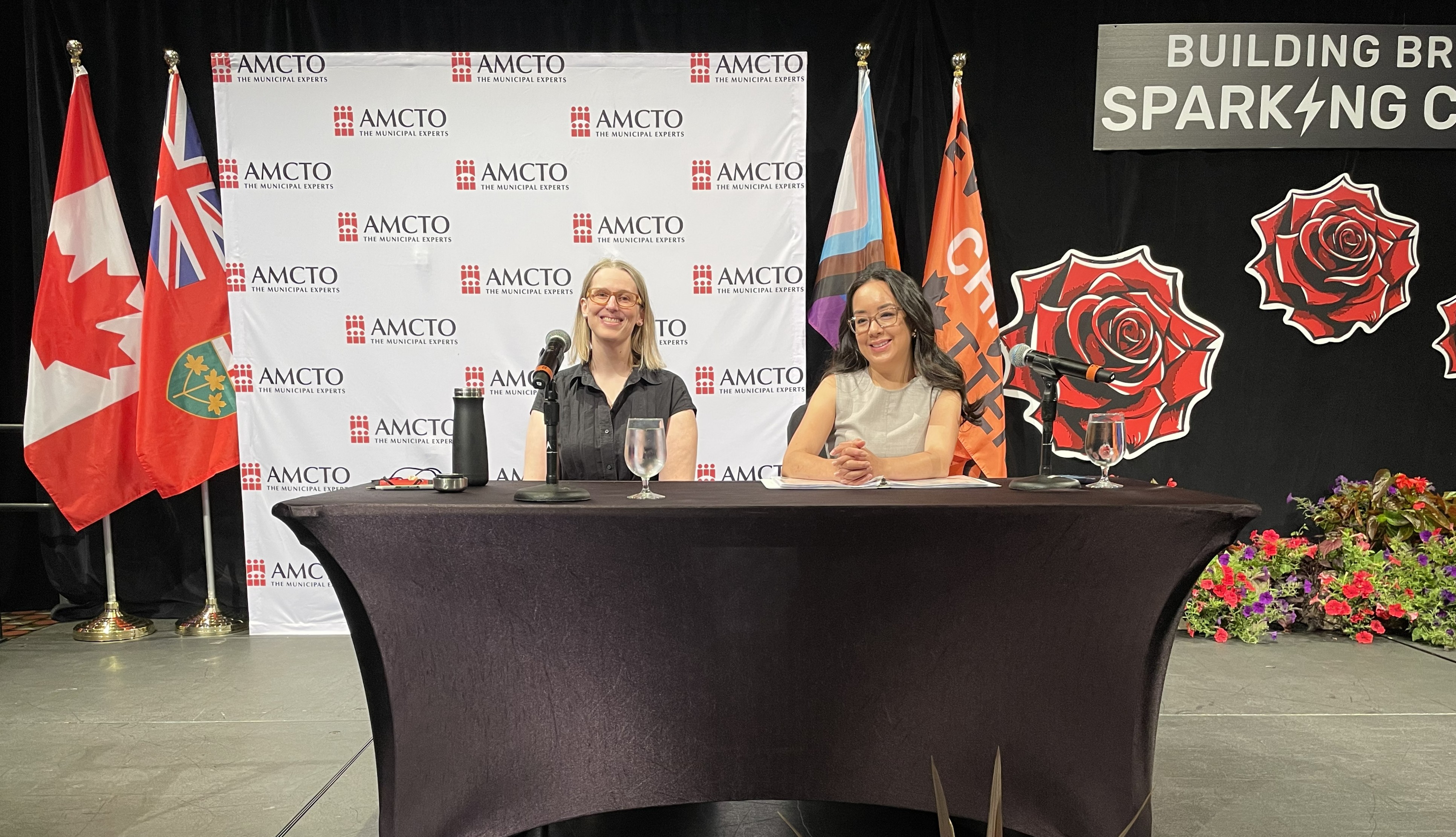
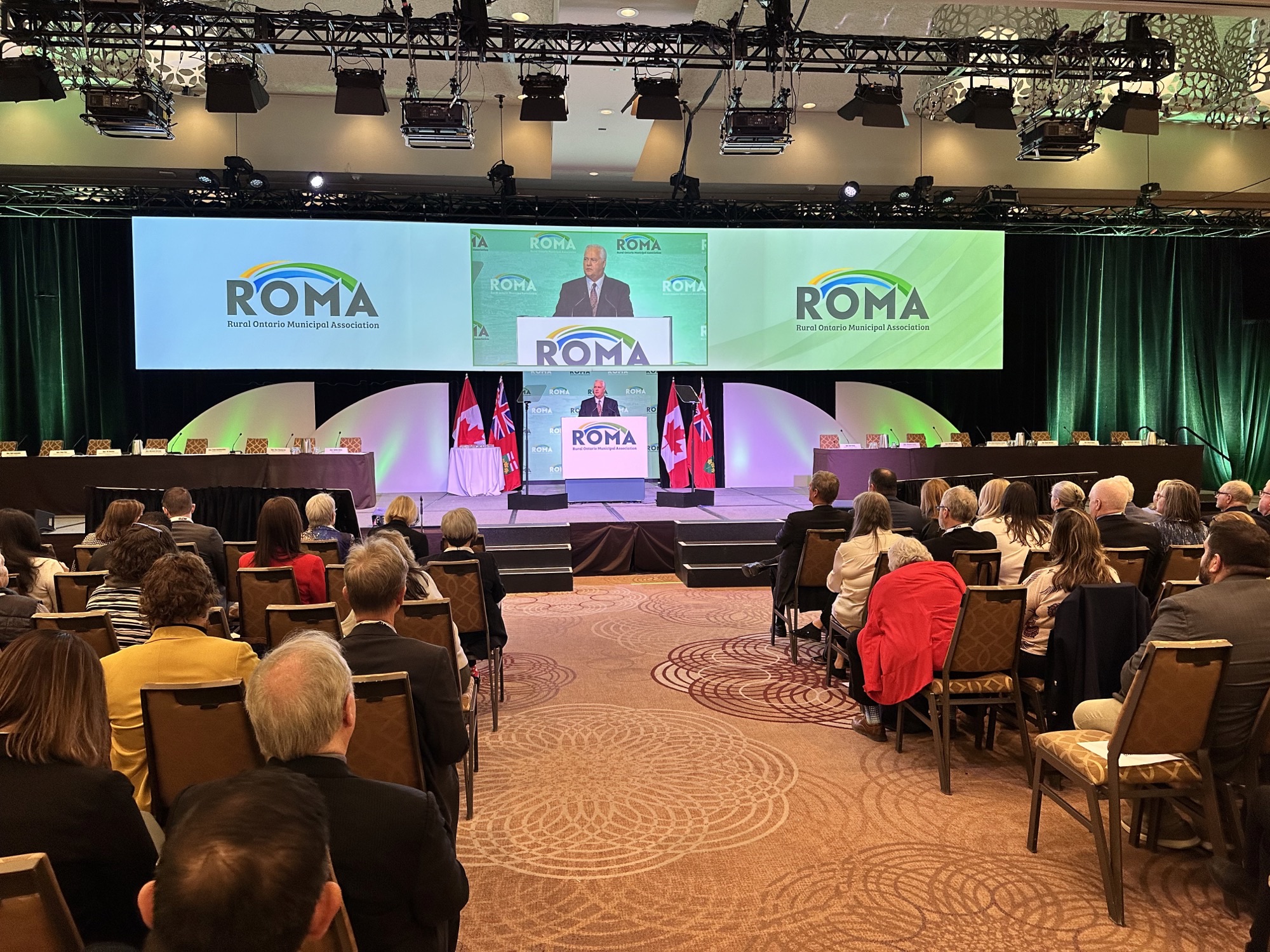
The Ombudsman and staff who specialize in municipal cases also regularly attend and speak at municipal conferences across Ontario. This past year, Ombudsman Dubé spoke at plenary sessions of the annual conferences of both the Association of Municipalities of Ontario (AMO) and the Rural Ontario Municipal Association (ROMA). Our staff were also invited by AMO to consult on its Leading with Respect guides about civility in local government, and spoke to the Association of Municipal Managers, Clerks and Treasurers of Ontario about managing public conduct and balancing transparency with safety concerns.
Trends in cases – General municipal issues
The most common topics of the cases we received about municipalities were about by-law enforcement, housing, and councils and committees – including complaints and inquiries about codes of conduct and local integrity commissioners.
We addressed these concerns quickly by contacting the relevant municipal officials, facilitating communication, and ensuring residents received responses to their concerns. In cases that fell outside of our jurisdiction – for example, we do not oversee library boards, public health authorities or municipal police – we referred people to the appropriate mechanism. The Ombudsman encourages municipalities to have policies to address complaints about these bodies.
Two recent changes at the provincial level affected our jurisdiction in the municipal realm:
- We now oversee the Ontario Provincial Conservation Agency, a centralized body overseeing conservation authorities created in 2025.
- Now that Ontario’s blue box collection is administered by Circular Materials (a not-for-profit, producer-led organization), we refer local recycling complaints to them or the provincial regulator, the Resource Productivity and Recovery Authority, which is outside of the Ombudsman’s jurisdiction. While these changes mean that we no longer have oversight of blue box collection and recycling services in Ontario’s municipalities, we continue to oversee municipal administration of waste services such as garbage and organics collection.
Accountability officers, complaint fees and complaint policies
We received 82 cases about municipal accountability officers in 2025-2026 (integrity commissioners, which are mandatory for all municipalities, as well as local ombudsmen and other optional officers). In reviewing such cases, we do not redo the work of the officer, but assess whether they acted in accordance with relevant legislation and procedures and followed a fair process.
conference, Windsor.
A persistent issue in such cases is fees, which some municipalities charge residents who file complaints. Such fees pose an unfair barrier to the public’s right to complain, and the Ombudsman has consistently urged municipalities to remove them and have a policy that allows discretion for dismissing frivolous and vexatious complaints instead.
In 2025-2026, the Ombudsman reiterated this position in a submission to government on new legislation. In related developments:
- The City of Hamilton received the Ombudsman’s Award for Good Governance for removing its $100 fee for complaints to its integrity commissioner.
- The City of Niagara Falls chose to double its complaint fee from $500 to $1,000, despite the Ombudsman’s explanation that frivolous and vexatious complaints are best managed at the discretion of the integrity commissioner, rather than a financial barrier that could deter legitimate complaints by those who cannot afford the fee. The city’s fee is only refundable if the integrity commissioner finds that there was a violation of the code of conduct.
- The Ombudsman wrote to both the Town of Iroquois Falls and the Municipality of Mississippi Mills to discourage them from implementing fees for integrity commissioner complaints.
“The municipality’s Code of Conduct already states that an investigation shall not be conducted where the integrity commissioner ‘is of the opinion that the referral of a matter to him or her is frivolous, vexatious or not made in good faith, or that there are no grounds or insufficient grounds for an investigation.’ Accordingly, a complaint fee is not required to address frivolous or vexatious complaints. By removing the fee, the municipality can ensure that legitimate complaints are not suppressed by an overly blunt barrier to access.”
— Letter from then-Ombudsman Paul Dubé to the Municipality of Mississippi Mills, January 2026
We also worked with several municipalities in the past year to ensure they provided residents with accessible information on their websites about their code of conduct and how to file complaints with their integrity commissioner.
Submission to government
In August 2025, the Ombudsman made a submission on Bill 9, the Municipal Accountability Act, 2025, regarding proposed changes to the municipal integrity commissioner framework. The bill was passed and given royal assent in early June 2026. Once brought into force, it will strengthen and standardize integrity commissioner training and municipal codes of conduct and allow for the removal of council members in certain circumstances. The Ombudsman’s most recent submission built on previous calls in 2021 and February 2025 for integrity commissioners to remain independent and for fees for making complaints to be eliminated. It also noted that we are available to offer best practices, based on our expertise, for any standardized codes and processes.
Good to know
Cases about Ontario Works can be found in the Social Services chapter of this report. Cases about municipal hydro can be found in the Energy and Environment chapter.
We will monitor the implementation of the new framework and regulations.
“To ensure that all Ontarians can access their local integrity commissioner, regardless of ability to pay a fee, the Bill should be amended to prohibit municipalities from charging a fee to make a complaint to an integrity commissioner.”
— Submission by then-Ombudsman Paul Dubé to the Standing Committee on Heritage, Infrastructure and Cultural Policy regarding Bill 9, Municipal Accountability Act, 2025, August 2025
Service restrictions and trespass orders
Municipalities have an obligation to ensure a safe environment for their staff and the public and occasionally have to restrict certain people from accessing municipal property or communicating with their staff through a service restriction or a trespass order.
When we review complaints about these restrictions, we look at whether the municipality followed a fair process. We often suggest ways municipalities can set up or improve their practices for such decisions.
For example:
- After a resident complained to us that his municipality placed a service restriction on him without saying how long it would last or whether he could appeal, it implemented our suggestions to add time limits and a formal review process to its complaints policy.
Councils and committees
Municipal councils and committees are consistently among the most common topics of complaint in this area. Although our Office does not intervene in decisions made by elected officials, we can look into whether they followed processes that were fair, transparent and in line with local by-laws or policies.
Some examples:
- A municipality agreed to include clear reasons and reference to its procedure by-law when refusing requests for delegations at council meetings after a resident complained to us that his request was denied without explanation.
- Concerned about their local council’s decision to locate a playground on environmentally protected land, several residents sought our help in obtaining more information. After our inquiries, the municipality clarified that they would not be proceeding with the playground, and offered to meet with the residents.
By-law enforcement
We receive hundreds of complaints each year from people who feel unfairly targeted by local by-law officers – and from those who believe their municipality isn’t tough enough on by-law violations. Our focus is always on ensuring that enforcement processes are applied predictably and transparently.
For example:
- We suggested best practices to improve by-law procedures in the City of Kawartha Lakes after a resident disputed the administrative fee he was charged for being the subject of two noise complaints. Our review determined that enforcement was largely at the discretion of by-law officers, the city’s policies were unclear, and there was no appeal process. The Ombudsman encouraged the city to develop a public policy that clearly sets out the rules around such fees and how they can be appealed.
Housing
Another top topic of complaint for municipal residents is local housing programs. We are often able to help vulnerable or disadvantaged residents resolve their housing issues by liaising with local officials. For example:
- We connected a tenant with the right municipal officials after he tried unsuccessfully to register complaints about by-law infractions by neighbours in his housing complex.
- We helped a mother whose children were experiencing mental health issues get an update on her request to have her application for housing for her and her children expedited based on medical priority.
- A mother who reached out to us was able to move to a housing unit that would better accommodate the specific special needs of her daughter with autism.
Infrastructure
Our Office also helps resolve complaints and issues about municipal infrastructure. For example:
- We helped a resident get the correct contact information for their municipality’s CAO after they had tried unsuccessfully for six months to raise concerns about delays installing safety cables on crash poles.
- Several residents from the same municipality complained to us that the flat-rate cost for water and sewer services was much higher than that charged by other comparable communities. We made inquiries with the municipality and shared information with the residents about how the rates were calculated, how they could get assistance with the costs, and how they could raise further questions with local councillors.
Trends in cases – open meetings
Enforcing the province’s open meeting rules in the interest of democratic transparency and accountability has been part of our Office’s responsibilities since 2008. Meetings of councils and their committees must be open to the public unless they fit within certain narrow exceptions set out in the Municipal Act, 2001.
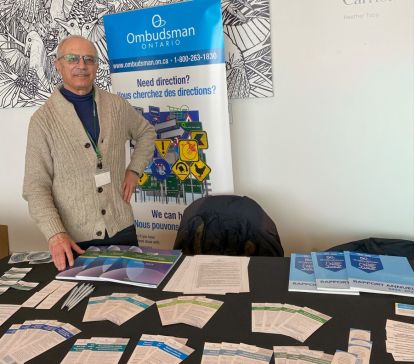
Anyone who believes a meeting was improperly closed to the public can file a complaint – and every municipality must have an investigator for such complaints. Municipalities can use the Ombudsman as their investigator at no charge, or hire their own. We are now the closed meeting investigator for 282 of Ontario’s 444 municipalities.
In 2025-2026, we received 104 complaints about open meetings, consistent with 99 the previous year. Of those, 87 were about municipalities where the Ombudsman is the investigator; the others were referred to the relevant investigator.
We received complaints about meetings in 55 different municipalities. We reviewed complaints about 75 meetings and issued 16 reports and 17 letters, in which the Ombudsman found 13 illegal meetings, 33 procedural violations, and made 16 best practice suggestions to help the municipalities improve the transparency of their meeting procedures.
All of these reports and letters were made public by the municipalities in question and are available on our website through the only such resource in the province, our Open Meetings Case Digest.
The digest is consulted thousands of times throughout the year by municipal officials, legal and oversight professionals and members of the public interested in local democratic processes. It can be searched by topic/keyword, municipality and relevant portions of the open meeting rules (set out in s.239 of the Municipal Act).
The Act does not provide for any penalties for violations of the open meeting rules. It does provide for the Ombudsman to make recommendations to address violations and municipalities must pass resolutions on how they will respond to an Ombudsman report. Our approach in our reports and resources is to promote consistent transparency in municipalities across the province by raising awareness of the rules and best practices for following them.
For example:
- After the Ombudsman found the Township of Bonfield illegally closed three meetings by failing to provide the required notice, it committed to making administrative changes to prevent future problems, including creating a checklist for meeting preparation, adopting new meeting software, and upgrading its website.
- We routinely encourage municipalities to audio or video record closed meetings to provide a clear and reliable record. The Ombudsman noted that the Municipality of Central Manitoulin’s video recording proved helpful in our review of a case this past year.
Local Services Boards: As of August 1, 2025, we can also investigate complaints about closed meetings of Ontario’s 46 Local Services Boards (LSBs). Not to be confused with “local boards” within municipalities, Local Services Boards provide basic municipal services to residents in rural areas that are not part of a municipality. To assist LSBs in ensuring they meet the open meeting requirements, we conducted webinars in English and French for LSB officials and developed a “tip card” specifically for them.
Most common issues
The most common complaints we receive about closed meetings relate to the nature and subject matter of the meeting, the procedures followed (or not followed), and/or whether the meeting materially advanced council business.
Some examples:
- Although the Town of Cobalt was advised by a consultant that renaming a committee as the Budget Advisory Group would exempt it from having to hold open meetings, the Ombudsman found that it did not. The Ombudsman urged the town to review all of its advisory groups to assess whether they were also “committees” whose meetings must be open to the public.
- When 17 members of council for the County of Simcoe did not return to their meeting after a recess, the Ombudsman found no evidence that they met elsewhere to discuss business. The Ombudsman noted that council members should be mindful of the public perception of such conduct.
- When a councillor for the Township of Ramara emailed members about a proposed course of action regarding a food waste program that informed a subsequent vote, our review found it was an illegally closed “meeting.”
- The Ombudsman found the Township of Coleman failed to provide sufficient public notice when it closed a meeting to hold an urgent discussion about a defunct refinery.
Other common complaints centre on whether the closed meeting fit within the specific exceptions in s. 239 of the Municipal Act, 2001. These include matters relating to legal advice, labour relations, land acquisitions, personal information, and “education or training.”
For example:
- The Ombudsman found a council meeting in the Town of Hawkesbury was illegal because rather than discussing “education or training,” members discussed ideas for its strategic plan with a consultant.
- Our review determined that the Township of Coleman could have used the “personal matters” exception to scrutinize the performance of specific lawyers behind closed doors, as did the Township of Schreiber when it discussed the conduct and personal circumstances of individual employees.
- In a handful of cases where municipalities closed meetings under the exception for “information provided by a third party” – as the Town of Essex did to hear a presentation from a third party proposing to build a sports complex – the Ombudsman encouraged the municipalities to obtain evidence in writing from the third parties clarifying what information should remain confidential and any risks associated with disclosing it.
Case summaries
Snowed under
A woman contacted us after receiving an overdue notice for non-payment of a parking ticket. The ticket was apparently for illegally parking on a road that was supposed to be clear for snow plowing during a snowstorm – but she told us she had never actually seen the original ticket. She said she had tried to explain her situation to the municipality’s by-law staff, but they told her she could not contest the ticket because the time for appeals had expired.
Result: After we raised the case with municipal officials, they agreed to allow the woman’s appeal. Ultimately, her fine was reduced by half and the late payment charges were waived. The municipality also informed us that it was using this case in future training for its by-law enforcement staff.
Firm but fair
We received 10 complaints from residents who were concerned about their municipality’s changes to a by-law regarding public conduct. They felt it was unfair that members of the public who were expelled from council meetings could be subject to a trespass order and required to make a public apology.
Result: We shared best practices with the municipality to help ensure that the process for expelling people from public meetings was fair. The municipality revised its procedure by-law to permit council to expel someone from a meeting without requiring a trespass order or an apology.
Refusal reversal
A council member complained that they were unable to file a complaint with the integrity commissioner because the municipality did not have one for four months. The municipality’s code of conduct had a time limit to make complaints and the integrity commissioner who was eventually appointed by council refused to take the complaint because it was outside of this time limit.
Result: We raised the issue with the integrity commissioner as a matter of fairness. The commissioner reconsidered their position and agreed to review the council member’s complaint.
Zoned out
A man complained to us that his municipality had rezoned his property from residential to institutional without his knowledge. He said he was seeking a permit to renovate a building on the property and was refused.
Result: After we spoke with municipal officials, they sent the man a letter apologizing for what happened and explaining his options. They also offered to waive the rezoning application fees and approved his building permit. The property owner thanked us for our help.
“We appreciate everything you’ve done for us. It’s given us a brighter outlook.”
Social Services
Overview
We hear from thousands of Ontarians every year who need help with social services – including those administered directly by the provincial Ministry of Children, Community and Social Services (MCCSS), like the Ontario Disability Support Program (ODSP) and the Family Responsibility Office (FRO), and income support payments administered by municipalities (Ontario Works). We also help many people navigate the complex systems for supports for adults and children with special needs and developmental disabilities.
Case volumes in all of these areas were up in 2025-2026 over the previous year. Many of the people who contacted us were vulnerable and under stress. Wherever possible, we work to resolve individual concerns with the appropriate agencies and try to avert further complaints by proposing ways they can improve fairness and accessibility.
When issues are pervasive or especially complicated, we seek to address them at a broader level by identifying root causes and suggesting best practices. For example:
- We alerted the MCCSS about complaints related to backlogs in the Social Assistance Digital Application (SADA), its central intake system for applications for Ontario Works and/or ODSP. We are monitoring the Ministry’s efforts to address processing and data entry issues in some regions.
- The MCCSS and Ministry of Health accepted all of the Ombudsman’s recommendations to address the systemic issue of adults with developmental disabilities being inappropriately housed in hospitals (see more under Investigations).
- We prompted the MCCSS to update its policies and training to address a fairness issue for some newcomers applying for Ontario Works benefits.
Trends in cases
Ontario Disability Support Program (ODSP)
The Ontario Disability Support Program provides financial and employment support to adults with disabilities, as well as health benefits. In 2025-2026, we received 1,599 complaints and inquiries about the ODSP – a significant increase from 1,038 cases in 2024-2025, and the highest volume in more than 10 years.
Many of these cases were about delayed benefits and difficulties in reaching case workers. We also monitored the ODSP’s efforts to assist recipients whose benefits were disrupted by the Canada Post strike in the fall of 2025. As well, we are looking into concerns shared by an MPP whose constituents reported problems with ODSP’s digital tools for submitting documents.
We resolved many individual cases by connecting with ODSP officials to address errors and delays. For example:
- A woman complained to us that she was unable to reach anyone at the ODSP to contest a $48,000 overpayment charge on her file. After we helped her connect with an ODSP office close to her home, it removed the incorrect charge.
- We helped a woman who was denied a $500 employment and training benefit reach ODSP officials. They discovered an error, reversed the decision, and committed to improving staff training for similar situations.
- We helped a man obtain interim ODSP funding as ordered by the Social Benefits Tribunal, after his benefits remained incorrectly suspended pending the tribunal’s final decision on his matter. ODSP officials confirmed they are working with the tribunal to improve information in such cases.
- A woman waited six months for her ODSP benefits to start, only to learn that it applied her entire retroactive payment towards a previous Ontario Works overpayment. After our intervention, the ODSP reversed the decision, provided her with $4,000, and established monthly installments to recover the overpayment.
- We helped a mother reach ODSP staff after six months of waiting for them to approve her son’s application. He was issued a $5,450 payment.
- We helped connect a blind Indigenous woman with ODSP staff who could communicate with her after she had difficulties with the online MyBenefits portal. We also liaised with her and ODSP staff to clarify certain documents she had to submit that resulted in her receiving $1,367 in back payments.
Trespass notices
We often receive complaints from people who are barred from ODSP offices because of concerns about their behaviour toward staff and other members of the public – an issue we also deal with in many other areas of the public sector. Our approach is always to ensure that public bodies follow fair and consistent practices for issuing and reviewing trespass notices. For example:
- After we looked into an ODSP recipient’s complaint that he had been barred for decades from a local ODSP office without reason or notice, the ODSP lifted the notice and implemented best practice suggestions to improve its process. These include communicating with affected clients about the reason and duration for such notices and informing them how to request a review. The ODSP accepted the bulk of our suggestions, and we will monitor their implementation.
Ontario Works (OW)
Ontario Works (OW) provides financial assistance for food, shelter, and other basic living expenses to people in financial need. The program is administered by the Ministry of Children, Community and Social Services, municipalities and district social services administration boards (DSSABs).
In the past year, we received 618 cases about Ontario Works, up from 412 in 2024-2025 and 390 the year before. The most common issues were delays and poor service or communication.
Some examples:
- After a man missed a vital out-of-town medical appointment because he didn’t receive his travel funds in time, we contacted the local DSSAB and the money was released immediately.
- We helped reverse a man’s $6,390 overpayment from 2012 – a debt that neither he nor the municipality had any documentation of.
- A 66-year-old man was facing eviction if he didn’t receive his OW payment, which was on hold until he filed his taxes to transition to seniors’ benefits. After we intervened, OW sent the payment and gave him extra time to complete the documentation.
Benefits for people with “irregular” immigration status
A legal aid clinic worker who helps newcomers to Ontario alerted us to an issue with the Ontario Works application process that was unfairly blocking people with “irregular” immigration status. The OW online and telephone application system would block any applicant whose status was not specifically listed in its menu of “legal status in Canada” categories.
Although the system would inform applicants they could phone or contact their local social assistance office for more information, we learned that many of those who called local OW offices were told they were ineligible for benefits or referred elsewhere. With no application submitted or written eligibility decision, they could not appeal to the Social Benefits Tribunal (SBT).
We raised this issue with the Ministry of Children, Community and Social Services, noting that some applicants were being unfairly denied the right to apply and to appeal decisions to the Social Benefits Tribunal. As a result, Ministry officials issued guidance to municipalities on how to handle these applications and updated OW policy provincewide to direct them to generate a Notice of Decision – restoring applicants’ right to appeal.
Indigenous recipients’ benefits and land claims
Several Indigenous recipients of OW and ODSP benefits contacted us in 2025-2026 with concerns about the effect of land claim settlements on their eligibility for benefits. For example:
- An Indigenous man contacted us after his OW application was denied because of funds he had received from the Robinson Huron settlement. We pointed out to OW staff that for the purposes of assessing social assistance eligibility, these funds are excluded. We also worked with the man to ensure he had submitted the appropriate documents to allow OW to promptly approve his benefits.
Other complaints and inquiries we received about the 2023 Robinson Huron settlement – which compensates the Anishinaabe people of Lake Huron for the Crown’s past breaches of the Robinson Huron Treaty of 1850 – related to individuals’ eligibility for settlement funds, or the process by which the funds were distributed.
We provided referrals and information to these complainants, as our Office does not oversee Indigenous governments or their programs, including the disbursement of settlement funds. When we receive these types of complaints, we help connect people with the relevant Indigenous administration representative.
Family Responsibility Office (FRO)
The Family Responsibility Office (FRO) is the agency that enforces court-ordered child and spousal support payments. Complaints and inquiries about the FRO increased to 616 in 2025-2026 from 423 the previous year. Most of these were about incorrect or inadequate enforcement of support orders or difficulties in communicating with caseworkers.
We meet regularly with FRO staff to address complaint trends and share suggestions for improvement. This past year, we also met with senior officials to help them bolster their internal processes for handling complaints.
We resolved many individual cases by bringing them to the FRO’s attention where warranted. Some examples:
- When a mother asked us to help find out why the FRO hadn’t contacted her about her child support, we discovered it had confused her with another client with a similar name.
- A father who had paid off his child support arrears complained to us that the FRO continued to report him to the credit bureau. We spoke with FRO staff, who confirmed he didn’t owe any more money and closed his file, and he told us his credit score returned to normal.
Services for children with developmental disabilities
Ontario Autism Program (OAP)
The OAP provides support to families of children and youth with autism, and AccessOAP helps families connect with services and manage their benefits. AccessOAP’s Independent Review Office handles complaints about services, processes, and supports.
We received 66 cases about these programs in 2025-2026, down from 92 the previous year. They were primarily about long waits for core clinical services and disagreement with decisions about expenses. We resolved these by connecting with the appropriate officials to address service and administration concerns. We also meet regularly with program and MCCSS staff to flag complaint trends and make suggestions for improvements – such as providing families with more information about wait times or sharing clearer explanations for decisions.
Some case examples:
- A mother with early onset Alzheimer’s Disease missed a deadline to submit invoices for reimbursement for therapy for her 12-year-old son. After we contacted the OAP, staff processed the invoices, issued the woman $1,600, and reached out to her directly about additional support with invoices.
- We flagged the concerns of a mother who was struggling financially and was waiting for invoices to be processed. After our intervention, staff contacted her to sort out some discrepancies and her invoices were processed, reimbursing her for $5,500.
Special Services at Home (SSAH)
The Special Services at Home (SSAH) program helps families caring for children with developmental and physical disabilities. We received 214 complaints about SSAH in 2025-2026, up from 171 in the previous year. Consistent with last year, many of these cases were about delays beyond SSAH’s 30-day processing standard for expense reimbursements.
Senior MCCSS officials told us that they continue to make internal system changes – such as a new case management system in May 2025 – to speed up processing times. They also told us that the February 2025 provincial election had delayed the release of annual funding packages, which also sparked complaints. We resolved cases wherever possible by facilitating communication between families and program officials. For example:
- We made sure a family got help in submitting a new form for reimbursement of more than $2,000 from SSAH, after they waited more than two months before learning they made an error in their first submission.
- We helped a mother get $6,065 in reimbursements from SSAH after the person responsible for her invoices was promoted and she wasn’t given a new contact.
Children with complex special needs
In 2025-2026, we received 23 complaints from parents and guardians about accessing programs and services for children who have complex special needs, consistent with 29 the previous year.
Families often turn to us in crisis when their children are not receiving the services and supports they need to manage risks of harm. Navigating the system of supports can take a significant mental, physical and financial toll, and these families often face multi-year waits for appropriate treatment options, as well as challenges in transitioning children to adult services.
We continue to raise these concerns in our regular meetings with senior Ministry officials, and resolve individual cases by helping families connect with relevant programs and services wherever possible.
Some examples:
- We heard from the parents of a 17-year-old Indigenous girl with complex special needs who had been living in a hospital because she couldn’t be safely cared for at home. We facilitated communication between several agencies and ministries to make sure the girl could safely transition to an appropriate supportive living arrangement as she turned 18.
- We helped the mother of a 15-year-old with developmental diagnoses connect with a local support agency to arrange respite services, so the child could move back home from a mental health facility.
- We worked with multiple community agencies, mental health service agencies, and ministries to find a community placement for a child with developmental and mental health diagnoses.
In its budget released in late March 2026, the province announced that its Extensive Needs Service, a pilot project launched in 2023 to support children with urgent, complex developmental needs and their families, would receive annual funding. We will monitor the impact of this program on families and complaint trends.
Adults with developmental disabilities
We regularly help adults with developmental disabilities and their families deal with challenges in accessing appropriate housing and services. In addition to investigating the underlying systemic issues that lead to crisis situations – such as people being housed for years in hospitals (see more under Investigations) – we work with support agencies and MCCSS officials to resolve individual cases wherever possible.
For example:
- We helped a woman connect with Developmental Services Ontario (DSO) to discuss the suitability of her son’s placement after his needs changed.
- We helped a father of a 17-year-old with dual diagnoses and complex support needs connect with the appropriate agencies in the adult sector, and the teen was able to move into a supportive living arrangement the day after his 18th birthday.
Investigations
Cases of adults with developmental disabilities who are inappropriately housed in hospitals
Report: Lost in Transition, released November 2025
Investigation update: This investigation grew from our follow-up on the Ombudsman’s recommendations in our 2016 report, Nowhere to Turn, which revealed systemic issues that were leading to adults with developmental disabilities being housed in homeless shelters, jails, long-term care homes and hospitals.
Although many improvements were made, we continued to hear complaints about vulnerable individuals with complex developmental, mental health and behavioural needs who were languishing in hospitals for years, often in restraints, because no suitable housing and support could be found in the community. The Ombudsman launched a new investigation in 2023, focused on the experiences of seven such individuals whose unwarranted hospitalizations ranged from 15 months to more than eight years.
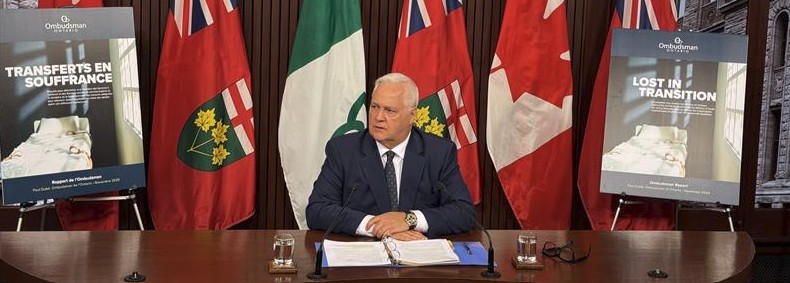
Our investigation revealed inconsistent collaboration between the Ministry of Children, Community and Social Services and the Ministry of Health to prevent or limit unwarranted hospitalizations. It found the ministries’ siloed and reactive planning approach and a chronic shortage of suitable housing and services often left those with the most complex needs deteriorating in hospital – in the wrong place, receiving the wrong care. These challenges are often even greater for those who require services in French.
Among his 24 recommendations, the Ombudsman called on both ministries to:
- Create a joint forum for proactive system planning
- Improve the availability of integrated supports and suitable living spaces in the community
- Improve recruitment and retention of developmental support professionals and access to clinical supports in the community – including to support French-speaking individuals.
The ministries accepted all of the recommendations and committed to working toward a more integrated, collaborative and person-centred system of services for people with developmental disabilities. We will closely monitor their progress in implementing the recommendations.
Individual cases: We continue to help families of individuals in similar situations. For example:
- We received a complaint about a 22-year-old man with dual diagnoses who had been inappropriately housed in a hospital for several months while waiting for an appropriate supported living placement through Developmental Services Ontario (DSO). We spoke with the hospital and various community agencies and raised our concerns with DSO and the MCCSS. We learned that a potential placement was being pursued but other factors were causing delays, including a respiratory disease outbreak at the hospital. We continued to follow up on the case and confirmed that the man finally transitioned into a permanent supportive living residence after 10 months in hospital.
“These individuals do not need hospitalization; they need coordinated, appropriate support in the community. The fact that our system continues to rely on hospitals as a default placement is not just inefficient – it is unfair, inappropriate, and profoundly harmful to them and their families.”
— Remarks by then-Ombudsman Paul Dubé at news conference on Lost in Transition, November 25, 2025
“You painted a picture of the exact reality of our system, the barriers, and challenges our families, clients and frontline workers face on a daily basis. You could not have done a better job [….] I am hopeful this will spark change in the near future.”
— Email to Ombudsman from developmental services provider, November 2025
“I am so heartened to hear about your recent report and its much-needed recommendations to focus on community spaces for those with complex needs and dual diagnosis[….] I just thank the Ombudsman’s Office from my heart for taking on this difficult investigation for our most vulnerable members of society, my daughter included.”
— Email from a parent whose daughter has complex needs and a developmental disability, November 2025
Care and custody of children with complex special needs
Report: Between a Rock and a Hard Place, released May 2005
Investigation update: A persistent issue that we have called attention to for more than 20 years since the publication of this report is the plight of families who are unable to care for children with complex special needs at home – and who are unable to access adequate supports for them. Year after year, they tell us they have no alternative but to surrender custody to a children’s aid society (CAS), which will then use its resources to find and fund appropriate care and treatment for them.
Not only do many families tell us they feel pressured to make this heart-wrenching decision, we are also investigating the challenges that CASs themselves are experiencing in finding appropriate placements, resulting in some children being placed in hotels, motels, offices and trailers (for more, see the Children and Youth chapter of this report).
Wherever possible, we work to help families connect with service providers, and we share concerns with senior Ministry officials. Some recent case examples:
- A mother whose 16-year-old daughter has complex special needs sought our help after the youth was hospitalized after violent behaviour. She told us she would not be able to care for the teen at home, and after another violent incident at the hospital, she decided to surrender custody to a children’s aid society (CAS). We confirmed that the CAS found a suitable supported living arrangement for the teen.
- A parent of two children with complex special needs and aggressive behaviours, ages 12 and 11, was struggling with a medical issue and told us they needed a supported living arrangement for the children. Our inquiries with the Ministry confirmed the family was getting all the support they were eligible for, but there were no suitable placements available. The parent told us they were turning to a CAS for help and considering giving up custody. We continue to follow up with the family.
- A mother told us she was struggling to care for a 15-year-old with fetal alcohol spectrum disorder whose behaviours had led him to be hospitalized frequently. We made inquiries with mental health and developmental support agencies in her community to confirm both were aware of and responsive to her concerns. Ultimately, she told us a children’s aid society secured him a placement at a group home and she felt her concerns were heard.
Case summaries
Mountain moved
A woman undergoing cancer treatment told us her medical transportation costs weren’t being covered by the Ontario Disability Support Program (ODSP), and she was denied reimbursement for incontinence supplies while program officials reviewed her expenses.
Result: Our inquiries revealed the ODSP had made an error in assessing the woman’s travel to appointments, and it already had the necessary information to reimburse the cost of her supplies. It corrected the mileage error and approved payment for her other costs. She told us: “You really moved mountains for me.”
Belated benefits
The Social Benefits Tribunal confirmed a man was eligible for Ontario Disability Support Program benefits 16 months after his initial application to the program. He came to us for help after waiting another five months to be registered with ODSP so he could start receiving benefits, including retroactive payments.
Result: We stepped in and escalated the issue to ODSP officials – and the man began receiving his monthly benefits, as well as retroactive benefits of $19,850.
Overpayment overturned
A mother complained to us that the Family Responsibility Office had stopped enforcing child support payments after a status review – which she maintained was incorrect – indicated that her ex-husband had been overpaying for many years.
Result: After we asked FRO staff to provide an explanation in writing for its recalculation of the man’s support obligations, they determined that it was indeed incorrect. In fact, he actually owed $4,300. The woman was happy with the outcome and thanked us for our intervention.
Timely transition
A father sought our help when he learned that the group home where his 16-year-old son lived – which provided him with around-the-clock specialized behavioural support – was closing, leaving him at risk of ending up without a safe place to live.
Result: We confirmed with officials at the service agency that the process to secure a new residence for the youth was being expedited. A new home was found in time, and he was able to move in on the same day his previous placement ended. His father thanked us for our help.
Education
Overview
We help Ontarians with a wide range of problems at all levels of the education sector, whether they relate to a provincial ministry or program, a school board, university or publicly funded college.
This past year saw numerous changes in this area, as the province took over direct supervision of several school boards, began the rollout of new Student and Family Support Offices at the board level, and introduced legislation to significantly change the roles of school trustees and Directors of Education in English school boards. It also announced changes to post-secondary funding after several years of tuition freezes, including lifting tuition freezes and making changes to the ratios of provincial grants and loans provided through the Ontario Student Assistance Program (OSAP).
We received a record number of education-related complaints and inquiries in 2025-2026. In particular, we saw more cases than ever about school boards (1,346) and about colleges of applied arts and technology (530).
It has now been more than 10 years since the Ombudsman’s jurisdiction was extended to Ontario’s 72 school boards and 10 school authorities (on September 1, 2015) and to its 23 publicly assisted universities (on January 1, 2016). Since then, we have helped thousands of students and families – in all, 9,845 cases about school boards and 2,725 about universities.
We aim to resolve cases quickly by connecting people with the right officials at the school board or program level. We also flag complaint trends and suggest best practices to help bodies improve fairness and processes. In the rare instances where we launch a formal investigation – such as our recent probe of the Ministry of Education’s payments for families during the COVID-19 pandemic (see more under Investigations) – our recommendations seek to address underlying causes and avert future complaints.
Trends in cases – early years through Grade 12
Provincial supervision of school boards and new legislation
The government placed eight school boards under the Minister of Education’s direct supervision in 2025-2026. When the government takes such an action, the elected trustees remain in office but their governance powers, decision-making authority, compensation and official duties are suspended, and a provincially appointed supervisor assumes control of the board.
The appointments of provincial supervisors prompted complaints to our Office from the affected jurisdictions, including from some trustees. These included concerns about the lack of transparency in the supervisor’s decision-making, insufficient communication and consultation with families, and changes to the discipline committees, which typically include trustees. Some boards voted to request that the Ombudsman investigate potential changes to the role of trustees. We also heard complaints about the government discontinuing livestreaming and video recording of committee meetings in boards under supervision.
In January 2026, the then-Ombudsman also heard concerns directly from trustees and others when he spoke at the Ontario Public School Boards’ Association (OPSBA) Public Education Symposium about our 10 years of overseeing school boards. At that event, and in written responses to boards that called for an investigation, he explained that our Office is not able to set government policy or overturn decisions of elected officials.
At a similar gathering of the Ontario Catholic School Trustees’ Association (OCSTA) in May 2026, Acting Ombudsman Barbara Finlay reiterated this message, while encouraging anyone who has a concern about accountability, transparency and fairness in the administrative conduct of boards and provincial bodies to contact us.
“Setting public policy in education, including determining governance structures and the role of school board trustees, is a matter to be determined by elected officials. My role as Ombudsman does not include setting public policy and I do not have the mandate to investigate or overturn the public policy decisions of elected officials or to make findings about anticipated decisions.
“My Office does have the power to review the administrative impact of government decisions once they are made and implemented – particularly if decisions are made behind closed doors or without meaningful public input. If the resulting administrative action is unfair, that is where we can step in.”
— Speech to OPSBA by then-Ombudsman Paul Dubé, January 20, 2026
Student and Family Support Offices
In November 2025, the government announced new requirements for school boards to create Student and Family Support Offices – some by January 2026 and the rest by September 2026. These offices can serve as a first point of contact for parents and students to address school-related concerns, and we refer complaints to them where appropriate, although as always, people can come to us if their concerns are not resolved.
We are monitoring the rollout of these offices and can intervene when necessary. For example:
- When a man contacted us about a school issue, we referred him to his Student and Family Support Office. He was then blocked by that office’s system because he checked a box indicating that he had already contacted us. We ensured that he was able to address his concerns and are following up with the board to address this problem.
Special education, accommodations and safety concerns
We often help parents and guardians of children who need special classroom supports or have issues with their Individual Education Plans. We work to connect them with the right officials or address communication issues. For example:
- A girl with complex needs had been out of school for four months, and her father’s efforts to find her a classroom with appropriate supports had stalled. After we raised the case with board officials, the girl was moved into a new school. The father thanked us, saying: “You did not just help me as a parent, you helped my child.”
- After we looked into the supports a board was providing to a child who communicates in American Sign Language (ASL), it assigned an educational assistant to her with the requisite ASL skills.
- A mother of a youth with complex special needs told us she was considering keeping him home from his first year of high school because the board was not going to provide an educational assistant for him. After we intervened, a superintendent reached out to her to explain the other supports set up for him, which eased her concerns.
Trespass notices
We often receive complaints about how trespass notices are used by schools – particularly when they unduly restrict a parent’s ability to participate in the child’s education. As we do in other areas where trespass notices are common – including in the social services and municipal sectors – we regularly share practical guidance on best practices.
In 2025, we created a “tip card” for school boards (available on our website) that covers these practices, such as ensuring that such notices have a set duration and there is a fair appeal and review process. For example:
- A father who had complied with a school board’s one-year trespass notice complained that it continued the restriction against him without explanation. After we shared best practices with the board, a senior administrator spoke with the man about code of conduct expectations and revoked the notice.
- After a mother complained she was not notified about a school issuing a trespass notice against her teenaged daughter, we shared best practices with the board, including that it should notify the parents or guardians of any minors who are the subject of trespass notices.
Submission to government – Police in schools
In November 2025, the Supporting Children and Students Act, 2025 amended the Education Act to require school boards to work with local police services to allow police access to school premises and enable them to participate in school programming, and require schools to implement police “school resource officer” programs where they were available, in circumstances to be set out by regulation. In early 2026, the Ministry of Education held a consultation on the proposed regulation regarding police in schools.
In February 2026, the Ombudsman made a submission that strongly encouraged the Ministry to share information and guidance with school boards and police services regarding the objectives of police-in-schools programs and ensure the proposed memoranda of understanding with police services be mandatory for all boards, not just those with school resource officers. The submission also called for these memoranda to include clear mechanisms for complaints about police presence in schools.
Transportation
We received 120 complaints about school transportation in 2025-2026, up from 102 the previous year, including about busing for children with special needs, bus stop locations, and boards refusing busing requests. We resolve these issues where we can by connecting parents with the relevant officials.
For example:
- We helped a mother whose request for transportation for her child in high school, who has a medical condition, was denied. She was referred to the student’s principal to request an exemption but had no success. After we made inquiries with the school board, it took the appropriate steps to confirm the child’s medical condition and arranged the requested transportation.
Registration and tuition fees
As in previous years, we dealt with cases about school boards refusing to enrol students without permanent addresses, or to grant tuition fee exemptions. For example:
- A father was unable to enrol his son, a 10-year-old Canadian citizen, in his local school when he returned to Canada after spending 18 months abroad. He told us the boy was out of school for months because the school board would not accept the proof of address documentation that the family had available to show they were living in the district. After we stepped in, the board reviewed additional documentation from the father and the child started school.
- A newcomer family sought our help in recovering international tuition fees they had paid to a school board for two children before they claimed refugee status. We raised the case with board officials, noting that the Education Act permits tuition exemptions for children of people awaiting refugee protection. The family ultimately received a refund of more than $30,000 and the board updated its tuition refund policy.
TVO Independent Learning Centre and credit recognition
We received 43 cases in 2025-2026 (up from 28 the previous year) about the TVO Independent Learning Centre (TVO ILC), a virtual online high school operated on behalf of the Ministry of Education. Many of these were about delays or challenges in scheduling exams and submitting assignments.
In addition to working with us to resolve these cases, TVO ILC also addressed an issue we raised in last year’s Annual Report, regarding how it credits students for prior learning. As a result of a case we flagged in which a homeschooled student’s prior learning was not credited, TVO ILC updated its Prior Learning Assessment and Recognition policy to allow for past learning credits to be recorded on the Ontario Student Transcript, and created a mechanism by which assessments of such credits can be appealed.
Investigations
Direct payment programs for parents and students
Report released: June 2026
Investigation update: From early 2020 to spring 2023, the Ministry of Education delivered five direct payment programs to support parents and guardians when children’s schooling was disrupted, first by labour unrest and then the COVID-19 pandemic. In all, it distributed more than $2 billion to help families.
We received more than 200 complaints about the Ministry’s administration of these programs.
The investigation focused on the experiences of parents and guardians who were denied payments for their children because someone else had already applied and received the money. It examined how the Ministry responded when the problem was brought to its attention, and what safeguards were missing that allowed people to claim benefits they weren’t entitled to.
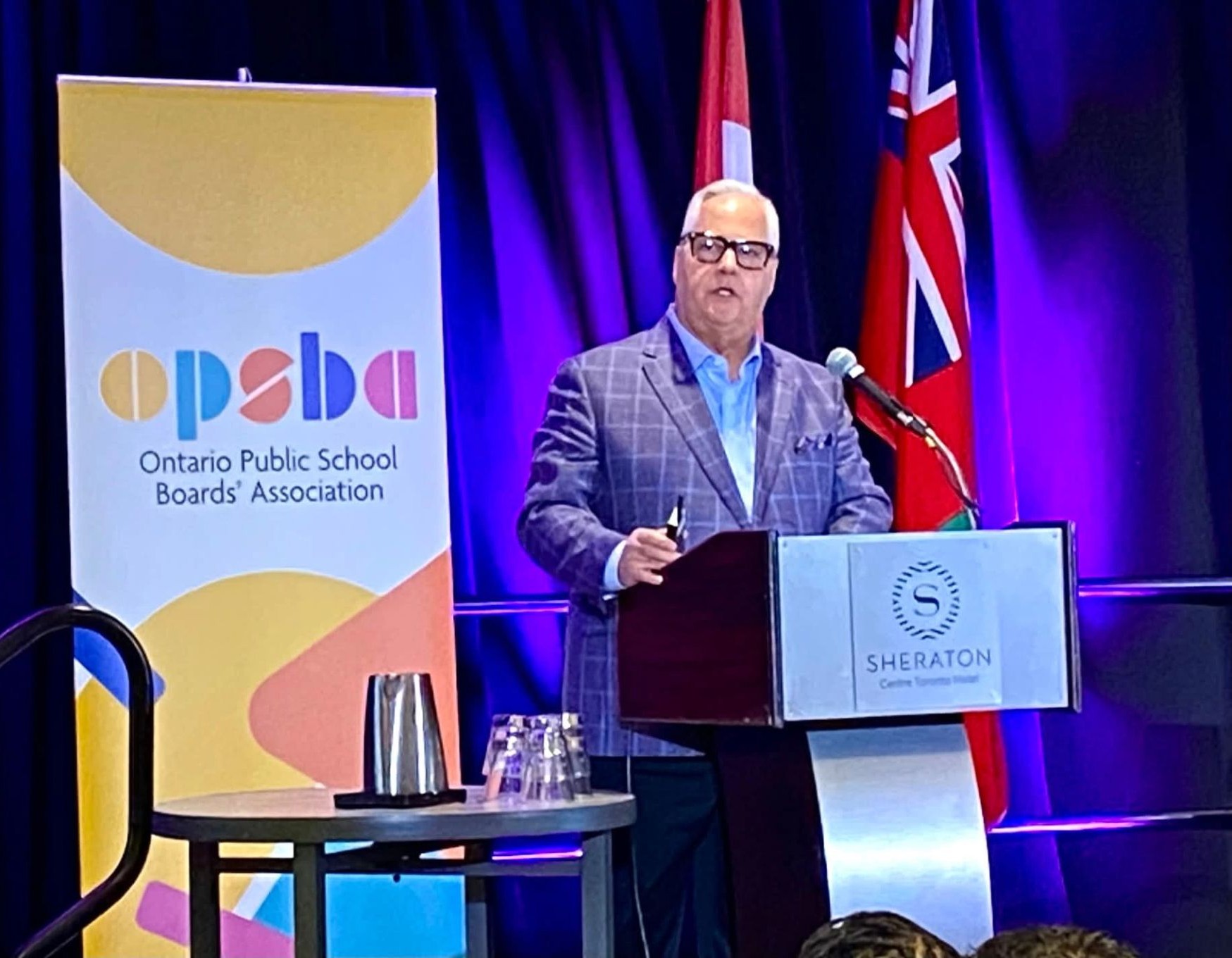
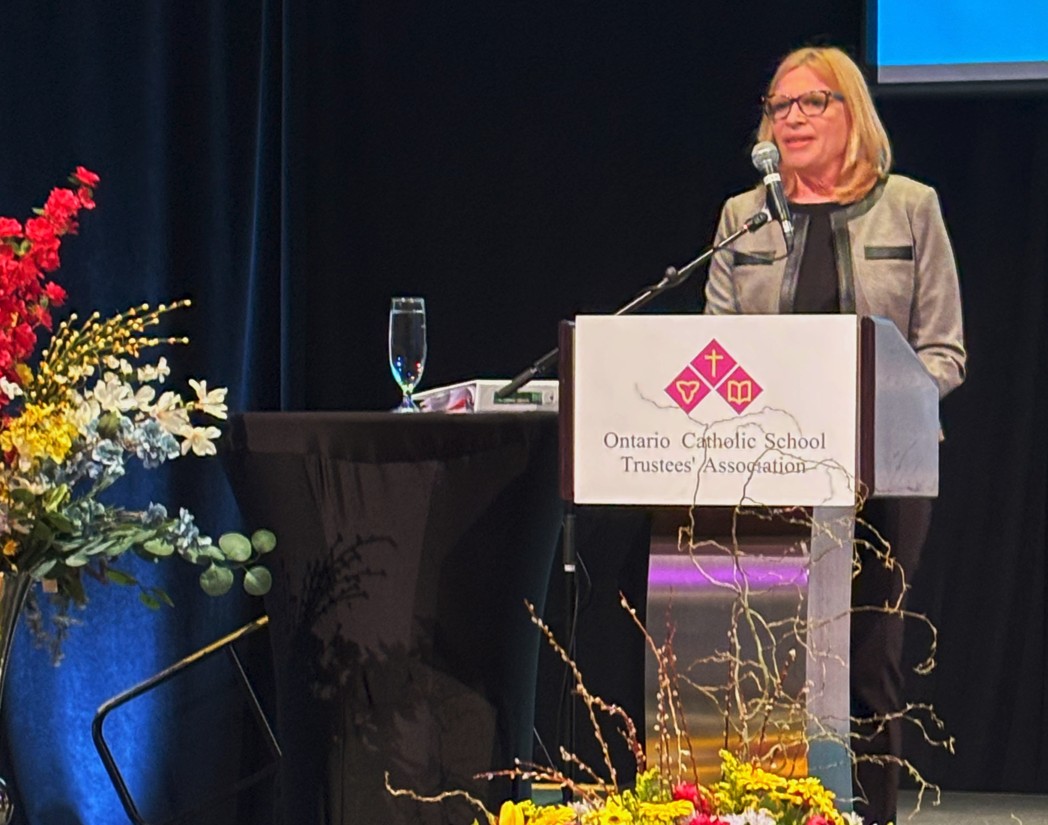
The Ministry accepted all 14 recommendations in this report, which are aimed at improving the administration of future direct payment programs, strengthening eligibility verification, and ensuring swift corrective action when misdirection of funds is detected.
Among the key findings:
- The programs suffered from a lack of planning and limited staff, training and resources
- The Ministry took a “first come, first served” payout approach that increased the risk of benefits being paid to ineligible applicants
- People who complained were often told the Ministry could not get involved in custody matters and they should try to recover the funds themselves
- Two of the programs simply “rolled over” eligibility to subsequent ones, meaning some people who were unfairly denied benefits under one program were also denied under the next
The Ministry committed to carefully considering the recommendations in designing and implementing any future direct payment programs, should they be contemplated.
Trends in cases – post-secondary
Case volumes related to universities, colleges of applied arts and technology and the Ontario Student Assistance Program (OSAP) all rose substantially in 2025-2026. The most common complaints we received were about refunds and fees, appeals of grades and accommodation requests, and communication issues. We helped resolve issues or connected students with the right people to make sure their concerns were addressed.
For example:
- A student wasn’t accepted into an advanced diploma program because her transcript from her previous college used letter grades instead of numerical ones. We put staff from both colleges in touch with one another to determine the equivalent numerical grades and the student was accepted into the program.
- We helped a woman who lived two hours away from her college get a refund when it changed her program to in-person classes only.
- An Indigenous student complained to us about a lack of services and supports for Indigenous students at his college. After we conveyed his dissatisfaction to the college, it acknowledged it had failed to provide him with the counselling services he had requested, due to a staffing shortage. The college committed to taking concrete action to better support Indigenous students in future, including ensuring there were adequate supplies and traditional medicines in its Indigenous student centre and increasing the presence of counselling staff on campus.
Ontario Student Assistance Program (OSAP)
We received 306 cases about OSAP loans and grants in 2025-2026, a 64% jump from last year’s 187 and the highest volume in more than 10 years. Many of these were about grant-to-loan conversions, delays and communication issues. We also heard concerns about the government’s planned changes to the calculation of OSAP grants and loans for the upcoming 2026-2027 school year. Although we cannot intervene in matters of broad public policy, we will monitor the effects of these changes and continue to address administrative issues.
Some recent examples:
- In two cases, students on medical leave were incorrectly recorded by OSAP as being on academic probation, resulting in their grants being converted into loans. We spoke with the relevant officials, who acknowledged the error and reduced the amount each student owed by $3,743 and $5,641 respectively.
- A student who withdrew from courses after experiencing domestic violence complained to us about OSAP’s handling of her Exceptional Circumstances Review. After our intervention, OSAP converted her $6,867 loan to a grant.
- We helped a student call OSAP’s attention to a processing error that prevented her from receiving her Canada Student Grant for Students with Disabilities. When the error was corrected, she told us: “I just logged into my OSAP account and found that the issue has been resolved, and the outstanding $6,160 will be released to me. Thank you so much for your help.”
Changes in policy for international students
As we noted in last year’s Annual Report, many students have sought our help in the wake of the 2024 federal government cap on international student visas. Affected students struggled to get tuition refunds from colleges after their permits were denied or delayed. For example:
- An international student was entitled to a refund of $8,900 after his study permit was denied, but he only received a quarter of that amount. After we raised the case with the college, he received a full refund and told us: “Your intervention made a significant difference, and I truly appreciate the professionalism and dedication shown throughout the process.”
Case summaries
Never a loan
An Indigenous woman who had received Ontario Student Assistance Program (OSAP) grant funding contacted us when she learned the funds had been converted into a loan. She told us she suspected that OSAP had incorrectly assessed the income of her First Nations mother, which should have been assessed as tax-exempt on-reserve income.
Result: We escalated the case to staff at the Ministry of Colleges, Universities, Research Excellence and Security, who confirmed that the mother’s income had indeed been incorrectly assessed. OSAP updated its records and sent the relevant information to the National Student Loans Service Centre to reverse the $6,267 loans back to a grant. The woman was thrilled and thanked us for our help.
Exclusion confusion
A father complained to us that his son, who has special needs and behavioural issues, had been excluded from his high school without reason or appropriate communication. According to the Education Act, an exclusion allows a school board to refuse to admit a person whose presence, in the principal’s judgment, would be “detrimental” to other students, without formally suspending or expelling them.
When we looked into the case, we learned the principal wanted to activate a safety assessment process to facilitate the student’s return to school, but had not provided the father with a written explanation along with the relevant appeal options, as required by the board’s Safe Schools policy.
Result: After we pointed this out to the board, it created a new exclusion policy and procedure, which will include consultations between parents and the principal and give excluded students access to educational programming and a re-entry plan. The board also explained these changes to the father and apologized for the lack of clear information. The son was able to participate in additional programming at a local community service provider.
New school, new start
The mother of an Indigenous Grade 6 student sought our help after her daughter was denied a transfer to a new school within the same school board. She told us the girl had been the victim of cyberbullying and racist comments and wanted to change schools for her own safety. When we raised this case with school board officials, they initially told us the request wasn’t in line with their typical processes and timelines.
Result: We drew the superintendent’s attention to the board’s out-of-area admissions policy which states that Indigenous students will be given priority access and can be admitted at any time in the school year. The superintendent agreed to facilitate the transfer and follow up with the principals at both schools to set up supports for the girl. Her mother thanked us for our help and said the girl was doing well at her new school.
Walk this way
Several parents in a new subdivision contacted us after they were told their children, who had previously been bused to school, were ineligible for busing because they did not live far enough away from the school.
The parents told us that in calculating this distance, the board had measured a pathway that went through areas still under construction, was marked “use at your own risk,” and was not maintained in winter.
Result: After we raised this information with school board officials, they liaised with municipal staff, who agreed to maintain the path in winter and remove the “risk” sign. The board also confirmed that construction would be limited during the times before and after school. It communicated these changes to the families.
Children and Youth
Overview
As the Ombudsman for all Ontario children, our work is guided by this simple commitment:
Children and youth deserve the same fairness, respect, and accountability from public services as anyone else. Our role is to ensure that the voices, rights and interests of young people are respected.
Although the bulk of the cases we discuss in this chapter are about children and youth involved with child welfare, youth justice and residential care systems, our mandate encompasses the rights of all young people seeking or receiving public services in Ontario – including those in schools and those receiving mental health or developmental services funded by the province.
In keeping with Article 20 of the United Nations Convention on the Rights of the Child, our services to young people and children are founded upon a recognition that they may require special assistance in bringing their concerns forward. Our staff are trained for this, and we have child-friendly processes.
Children and Youth Unit
Our Children and Youth Unit is made up of Investigators and Early Resolution Officers who have specialized training and are experienced in speaking with children and youth, including those with complex needs. They handle hundreds of individual cases, conduct reviews and investigations, and participate in a wide range of outreach activities, from conferences of child welfare professionals and presentations to children’s services agencies to youth and community gatherings like Pow Wows.
Five specialized teams within the Children and Youth Unit focus on outreach to and meetings with specific groups of children and youth, consult on individual cases and investigations, and contribute to cultural training and outreach where appropriate.
They are:
- 2SLGBTQIA+ Outreach Team
- Black Children, Youth and Families Roundtable
- Indigenous Circle
- Provincial and Demonstration Schools Outreach Team
- Youth Justice Outreach Team
Proactive work and outreach
We make a point of connecting in person with young people who are in care, in custody or living at Provincial and Demonstration schools. Whenever we meet with young people as a group, we follow up with each of them privately to ensure they have a chance to raise their concerns with us directly.
In 2025-2026, we delivered 36 presentations to a variety of audiences, including workers at children’s aid societies (CASs), Indigenous Child and Family Well-Being Agencies, and youth justice facilities, as well as community agencies and organizations, the Provincial Missing Persons Investigators Working Group and students in the youth care or social work fields.
We also convened focus groups of youth involved with CASs to hear directly from them about the best way to share information with them, so we can better tailor our communications to their needs. In our outreach and communications, we emphasize that all youth in care have a legislated right to contact our Office, and those involved with children and youth have an obligation to tell them how they can reach us.
We are members of the Canadian Council of Children and Youth Advocates, the Children and Families Chapter of the United States Ombudsman Association, and we closely follow the work of the European Network of Ombudspersons for Children. Through these networks, we share expertise, learn about issues and trends in other jurisdictions, and operate under common principles.
We also meet regularly with both the child welfare and youth justice divisions of the Ministry of Children, Community and Social Services, the Ontario Association of Children’s Aid Societies (OACAS), the Association of Native Child and Family Service Agencies of Ontario (ANCFSAO), the Foster Parents Society of Ontario, the Ontario Association of Child and Youth Care, and the Ontario Care Collective to discuss common concerns and raise awareness of our work.
We also keep ourselves informed by attending events like ANCFSAO’s annual conference and the Power Up Youth Symposium for Black children and youth in care. All Children and Youth Unit staff also completed the “Kujali: Caring for Black Children” training this year, developed by the Ministry and OACAS.
New resources
We continuously update our digital and print resources for children and youth, families, and professionals in the field. Some recent examples:
- For older teens seeking CAS services: We created information cards (printed and digital, available on our website) for 16- and 17-year-olds about Voluntary Youth Services Agreements and the province’s Ready, Set, Go program. We plan to provide these to CASs to assist with their legal obligation to provide youth seeking voluntary services with information about our Office.
- For professionals: We collaborated with the Office of the Information and Privacy Commissioner on an updated guide for professionals on what information they can provide to child welfare workers in cases where children are at risk. The guide – Yes, You Can – is available on our website.
2SLGBTQIA+ Youth Rights Conference
In November 2025, we hosted a Youth Rights Conference for 2SLGBTQIA+ youth, their friends and supporters across the Greater Toronto Area. The event focused on helping youth understand their right to be treated fairly when receiving public services, such as in schools, the child welfare system, youth justice, and ServiceOntario. Centred on youth voices, the event aimed to empower youth with knowledge about their rights and the supports available to affirm their identities and well-being.
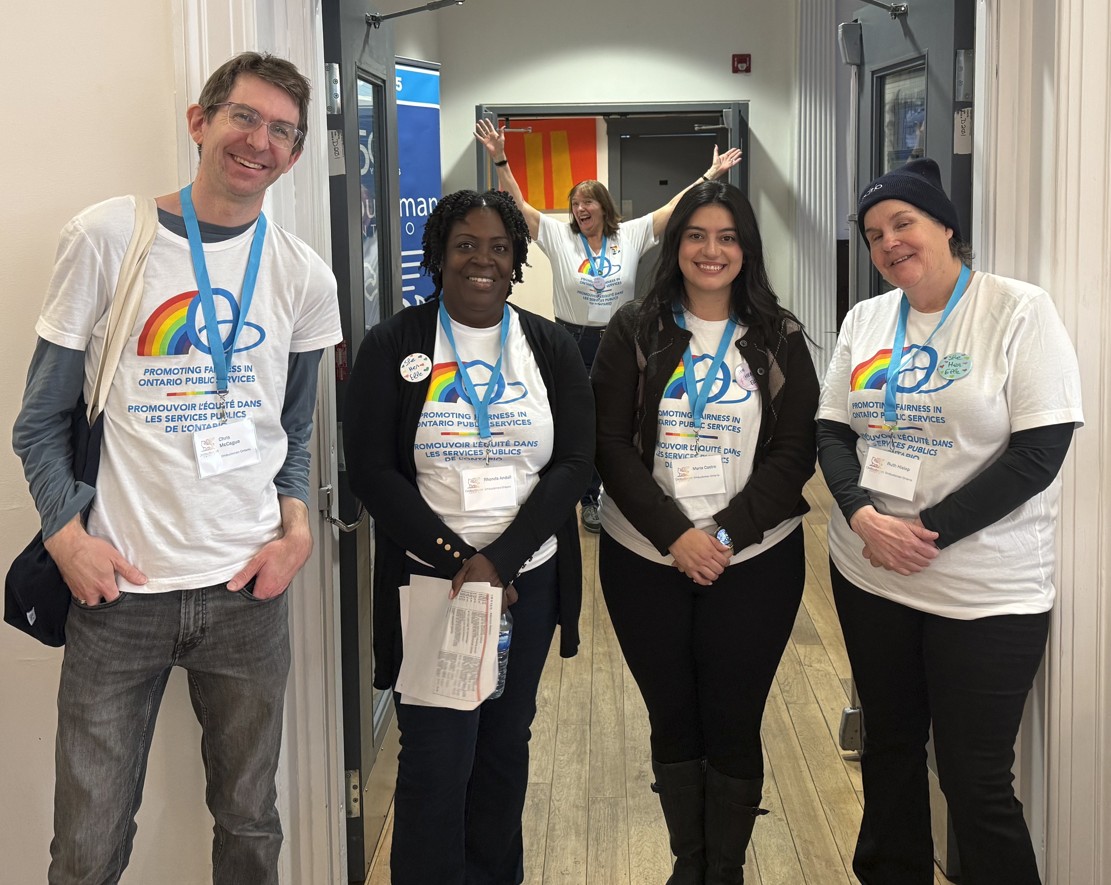
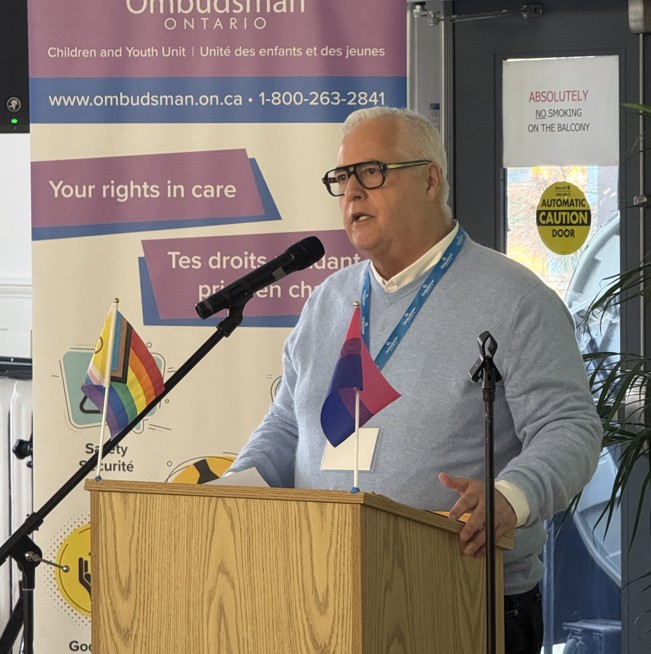
More than 60 youth, ranging from middle school students to young adults, took part in workshops and creative activities, including a scavenger hunt that encouraged them to connect with organizations offering support services. Speakers shared personal journeys and spoke about advancing the rights and well-being of 2SLGBTQIA+ communities.
Trends in cases
We received 2,552 complaints and inquiries in 2025-2026 regarding services provided to children and youth by children’s aid societies, residential licensees (group homes and foster homes), and youth justice facilities, a 20% increase over 2,129 the previous year.
The bulk of these cases – 1,664 – were about children’s aid societies, up from last year’s 1,533. Of those, 222 were about Indigenous Child and Family Well-Being Agencies. Residential licensees accounted for 153 cases, and there were 25 about secure treatment (compared to 103 and 12 in 2024-2025, respectively).
Cases about youth justice centres, which reached a peak last year of 423, rose to a new high of 436.
Children’s aid societies and residential licensees
The most common concerns we hear from young people in care of children’s aid societies (CASs) are about access to family members, problems with their placements and interactions with the staff who are working with them.
A frequent complaint we hear from adults is about the adequacy of child welfare investigations. These types of complaints may come from parents or family members, as well as adults who have raised concerns about the safety of a child.
Voluntary Youth Services Agreements (VYSAs)
A top issue we hear about from youth aged 16 and up is Voluntary Youth Services Agreements (49 cases this year), which entitle them to the full range of services from a CAS. VYSAs – and the reluctance of many CASs to agree to young people’s requests for them – were the central issue of our 2024 investigation report, Rights Unrecognized: Mia’s Story (see more under Investigations).
During that investigation, we identified 88 other cases where young people’s requests for VYSAs were refused. Since then, the Ministry of Children, Community and Social Services has worked with the Ontario Association of Children’s Aid Societies (OACAS) to make improvements provincewide and deliver training and resources on delivering services to 16- and 17-year-olds.
The OACAS convened a meeting of service directors from CASs and Indigenous Child and Family Well-Being Agencies, where we shared issues we identified in VYSA cases over the past year. These included cases where agencies:
- Did not complete investigations before denying VYSA requests
- Proposed youth shelters as a viable alternative
- Focused on parent/teen conflict rather than considering potential emotional harm to the child
- Failed to notify Office of the Children’s Lawyer about VYSA requests
- Left teens fearful that they would contact their parents and make the situation worse
We also were given an overview by OACAS members of a new training course called “Beyond Care: Elevating youth voice in decision-making and planning,” which will include guidance on VYSAs and youth-informed content and is expected to be rolled out later this year.
The Child, Youth and Family Services Act, 2017 was amended in late 2025 to require CASs to provide 16- and 17-year-olds with information about the Ombudsman’s Office whenever they request voluntary services from a society, enter into a VYSA, or when a CAS seeks to terminate a VYSA.
Indigenous Child and Family Well-Being Agencies
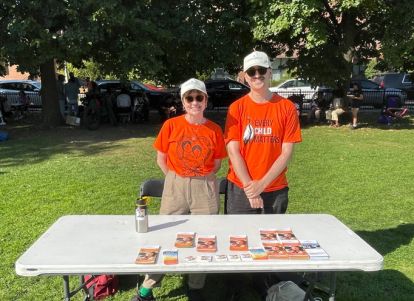
We received 222 complaints and inquiries about Indigenous Child and Family Well-Being Agencies in 2025-2026. We received at least one call about each agency across the province. In cases where someone reaches out to us about an agency that is within the jurisdiction of an Indigenous governing body – and therefore outside of our jurisdiction – we do our best to connect them directly with someone in the community who can assist with their concern.
Some examples:
- A First Nations student living at a demonstration school for students with severe learning disabilities asked us for help with obtaining his Indian Act status card. We connected him with a counsellor at an Indigenous Friendship Centre who had previously helped him.
- A First Nations youth who had spent a month in custody at a youth justice centre told us she would not be released until her Indigenous Child and Family Well-Being Agency found a placement for her. After we reached out, the agency identified three options and met with the youth and her lawyer the next day.
Our Indigenous Circle Team attends Pow Wows and community events throughout the year and monitors cultural, political and legal developments respecting First Nations, Inuit, and Métis children and families in Ontario. As part of our efforts to keep ourselves informed, we attend conferences such as that of the Association of Native Child and Family Service Agencies of Ontario (ANCFSAO), Our Children Our Way and Loving Justice. We have also committed to working with the Chiefs of Ontario and ANCFSAO to develop materials for First Nations children about their rights.
Death and Serious Bodily Harm (DSBH) reports
Children’s aid societies and residential licensees must report to us whenever they become aware of an incident of death or serious bodily harm involving a child or youth who has received services within the past 12 months. “Serious bodily harm” includes any injury that requires treatment beyond first aid, sexual assault, and any injury from use of a physical restraint.
In 2025-2026, we received 1,621 DSBH reports about 1,364 incidents. These included 115 deaths and 1,254 cases of serious bodily harm.
We review this data to identify individual cases that require follow-up, to analyze trends, and to inform our reviews of systemic issues. Death investigations can only be conducted by the Office of the Chief Coroner, but once they are completed, we can look into any concerns about the services the child received.
We follow up on every report of injury due to physical restraints by reaching out directly to the young person. There were 66 such reports in 2025-2026, compared to 40 the previous year.
Youth justice centres
Youth justice centres are where young people are held if they are awaiting trial or serving sentences under the Youth Criminal Justice Act. Our Youth Justice team visits centres regularly to meet with them in person, in addition to responding to complaints from them, their families, and other concerned parties.
In 2025-2026, we went to Sprucedale Youth Centre, William E. Hay Centre (twice), Peninsula Youth Centre, and Arrell Youth Centre. There are 25 centres in the province, and our goal over the next year is to meet with young people at a different one each month.
The types of complaints we heard during these visits included:
- Use of excessive force and injuries sustained as the result of physical restraints
- Barriers to accessing our Office
- Strip searches
- Poor living conditions
- Lack of access to basic needs (e.g., culturally appropriate hair products)
- Lack of programming
- Cancellation of family visits due to staffing shortages
- Poor access to mental health supports
We work to address these issues by flagging them to the facility, escalating issues to Ministry Regional Offices or the Assistant Deputy Minister, or repeat visits to monitor follow up and resolution. For instance:
- When we raised a youth’s complaint that staff at their youth centre would not let them contact our Office privately – which youth have a legislated right to do – Ministry officials directed all youth centre supervisors to clearly outline this right to all residents when they arrive.
Some examples of cases we resolved:
- We helped a Muslim youth raise concerns about being disparaged as ungrateful for not wanting to eat non-halal food at his open custody facility.
- We helped a youth in secure custody get a transfer to be closer to family after their requests went unheard.
We also heard positive feedback from youth across the youth justice system about the trades and apprenticeship program at Sprucedale Youth Centre and a desire for programs to be implemented in a similar way in other youth justice facilities.
Good to know
More stories about the results we’ve achieved for children and youth can be found in the Education and Social Services chapters of this report.
Strip searches
In last year’s Annual Report, we identified concerns from youth about strip searches. On July 1, 2025, new rules came into effect for staff conducting strip searches, including that a young person should never be completely undressed or touched by staff unless they request physical support. Facilities must also document strip searches and report them monthly to a provincial director.
Despite these changes, we continue to receive complaints from youth in custody who were stripped fully naked, sometimes for extensive periods, in the presence of staff of the opposite sex or in humiliating positions.
Earlier this year, the Ministry introduced the use of x-ray body scanners as a pilot program at several youth justice facilities which, when fully operationalized, they believe will greatly reduce the number of strip searches performed. We continue to follow up with the Ministry to ensure that the new regulations are being followed in all facilities and by meeting with young people in person at custodial facilities to hear directly about their experiences.
Investigations
Child welfare agencies placing youth in unlicensed settings
Launched: September 2024
Investigation update: This ongoing investigation is focused on the practice of child welfare agencies placing children and teens – many who have complex special needs – in hotels, motels, offices and trailers.
The investigation continues and the investigative team has conducted 140 interviews with young people, parents, key stakeholders, police services, staff and leadership from several children’s aid societies across the province, as well as representatives from the Ministry of Children, Community and Social Services and the Ministry of Health. The Ombudsman’s report is expected to be released later this year.
Services provided to missing and at-risk Indigenous girl
Report: Missing in Inaction: Misty’s Story, released April 2023
Investigation update: The Ombudsman made 58 recommendations in this case, which focused on how the foster agency caring for 13-year-old “Misty” lost track of her seven times while she was placed with an agency in Southwestern Ontario, far from her northern First Nation. She suffered serious harm, including assaults and drug overdoses.
The foster care agency, Johnson Children’s Services, fulfilled the Ombudsman’s recommendation that it repay $44,000 to Misty’s Indigenous Child and Family Well-Being Agency (Anishinaabe Abinoojii Family Services) for services she did not receive. Johnson Children’s Services is no longer licensed to provide children’s out-of-home care in Ontario.
Anishinaabe Abinoojii Family Services implemented all 23 recommendations made to it by the Ombudsman, including the development of a checklist that will be used to help staff monitor special rate agreements and the provision of 1:1 services.
The Ministry has also amended legislation and regulations in light of this case that apply provincewide, setting expectations for information sharing between agencies in similar cases and establishing a mechanism that allows the Ministry to order licensees to reimburse agencies for services that aren’t delivered.
Services provided under a Voluntary Youth Services Agreement
Report: Rights Unrecognized: Mia’s Story, released April 2024
Investigation update: “Mia” was a 16-year-old who asked York Region Children’s Aid Society (York CAS) to place her in foster care in late 2020 before she died suddenly. She was never offered the “full range of services” the Child, Youth and Family Services Act provides for 16- and 17-year-olds – in particular, a Voluntary Youth Services Agreement (VYSA).
York CAS accepted and has now fulfilled all 20 of the Ombudsman’s recommendations and made significant changes to its policies and procedures with regard to training and services for older teens. For example, it introduced youth-driven conferences as part of its strategy to prepare young people for transition to adulthood and ensure their voices are central to decision-making. It also developed training for frontline staff based on this report.
This case has also been used by the Ministry of Children, Community and Social Services and the Ontario Association of Children’s Aid Societies to develop guidance and training on VYSAs across the province.
Case summaries
Concerns connected
A 9-year-old boy living in a foster home sought our help because he wanted access to his file. He told us his social worker was not responding to his emails and phone calls. He had been living with the same foster family for four years and was hoping to be adopted by them. With the child’s consent, we contacted the worker directly to raise these concerns.
Result: The worker met with the boy, provided the file, and offered him further support if needed. The worker also confirmed that the foster parents were developing a plan to adopt him. When we followed up, the boy told us he was relieved that his concerns had been heard.
Inspection correction
A youth living at a foster home contacted us about serious problems that she and other residents had about their foster parent. They complained that the foster parent made disparaging comments about them, didn’t treat everyone equally, restricted their access to food, and provided allowances inconsistently. She told us they had raised these concerns with their workers, with mixed success.
Result: We raised this case with the responsible children’s aid society and the Ministry of Children, Community and Social Services. The Ministry conducted an unannounced inspection of the home and identified areas of non-compliance with its rules. Ultimately, the Ministry placed conditions on the operator’s licence and increased the frequency of unannounced inspections and visits. When we followed up with the affected youth, they told us their situation had improved since the inspection of the home.
Ready and set
A young man who had been in the care of an Indigenous Child and Family Well-Being Agency until he turned 15 sought our help in arranging a Voluntary Youth Services Agreement (VYSA). He said he had been placed in several foster homes before the agency returned him to his mother’s custody, which did not work out. He had since been unhoused, lived for a time in youth shelters, and was also involved with the youth justice system.
He told us his request for a VYSA was denied by the agency because his mother would not co-operate with them.
Result: After we raised this case with the agency, the youth was granted a VYSA, allowing him to receive continued care and support through the Ready, Set, Go program after he turned 18.
Assault uncovered
A father complained to us that his son was assaulted while in custody at a youth justice centre. He told us he only learned of the assault when the youth appeared at a bail hearing with a black eye. When we met with the youth at the facility, he told us he was assaulted by other residents, but facility staff denied him the right to speak to his father and his lawyer after the assault occurred.
Result: We followed up with the facility and requested an investigation. Once it was completed, we reviewed video of the incident, and the investigation report, which concluded that staff at the centre should have been more proactive in de-escalating tension between the residents. The centre also acknowledged that the father should have been notified, but it had failed to obtain that contact information when the youth was admitted.
Money and Property
Overview and trends in cases
This topic area includes provincial ministries, agencies and corporations that handle financial and property-related matters. These include the Ministry of Finance, the Treasury Board Secretariat, the Municipal Property Assessment Corporation (MPAC), the Liquor Control Board of Ontario (LCBO), the Ontario Lottery and Gaming Corporation (OLG), and the Ontario Cannabis Store (OCS).
Also included are some bodies that fall under the Ministry of the Attorney General, such as the Alcohol and Gaming Commission of Ontario (AGCO), the Landlord and Tenant Board (LTB) and the Office of the Public Guardian and Trustee (OPGT), which handles money and property matters for people who are incapable of doing so themselves.
Complaints and inquiries about the LTB, which is part of Tribunals Ontario, have steadily declined since our investigation of systemic delays, completed in 2023. In 2025-2026, we received 779 cases about the LTB, compared to 971 the year before, and continuing a downward trend from 2022-2023’s peak of 1,894. Still, we continued to hear concerns about delays in hearing dates and orders, and resolved individual cases while still monitoring the board’s progress in implementing the recommendations in our 2023 report. (See more under Investigations.)
Cases for other organizations in this category remained relatively low, consistent with recent years: We received 18 about the LCBO, 5 about the OCS, 26 about MPAC, and 50 about the OLG.
Ontario First Nations HST rebates
We continue to hear about persistent delays in reimbursements under the Ministry of Finance’s Ontario First Nations HST rebate program – an issue we highlighted in our past two Annual Reports. This program allows eligible First Nations individuals, bands and band councils to claim a rebate of the provincial portion of the HST (8%) paid on qualifying purchases made off-reserve. We received 6 complaints about the program in 2025-2026.
The Ministry has acknowledged that it is not meeting its eight-week public service standard for processing these claims, citing an increasing number of claims, staffing challenges and manual processes. While the Ministry continues to consider and implement measures to address the delays, more recent application processing times have grown to about nine months.
We are actively monitoring the Ministry’s efforts to address delays and reduce the backlog and working with staff to resolve individual cases. For example:
- An Indigenous man was told the receipts he provided for reimbursement under the Ontario First Nations HST rebate program were too old to be eligible. After we raised this case with Ministry officials, they discovered it was a staff mistake – and quickly issued the reimbursement.
Alcohol and Gaming Commission of Ontario and iGaming Ontario
Regulated online gambling, or “igaming,” became available throughout Ontario in 2022 after the province established a new agency, iGaming Ontario (iGO), to manage online gaming contracts with gaming companies. To be approved to participate, gaming companies must successfully register with the Alcohol and Gaming Commission of Ontario. iGO was a subsidiary of the AGCO until May 2025, when it became an independent agency reporting to the Ministry of Tourism, Culture and Gaming.
In 2025-2026, we received 16 cases about iGO and 34 about the AGCO related to online gaming. Players reached out to us after first going through the iGO complaint processes and providing the AGCO with information about their concerns. They cited poor communication, unclear decision-making and confusion about the outcome of their complaints. Our review of these cases is ongoing as we are assessing potential systemic issues.
Office of the Public Guardian and Trustee (OPGT)
We received 228 cases about the OPGT this past year, up from 195 in 2024-2025. Complaints came from OPGT clients and their family members or designated decision-makers, who encountered problems with delayed funds, communication, or OPGT decisions.
Some examples:
- The sister of an OPGT client complained to us that the OPGT would not release his apartment to his landlord during a period while he was in hospital and waiting to be moved to a long-term care home, meaning he owed nine months of rent for a place he did not live in. We raised the matter with OPGT staff, who worked with the landlord to settle the rent payments.
- After a man complained the OPGT wasn’t responding to concerns about his neighbour – for whom he had power of attorney – we confirmed with them that the power of attorney was still valid and the man could resume control of his neighbour’s finances.
- We made sure a man with no phone or email address could reach his OPGT support worker.
- Thanks to our intervention, a woman received her weekly grocery allowance through the OPGT after it was delayed due to a system error.
“I very much appreciate the collaboration between our Offices, and I trust that this productive relationship will continue for the benefit of the clients we serve.”
— Letter to Ombudsman from the Public Guardian and Trustee
Discoveries of Indigenous ancestral remains
This past year, we heard from two property owners in different areas of the province who were required to pay for archaeological excavations on their properties following the discovery of ancestral human remains, believed to be of Indigenous persons.
In one of these cases, we identified inconsistencies in the direction from the Ministry of Public and Business Service Delivery and Procurement for identifying and cataloguing burial sites, which we noted contributed to a delay in moving forward with an archeological excavation. In light of our inquiries, the Ministry has agreed to develop resource materials about burial sites for property owners. We also shared information with the property owners about how to apply for financial assistance with the excavation costs.
This is an ongoing area of concern that impacts Indigenous communities as well as individual property owners. We will continue to actively monitor the complaints that we receive and the Ministry’s role in communicating with those involved in the excavation process.
Investigations
Delays at the Landlord and Tenant Board
Report: Administrative Justice Delayed, Fairness Denied, released May 2023
Investigation update: All 61 of the Ombudsman’s recommendations in this investigation were accepted by the Ministry of the Attorney General, Tribunals Ontario and the Landlord and Tenant Board (LTB). They report to our Office regularly on their progress in implementing these recommendations, including several initiatives to reduce delays and backlogs, and legislative change.
“I greatly appreciate everything you’ve done.”
Legislative amendments passed in 2025 now allow the reassignment of cases where there are significant delays. Other changes expected to come into force later this year are expected to strengthen tenant protections, clarify landlord obligations, and standardize LTB processes.
The LTB has also expanded mediation services, improved technical support for hearing participants, and aligned French and English application timelines. As of May 1, 2026, it had a full complement of adjudicators.
The volume of cases we received about the LTB continued to decline – there were 779 this past year, down from 971 in 2024-2025. We continue to monitor its progress in reducing delays and improving service.
Individual cases: Some examples of how we helped resolve individual cases about the LTB:
- We followed up with the LTB to verify that it issued two orders after a landlord told us he had been waiting more than six months for them.
- After we stepped in, the LTB identified an administrative error that had resulted in a tenant missing her hearing – and the tenant was able to request a review of the order issued in her absence.
- We helped a paralegal get a refund after he was double-charged for filing fees.
- We made sure a tenant’s accommodation request for an upcoming hearing was reviewed and he received a response from the LTB.
Case summaries
Refund recovered
A new homeowner complained to us after applying for the province’s Land Transfer Tax Refund for First-Time Homebuyers. He told us he had heard nothing from the Ministry of Finance for six months, and his legal representative’s requests for a status update received no response.
Result: After we made inquiries with the Ministry, the buyer was issued a $4,000 refund.
Blanked out
A single mother asked us for help when she was stunned to learn that she was being evicted from her rental property. She told us she had received a “notice of hearing” from the Landlord and Tenant Board, but it was blank – no information about the time, date or location for any hearing was included, nor was she given any opportunity to contest the order.
Result: After we made inquiries, the Landlord and Tenant Board put the eviction on hold, acknowledging that a glitch in their system resulted in the tenant receiving a blank notice. This reprieve allowed her to remain in her home and gave her a fair chance to participate in the hearing.
Tax facts
A real estate lawyer contacted us on behalf of clients who were seeking a land transfer tax exemption from the Ministry of Finance. They had just sold their home to Metrolinx in lieu of having it expropriated for a subway extension, and were in the process of closing their purchase of a new one. We were told the Ministry denied the request to exempt them from the transfer tax on the new home because they had not closed the purchase yet.
Result: As a result of our review, the Ministry acknowledged its error and approved the request for a land transfer tax exemption. The Ministry committed to delivering staff training to ensure accurate information is provided to other buyers in similar situations, and updating its website to provide clearer details about processes and timelines.
Demolition deadline
A lawyer representing a landlord sought our help with a stalled Landlord and Tenant Board (LTB) case. The landlord had been ordered by his municipality to demolish a rental property that was unsafe to live in, and had obtained the necessary permits. The landlord was given an expedited hearing to evict the home’s tenant, but had waited months for the LTB to issue an eviction order. The landlord was told if the house wasn’t demolished by the expiry date on the permit, the municipality would do it, at an additional cost to the landlord.
Result: After we flagged the case to staff at the LTB, the eviction order was issued. The lawyer thanked us for helping to resolve the matter quickly.
“It took me phoning you to get somewhere and whatever you did, it worked.”
Transportation
Overview and trends in cases
In 2025-2026, we received 867 cases about the Ministry of Transportation and its programs. This was a significant increase from the previous year’s case total of 528. Cases in this area relate to agencies and programs that deal with driving and driver licensing, vehicles and highways, and public transit, including GO and Metrolinx.
The most common complaints were about customer service issues, medical review of licences, exchanges of foreign licenses, and suspensions, fines and fees. We noted an increase in many of these areas, along with a substantial rise in cases related to DriveTest (316, compared to 146 last year). These were mostly about customer service, failed road tests, and the conduct of examiners.
Licences for drivers from outside Canada
We frequently receive complaints from drivers from outside Canada who are denied Ontario licences or are treated as new drivers because their international driving experience is not recognized. We help by connecting them with relevant officials to ensure they receive credit for their driving experience, sharing information, and escalating complaint trends to the Ministry.
For example:
- We helped a driver who was licensed internationally and in Quebec to get a full licence, after first only being given a G2.
- After we stepped in, a woman with extensive driving experience in India was able to register directly for a G test instead of having to go through the G2 testing process.
- A newcomer to Ontario was told he would have to pay the insurance premium for new drivers, until we intervened and his 20-year international driving record was recognized.
International Registration Plan applications
The International Registration Plan is an agreement between certain Canadian provinces and U.S. states that allows commercial vehicles to travel between them with one licence plate and a single registration document.
In 2025-2026, we received 6 cases about delays in processing applications to this plan – most of them after it was moved from the Ministry of Transportation to ServiceOntario (part of the Ministry of Public and Business Service Delivery and Procurement) in March 2025. Drivers complained to us that it took weeks for their applications to be processed, meaning they couldn’t travel between jurisdictions, which cost some of them thousands of dollars in revenue.
We flagged individual applications to be expedited, while the Ministry of Transportation completed an internal review of its transition process. We continue to monitor how it implements initiatives to improve transition planning in future.
Local roads boards
In areas of the province not covered by municipal governments, landowners can ask the province to create “local roads boards,” which can create plans to make sure road maintenance work is done. The Ministry of Transportation provides funding and operational support to these boards.
We received complaints from 9 local roads boards in 2025-2026 about the Ministry’s sudden decision to change the support it provides, including reduced staff support to assist with monitoring winter road conditions. They raised concerns about whether they would be able to complete planned maintenance work and what support they could expect in future to assist in addressing potential road safety situations, like road washouts and resurfacing. We reached out to the Ministry about how it plans to address these concerns.
“Thank you so much. You resolved in one day what took me 8 months of calling to try to resolve. It’s such a helpful service.”
Rat infestations in Ontario Line construction areas
In mid-2025, the media reported on a variety of concerns from Toronto residents about construction of the new Ontario Line, a 15.6-kilometre subway line in Toronto, including issues with rats – displaced by the massive excavations – burrowing into homes.
On our own initiative, we began looking into these concerns and raised them with Metrolinx to ensure it had a clear and consistent process for managing such complaints, including reimbursement for pest control services. Metrolinx confirmed it was developing a pest management strategy specific to Ontario Line sites in conjunction with the City of Toronto. We continue to monitor Metrolinx’s efforts to develop and implement this strategy, including how affected residents can report concerns and how pest-related issues will be responded to and managed.
Case summaries
A bid for fairness
We received a complaint after the Ministry of Transportation cancelled a procurement process for a tool for transportation planning. The Ministry didn’t provide an explanation to bidders – only an automated notice of the cancellation. The bidder who complained cited their frustration after spending “thousands” of hours developing a proposal.
Result: After we raised the matter with Ministry staff, they provided bidders with a clear written explanation for the cancellation. The Ministry also agreed to look at implementing a standardized explanation process for cancelled procurements, to ensure fairness and transparency in the bidding process.
Mistaken ID
A man sought our help in finding out why his driver’s licence was suspended. He had been told his Ontario licence was invalid because he had a licence in another province. However, he had never even visited, much less had a driver’s licence in, that province.
Result: We raised the case with Ministry of Transportation officials. Thanks to our intervention, they confirmed the suspension was a mistake and quickly reinstated the man’s Ontario licence.
Back on board
A school bus driver who had to undergo certain medical tests in order to keep his driver’s licence and continue working had applied for a time extension to complete the tests. He came to us for help when his licence was downgraded, despite the extension.
Result: When we made inquiries, we discovered the Ministry of Transportation had received confusing results from the bus driver’s physician. Ministry staff reviewed the file and determined the medical information provided was sufficient for the man’s licence to be reinstated – and he was able to return to work.
Licence lament
A driver from another province who identifies as non-binary contacted us after having difficulty changing their licence to an Ontario one. Their licence from the other province carried the non-binary gender marker “X” – an option that is also available for Ontario drivers.
However, they were told that in order to obtain the equivalent licence in Ontario, they would have to go to a DriveTest location and first declare a binary gender (that they did not identify with) to generate an Ontario licence number. Only once this had been completed could they then have the binary gender changed to X.
Result: We raised concerns with the Ministry of Transportation about the lack of fairness and inclusivity in this process. Ministry staff confirmed they were aware of the limitations of the licensing system, and that they are working on updating it so people will no longer be required to declare a binary gender to set up an Ontario driver’s licence number. We continue to follow up with Ministry staff on the status of these changes.
“I truly believe that your follow-up and your communication… helped resolve this issue more quickly and effectively.”
Employment
Overview and trends in cases
The Ombudsman oversees the Ministry of Labour, Immigration, Training and Skills Development and its programs, agencies and tribunals. This includes the Workplace Safety and Insurance Board (WSIB) and its internal ombudsman, the Fair Practices Commission (FPC), as well as Skilled Trades Ontario, the Ontario Immigrant Nominee Program, the Ontario Labour Relations Board and Better Jobs Ontario.
Complaints and inquiries in this area rose significantly in the past year. We received 1,029 cases about the Ministry and its programs in 2025-2026 – more than double the previous year’s 470. Cases about the WSIB accounted for a large portion of these, largely due to temporary changes in the board’s online adjudication process. Cases about Skilled Trades Ontario and the Ontario Immigrant Nominee Program also increased steeply.
Workplace Safety and Insurance Board (WSIB)
Cases about the WSIB usually relate to communication issues, delays, or disputes about compensation decisions. We often refer complaints to the WSIB’s Fair Practices Commission, or to the Office of the Worker Adviser. We also facilitate communication and make inquiries with the WSIB where appropriate.
We received 450 cases about the WSIB in 2025-2026, a significant jump from 213 the previous year. More than 200 were linked to temporary changes in the WSIB’s eAdjudication process for approving certain claims, which prompted concerns about how claim approval decisions might be affected. We helped people who were affected by these changes understand how to bring their cases to the Fair Practices Commission, and let them know they could return to us if their concerns weren’t resolved.
Ontario Immigrant Nominee Program (OINP)
The OINP assesses candidates for permanent residence in Ontario based on their skills and experience, although ultimately the federal government sets how many nominations the OINP can make in a year, as well as makes final decisions to approve permanent residence. Applications can be made under several program streams, each designed to address specific labour market needs.
We saw a sharp increase in cases about the OINP in the past year – we received 211, almost quadruple the 57 we received in 2024-2025.
In November 2025, the OINP suspended its Express Entry Skilled Trades Stream after identifying potential fraud related to the eligibility requirements of this program stream. It returned nearly all pending applications, effectively cancelling hundreds of them, and applicants – many who had been waiting years for a decision – had no way to appeal. Some 64 of the complaints we received were from people who were concerned this situation might prevent them from remaining in Canada. We continue to monitor this issue and follow up directly with the Ministry on the return of applications, ongoing delays, and individual cases.
Skilled Trades Ontario (STO)
Cases about STO ballooned to 135 in 2025-2026 from just 18 the previous year. Of those, 55 were related to STO taking over apprenticeship testing in April 2025. People told us about numerous difficulties with communicating with STO staff, registering for and taking exams, and processing of their apprenticeship hours. Several people complained about the sharp reduction in the number of testing locations, from 24 to 4, particularly in Northern Ontario.
We escalated these concerns to senior STO staff, and are monitoring its efforts to improve the situation, including restoring the number of testing locations across the province to 23, and hiring more staff to reduce response times.
We also continue to resolve individual cases, for example:
- A man who couldn’t complete his certifying exam due to technical issues was told he would be given a credit for the exam fee and priority access to reschedule, but he didn’t receive either. We spoke directly to STO staff, who worked with him to rebook his exam and provide the credit.
- A would-be automotive technician sought our help after waiting several months for his application to Skilled Trades Ontario to be approved. After we spoke with STO staff, they confirmed his application was ready to be processed, expedited it, and contacted the man to answer his questions.
Employment Practices Branch
We received 5 complaints about long delays in the Ministry’s assignment of Employment Standards Act claims – in some cases, it took nearly a year for claims to be assigned to an Employment Standards Officer for investigation and decision. We are monitoring the Ministry’s efforts to address these delays, communicate with claimants about wait times, and prevent future backlogs.
Case summaries
Please advise
A woman who was permanently injured in a workplace incident wanted to dispute certain aspects of the WSIB’s decision relating to her health care costs. She told us her appeal was not filed by the Office of the Worker Adviser (OWA), and she was unable to receive information or updates about her case.
Result: We connected with staff at the OWA, who in turn confirmed that the woman’s appeal was received by the WSIB. They also spoke directly with the WSIB regarding a potential technical issue that might have prevented the woman’s materials from being received, to ensure other applicants would not face the same problem. The OWA also apologized to the woman and assigned her a new adviser. The woman thanked us for our help in listening to and resolving her concerns.
Stuck in the system
A woman contacted us because she wasn’t able to change the name of the company she worked for within the Ontario Immigrant Nominee Program (OINP) application system. She had provided all the necessary information in November 2025, but the name still hadn’t been changed in the system two months later, and her attempts to contact OINP went unanswered.
Result: We contacted OINP staff, who agreed to review the woman’s file to figure out what had happened. Within two weeks, they confirmed the company name had been updated and the issue resolved. The woman thanked us for our help.
Email short circuit
An electrician with international work experience contacted us in frustration after receiving multiple requests from Skilled Trades Ontario (STO) to submit the same documents for a trade equivalency assessment. He said he escalated his concerns to a supervisor, who told him a different form was missing – but after he provided the form, he received yet another email saying the document was still missing.
Result: After we raised this case with STO staff, they reached out to the man to explain precisely what he needed to submit. He provided the information and was finally able to complete his application, which was processed for review. The STO also agreed to work with staff to improve their communication with applicants.
Health
Overview and trends in cases
This topic area includes the Ministry of Health, the Ministry of Long-Term Care, the Ontario Health Insurance Plan (OHIP) and various programs, including those responsible for long-term care inspections and funding of drugs and medical devices, all of which are within the Ombudsman’s jurisdiction.
However, we aren’t able to intervene directly in cases about hospitals, long-term care homes, and home and community care support services – we refer these to the Patient Ombudsman, which handles matters related to patient care. We received 565 cases about hospitals, 71 about long-term care homes, and 52 about Ontario Health at Home in 2025-2026. We also received 43 cases related to public health units, which are not within either our jurisdiction or that of the Patient Ombudsman.
Ontario Health Insurance Plan (OHIP)
We received 76 complaints about the Ontario Health Insurance Plan (OHIP) in the past year, consistent with 65 the previous year. Many of these were about eligibility for services and health card renewals. For example:
- A newcomer to Canada whose work permit and health insurance eligibility had been extended told us ServiceOntario staff asked him to provide a non-existent document to extend his children’s OHIP coverage. When he went to a different branch, he was able to get coverage without issue. After we raised this matter with ServiceOntario, it acknowledged the error, apologized to the man, and ensured staff were trained accordingly.
- An Ontario resident born in Nova Scotia called us because she had been denied OHIP coverage and didn’t know what to do next. Our staff helped her understand how to appeal the decision.
“The Ministry values the important role of the Ombudsman’s Office in promoting accountability and continuous improvement across public services.”
— Email from Ministry of Health in response to our best practice suggestions
Drug programs
We received 43 cases in 2025-2026 about Ontario’s drug programs, compared to 54 the previous year. These included 24 about the Trillium Drug Program and 14 about the Exceptional Access Program. Many were about delays, communication issues, or decisions about funding specific drugs. For example:
- A senior couple was denied compensation by the Trillium Drug Program because their supporting documentation was not submitted prior to the deadline. With our intervention, the deadline was extended and their receipts were processed for reimbursement.
- A man who wanted to lower his deductible contacted the Trillium Drug Program, but his request was rejected multiple times for being unreadable. We made inquiries with staff at the program, who confirmed that the reassessment had in fact been completed. The man was notified of the reassessment and his deductible was adjusted.
Investigations
Oversight of long-term care homes during COVID-19
Report: Lessons for the Long Term, released September 2023
Investigation update: The Ombudsman launched this investigation in the wake of troubling revelations about the condition of five Ontario long-term care homes during the first few months of the COVID-19 pandemic. This report included 76 recommendations to the Ministry of Long-Term Care to strengthen its inspection system and better prepare and protect residents and staff in future health crises.
The Ministry accepted all of the recommendations and reported regularly to us on its progress in implementing them. For example, it has doubled its staff of inspectors and hired more people with infection prevention and control expertise. It has also:
- Updated policies and guidance for when new public health threats emerge, to support inspectors and staff in their work
- Worked with the Chief Medical Officer of Health to establish priority for inspectors for personal protective equipment at the outset of a future pandemic
- Established formal working relationships with Ontario public health units
- Taken steps to ensure long-term care residents can access complaint mechanisms
- Made its inspection reports, which are posted online, more clear and concise
In light of this progress, the Ministry is no longer required to send us progress reports every six months, but we continue to monitor its ongoing implementation of the recommendations. We also regularly assess new complaints relating to the Ministry’s inspections of long-term care homes and, where appropriate, make inquiries with its Inspections Branch to resolve issues.
“I would like to thank you and your Office for the ongoing advice and consideration of the Ministry’s progress relating to […] Lessons for the Long Term. The Ministry has found the subsequent dialogues with your Office tremendously valuable […].
“As of December 2025, the Ministry has assessed approximately 90% of total recommendations as fully implemented. […] Your advice and partnership have been instrumental in guiding this work, and we deeply appreciate the collaborative relationship we have built with your Office.”
— Letter to Ombudsman from Deputy Minister of Long-Term Care, December 19, 2025
Oversight of complaints about ambulance services
Report: Oversight 911, released May 2021
Investigation update: Since the release of this report, the Ministry of Health’s Emergency Health Services Land/Air Branch has continued to implement the Ombudsman’s 53 recommendations to improve its oversight of complaint investigations and incidents regarding land and air ambulance services.
It has improved its information for the public on complaint handling, updated investigation procedures and training, and strengthened requirements around closing complaints. As of the writing of this report, 14 recommendations remained in progress, all related to the Ministry’s ongoing Emergency Health Oversight and Compliance Modernization initiative.
Case summaries
Power move
A man who relies on a power wheelchair to get around contacted us about the poor service he received from the vendor contracted by the province’s Assistive Devices Program to service and source parts for such devices. He complained about poor customer service from this vendor, including months-long delays in responding to his requests to meet with a seating consultant. He told us he had also reached out to the Ministry of Health but hadn’t received timely responses to his concerns.
Result: We escalated the man’s concerns to senior Ministry staff and suggested that the Ministry work with the vendor to develop service standards and timelines for responding to customer inquiries and complaints. The Ministry has since updated its website with information about its process for submitting complaints about the Assistive Devices Program and what to expect. We continue to monitor its progress in making improvements to the program.
Making an exception
A man with a rare condition that causes muscle weakness was prescribed a medication that wasn’t covered by the Ontario Drug Benefit program. He had been on the medication for 20 years and couldn’t get out of bed without it, but could no longer afford it after the manufacturer discontinued its compassionate funding program.
He told us his application to the Exceptional Access Program (EAP) was denied because he was required to try a different medication first. However, he said that medication was not available in Canada.
Result: We escalated the man’s case to EAP staff, who assessed the file and agreed to provide funding for his existing longtime medication through the program’s compassionate review policy.
Deductive reasoning
A young man with special needs had his drug costs covered by the Trillium Drug Program, as a member of his parents’ household. However, the program required his parents to pay a high deductible cost due to their combined incomes that they struggled to afford. The family contacted us for help after the man’s request to have his file considered as that of a single-member household as he had his own separate income – thereby reducing the deductible – was denied.
Result: We reached out directly to staff at the Trillium Drug Program, who reviewed the request and determined it should have been approved. They made the change, accepting the man as a single-member household, and his parents’ deductible was lowered.
Certificates and Permits
Overview and trends in cases
Every year, we help Ontarians with problems they encounter in accessing or changing important documents like birth certificates, marriage certificates, death certificates, and other government-issued identification or paperwork.
Most of the complaints and inquiries we receive on this topic involve ServiceOntario, which provides frontline service related to all types of identity documents, and the Office of the Registrar General, which issues birth, marriage, and death certificates.
In 2025-2026, we received 407 cases about ServiceOntario, a significant increase from the previous year’s 218. Cases related to the Registrar General increased even more steeply, largely due to delays that people experienced in receiving important documents – we received 257 cases, more than triple the 85 we received in 2024-2025.
Document delays
A majority of the complaints we received about the Registrar General involved delays. People told us the wait for important documents affected their access to services like health care, passport renewals, and tax filings. In cases like these, we help by looking into the source of the delay and connecting people with relevant officials who can answer their questions or obtain any missing information that might be holding up the process.
We are monitoring this situation closely and following up with senior officials at the Registrar General to determine causes for the high volume of cases and what steps can be taken to address growing delays. In the meantime, we resolved many individual cases. For example:
- We helped a widow get her husband’s death certificate expedited in time for her to meet a deadline to file their business taxes.
- We helped a man with serious health issues who had been forced to pay for health care because of issues with his birth certificate. Once we intervened, he received the certificate, allowing him to apply for his health card.
- We helped a father who needed a birth registration and certificate for his baby to get a passport. After we flagged his stalled application to the Registrar General’s office, it was processed quickly, and he received a reference number for a temporary passport for the baby in the meantime.
“This would not have happened if I didn’t call you. I wanted to thank you for that.”
Confusion about application processes and requirements
Many of the complaints we received this year were from people who had difficulty understanding the process to obtain or update specific documents. We were often able to help clarify processes or make inquiries to help identify missing information.
Some examples:
- We helped two people now living in New Brunswick get their Ontario birth certificates. In one case, the certificate had been sent to the wrong address, and in the other, the applicant hadn’t provided all the necessary information.
- A woman needed an expedited birth registration for her baby so they could travel outside of Canada together. We helped clarify the information she had to send to the Registrar General, and the registration was printed the same day.
- After a children’s aid society spent a year unsuccessfully trying to register the birth of an abandoned newborn, we facilitated communication between the Registrar General and the CAS so they could finalize the documents and the registration.
Access to services for Indigenous communities
As noted in our past two Annual Reports, we have heard from a number of Indigenous communities about systemic barriers that their residents face in obtaining documents like birth registrations and certificates. These documents are generally required to access government services and programs.
Over the past year, we have worked with senior staff in several branches of the Ministry of Public and Business Service Delivery and Procurement to explore solutions. We continue to monitor the issue and follow up with senior Ministry staff and the political territorial organizations representing affected Indigenous communities.
Name changes and gender markers
We regularly hear from people who run into problems when they try to change their names and gender markers on official documents. Some recent examples:
A transgender woman told us the Registrar General’s delays in processing her name change application prevented her from updating her social insurance number and registering for college with her preferred name. Shortly after we confirmed with Registrar General staff that her application was being processed, she received her name change certificate.
A person seeking to change the sex designation on their birth certificate sought our help because the process was taking a long time without explanation. After we stepped in, Registrar General staff expedited the file and provided the complainant with a status update.
Case summaries
Fill in the blanks
A mother of three children experienced delays when she applied to change her surname and theirs. Our inquiries with the Registrar General determined that the delay stemmed from the fact that she had not confirmed she had sole custody. However, we also noted that nothing on the application stated that this information was mandatory.
Result: After our intervention, Registrar General staff reached out to the woman directly to explain what information was missing, and allowed her to re-send her documents digitally to avoid further delays. We continue to follow up with the Registrar General’s office to ensure that application requirements are clearly communicated.
Twin trouble
New parents of twins sought our help after they submitted applications to register the births of both children, but inexplicably only received one registration.
Result: We contacted Registrar General staff, who told us they often conduct a manual review of the files in twin applications to ensure there is no accidental duplication. This can result in a delay in registering both births. Thanks to our inquiry, this issue was escalated at the Registrar General’s office, and we let the parents know they would soon receive the registration for the other twin.
In loco parentis
A man with serious health issues contacted us after he was unable to obtain a new birth certificate, which he needed to receive health coverage in another province. Registrar General staff informed him that there was an issue with his original birth registration. He told us they requested the signatures of his parents, which he could not provide because they are deceased.
Result: We spoke with Registrar General staff, who contacted the man to provide him with a list of forms to fill out to confirm his identity and receive his new birth certificate.
Last name at last
A woman whose husband changed his last name wanted to change hers to match. She told us ServiceOntario wouldn’t accept her marriage certificate – from another province – for this process because it still had the old last name.
Result: After we intervened, ServiceOntario staff connected with the ministries of Health and Transportation to review the woman’s situation. They ultimately issued her new identity documents with the new surname and arranged an in-person meeting for her at a ServiceOntario location to complete the paperwork.
Good to know
Cases related to driver’s licences can be found in the Transportation chapter of this report.
Cases related to health cards can be found in the Health chapter.
An update on the French Language Services Commissioner’s investigation into service in French at ServiceOntario locations can be found in the French language services chapter.
French language services
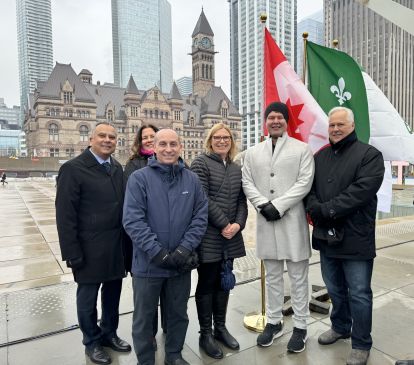
Overview and trends in cases
It has been almost 40 years since the French Language Services Act (FLSA) was first introduced to protect the rights of French-speaking Ontarians. Today, the law entitles all French speakers in the province to an “active offer” of service in French when they seek provincial services. Our Office is now in its eighth year of overseeing compliance with the Act to ensure these rights are respected.
Under the leadership of French Language Services Commissioner Carl Bouchard, our French Language Services Unit does this by reviewing and resolving complaints and inquiries, investigating systemic issues, and engaging in outreach activities with a wide range of French speakers across the province. Their work is supported by our entire Office, which has always served Ontarians in both French and English.
Over the past seven years, we have handled 2,303 cases and launched three investigations regarding French language services. The Commissioner has published six annual reports (separate from the Ombudsman’s Annual Report). During the fiscal year covered by this report (April 1, 2025 to March 31, 2026), we received 266 cases.
As in previous years, the most common cases were about access to in-person services in French – for example, frontline service at ServiceOntario, the subject of one of our investigations. People also brought complaints and inquiries to us about communications that did not have content in French that was equivalent to that in English, and about a lack of equivalent French content on government websites, and provincial signage in English only.
“Mr. Bouchard, please allow me to express to you and your team my sincerest thanks for your unwavering commitment to promoting and defending the linguistic rights of Francophones in our province. […] Your Office embodies the essential support that allows the Franco-Ontarian flag to fly proudly.” [Translation]
— Lieutenant Governor Edith Dumont, speaking at Ombudsman Ontario 50th anniversary event, October 29, 2025
Our services for Francophones
It’s important to note that we can and do help Francophones with a wide range of other issues related to public services, in addition to those subject to the French Language Services Act. French-speaking staff throughout our Office specialize in all areas of our jurisdiction. In 2025-2026, we served some 460 people in French, helping them resolve issues that were not related to French language services, but other issues involving provincial agencies, municipalities, school boards, universities and children’s aid societies.
Overall, about 71% of those were about organizations within our authority and about 29% were outside our authority (such as federal government agencies or private businesses). More than half of the cases within our authority (54%) related to Ontario government bodies. We also received 86 cases about French-language school boards, and handled more than 80 cases about municipalities in French.
Outreach and engagement
Meeting with Francophones across the province and engaging in activities to promote and celebrate Ontario’s Francophonie is an important part of the Commissioner’s role. These activities, which we list in the Commissioner’s Annual Reports, allow us to hear directly from Francophones about their needs and concerns.
In 2025-2026, the Commissioner and team were present at more than 20 public events, where our involvement included giving presentations and speeches and sharing materials at information booths. The Commissioner also had some 60 meetings with Franco‑Ontarian organizations and made numerous media appearances.
Annual Report of the French Language Services Commissioner 2024-2025
Commissioner Bouchard published his third Annual Report in December 2025, covering the 315 cases received about French language services between October 1, 2024 and September 30, 2025 (the period covered by that report).
In his report, the Commissioner highlighted many tangible outcomes resulting directly from our interventions, such as the revised Fire Code, which came into force in January 2026 and is now available in French for the first time.
He also pointed to areas for improvement, including gaps in the required “active offer” of service in French by provincial public services, and the ongoing need for the province to update its list of designated areas (where the FLSA requires provincial services in French to be equivalent to those in English). The list has since been updated.
His report included one recommendation to ensure that French translations of government information are available, as required under the FLSA. In several cases we reviewed, agencies cited Regulation 671/92 to exempt some documents from translation requirements – resulting in what the Commissioner warned could create a risk to equitable access to information. He called on the Ministry of Francophone Affairs to develop a clear and defined framework to ensure the exemption is narrowly applied.
“We have dealt with several cases since 2019 where services were wrongly exempted from meeting these obligations, which deprived the public of information that should have been provided in French. […] Respect for language rights should not depend on cost, value for money or administrative flexibility.”
– French Language Services Commissioner Carl Bouchard, releasing his Annual Report, December 4, 2025
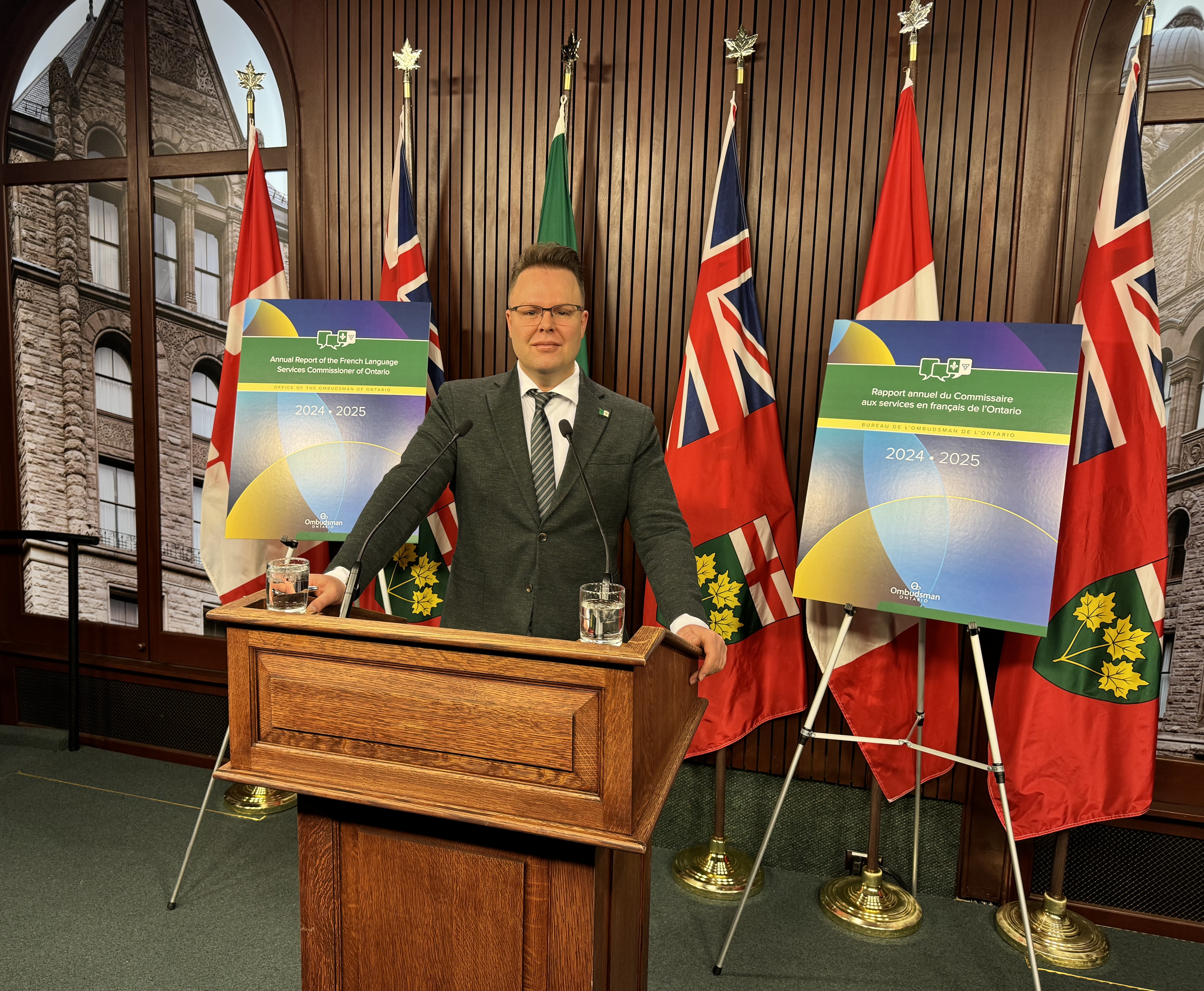
Investigations
Frontline service in French at ServiceOntario
Launched: April 2025
Investigation update: The Commissioner launched this investigation, focusing on in-person services offered in French at ServiceOntario locations, on his own initiative.
The investigation is focused on the extent to which ServiceOntario complies with the French Language Services Act (FLSA), including whether staff at locations where the FLSA requires service in French are aware of this obligation, and the quality of the service provided. For example, whether staff make an “active offer” of service in French, and are proficient enough to provide service in French that is equivalent to that provided in English.
The investigation involved interviewing numerous French-speaking members of the public who shared their experiences at ServiceOntario, as well as staff from ServiceOntario locations (both government-operated and privately owned), and the Ministry of Public and Business Service Delivery and Procurement.
At the time of writing this report, this investigation had been completed and the Commissioner’s report and recommendations were being prepared for release.
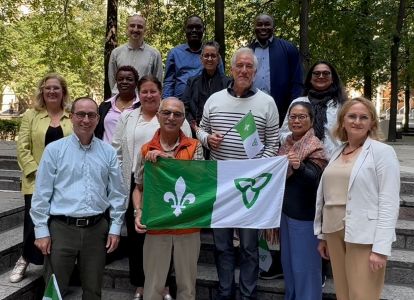
Unilingual out-of-home government advertising
Report: Missed Messages, released July 2024
Investigation update: Commissioner Bouchard made 7 recommendations in light of this investigation, which found that only three of the Ministry of Health’s 17 out-of-home advertising campaigns during the COVID-19 pandemic (between April 2020 and March 2023) contained any French content. His key recommendation was that the government use a bilingual format for all out-of-home advertising, to respect the spirit of the French Language Services Act.
The Ministry of Francophone Affairs and Cabinet Office (which is responsible for such advertising) agreed to report back to the Commissioner on its progress in addressing these recommendations. In January 2026, Cabinet Office reported that five government outdoor advertising campaigns in the past year included messages in French. It also indicated that it and the Ministry continue to assess how they might improve bilingual out-of-home advertising.
Cuts to French-language programs at Laurentian University
Report: Strengthening the Designation: A Collaborative Effort, released March 2022
Investigation update: This investigation examined the consequences of cuts made by Laurentian University to its French‑language programs after its financial restructuring in 2021. It concluded that the university, the Ministry of Francophone Affairs and what is now the Ministry of Colleges, Universities, Research Excellence and Security failed to fulfill their responsibilities under the French Language Services Act.
All three accepted our recommendations and reported back to us on their efforts to address them. The Commissioner has determined that 8 have been adequately implemented. All of those directed at Laurentian have been addressed. We continue to follow up with the two ministries on their progress and will include further details in the Commissioner’s next Annual Report.
Good to know
We publish a separate Annual Report of the French Language Services Commissioner of Ontario. The next one will cover cases received between October 1, 2025 and September 30, 2026, and will be released in December.
Case summaries
In fine form
A Francophone wanted to file a complaint with the Inspectorate of Policing. When they discovered that the agency’s downloadable complaint form was available only in English, they contacted our French Language Services Unit.
Result: We raised the issue with this organization— an independent division of the Ministry of the Solicitor General. We learned that a French version of the form did exist, but it couldn’t be downloaded because of a technical glitch, which was quickly resolved.
We also pointed out that the English version of the form did not include a notice in French indicating the existence of a French version, as required under Ontario Regulation 544/22 on active offer. As a result of our intervention, the statement “This form is available in French” was added (in French) to the bottom of the first page of the English complaint form.
Late alert
A French-speaking woman received an alert on her phone from a municipal police service regarding a murder suspect in the area. She complained to us that the alert was in English only – and a French version was not issued for another 10 minutes.
Result: We raised the issue with the Ontario Provincial Police (OPP), which manages the alert system used by municipal police services. The system is capable of issuing alerts in French and English simultaneously. However, this is enabled by a check box in the system – and in this case, it was not checked. The OPP accepted our suggestion that this box be checked by default, to ensure this type of alert is simultaneously issued in both languages across the province.
Spreading the word
Concerned about recent measles outbreaks, a French-speaking woman visited Public Health Ontario’s website for information. She noted that the organization encourages the public to contact their local public health unit for general information about measles vaccines. She contacted us after she looked at the websites for the units in areas where measles had been reported – 11 in all. She told us she could not find any information in French about measles on their websites.
Result: Our Office does not have jurisdiction over local public health units, as they do not meet the definition of a government agency under the French Language Services Act (FLSA). However, in response to our inquiries, the Office of the Chief Medical Officer of Health sent a memo to local public health units reminding them of the importance of communicating information about the measles outbreak in French, and included information on resources they could access to do so.
Energy and Environment
Overview and trends in cases
This topic area covers cases related to fuel and electricity, as well as natural resources and the environment. Although Hydro One is outside of the Ombudsman’s jurisdiction (we refer complaints to its internal ombudsman), we are able to help with issues regarding municipal hydro companies, as well as the Ministry of Energy and Mines and its programs.
We also deal with complaints and inquiries about the Ministry of the Environment, Conservation and Parks, the Ministry of Natural Resources, and municipal conservation authorities – including issues related to Indigenous hunting and fishing rights.
In 2025-2026, we received 270 cases about the provincial ministries in this sector, more than double last year’s total (106). We resolved many of these by working directly with the ministries to share best practices for fair and transparent decision-making, and suggested improvements for communicating decisions to the public.
Indigenous rights
In cases where Indigenous communities and individuals seek to have their rights respected – including concerns about consultation and exercising their hunting and fishing rights – we work with them and the relevant bodies to resolve issues and identify ways to improve policies and processes. We have also visited communities to speak directly with affected individuals.
Some case examples:
- We received complaints from Indigenous groups in Northern Ontario about how industrial development and changing endangered species legislation are negatively impacting the traditionally significant Boreal caribou, a threatened migratory species. As part of our review, in late October we visited Attawapiskat First Nation to meet with the Chief, council and community elders and land users. We then escalated these concerns to various ministries to improve the communication and consultation with the First Nation. We continue to work with the Ministry of the Environment, Conservation and Parks to better understand regulations authorizing industrial development and how compliance with endangered species regulation is monitored and enforced.
- After an Indigenous man approached us with concerns about registering for a trapline, we spoke with the Ministry of Natural Resources to confirm that people who identify as Indigenous receive priority during the trapline allocation process. We are also reviewing how industrial development is regulated in areas with registered traplines.
- An Indigenous group contacted us, unsatisfied with the Ministry of Natural Resources’ management of freshwater walleye in the White Lake area. The Ministry told us White Lake doesn’t have a fisheries management plan, but assessments are conducted every five years to monitor the state of the fisheries in the area, which are among the healthiest in the province. The Ministry held an open house in the community to explain its assessment methods and staff continue to meet with the community monthly to address concerns.
- As noted in our 2020-2021 Annual Report, we received complaints from Indigenous groups about the Ministry of the Environment, Conservation and Parks’ decision to cancel a class environmental assessment about the impacts of a local dam on native fish populations. We escalated this issue to senior officials. This past year, the Ministry of Natural Resources consulted with local Indigenous communities and finalized a management plan to improve the surrounding fish habitats.
Municipal utilities
Millions of Ontarians receive electricity, water and other services from utility companies that are majority-owned or controlled by one or several municipalities. In 2025-2026, we received 113 cases about municipal hydro – mostly about billing disputes and service disconnections.
Some examples:
- We helped a homeowner understand increases in her municipal water and sewer bill, which were the result of previous billing errors. After our intervention, municipal staff provided her with a detailed explanation and forgave the charges for two billing cycles.
- We helped a homeowner who discovered the cost of connecting his property to a municipality’s water system would be $10,000 – five times what he said the municipality told him it would be. After we raised this case with municipal staff, they agreed to use clearer language in similar situations.
- A landlord complained to us that his utility company refused to close his previous tenant’s account and open one for his new tenant. After we spoke to a supervisor at the utility company, they acknowledged this was an error, apologized for the delay and offered to write off part of the utility bill.
Land use and environmental issues
The Ministry of Natural Resources is responsible for maintenance and protection of natural resources, such as forests, lakes and wildlife. It also issues permits and authorizations for pesticides and land use. We helped resolve several complaints in this area.
For example:
- We received complaints after the Ministry modified the boundary around an Area of Natural and Scientific Interest (ANSI) near Port Hope, which allowed for commercial development. The ANSI contains “pitted outwash” – a unique landform created by sand and gravel deposited by melting glacial ice. We confirmed that Ministry staff changed the boundary after a geological review determined part of the area was no longer characteristic of outwash and did not meet the ANSI designation. The Ministry communicated the results of its review to the municipality and area residents.
We also conducted a review of the Ministry of Energy and Mines’ oversight and safety regulations for waste stored in tailings dams, in light of concerns raised in media articles. Tailings dams are structures built to store byproducts from mining operations, and a potential failure can lead to severe environmental damage. We confirmed that the Ministry conducts technical reviews before and after a tailings dam is constructed or modified. We are monitoring its development of criteria to prioritize mine sites for inspections and a template to guide inspections.
Case summaries
Conservation confusion
We received a complaint from a resident of Laurentian Valley who was concerned about erosion on her property from a nearby river. Because her municipality is not overseen by a conservation authority, there was confusion about the roles of the municipality and the Ministry of Natural Resources in managing any environmental hazards caused by the river and addressing erosion concerns.
Result: We determined that the Ministry’s role is to provide technical guidance for managing natural hazards of this sort. We pointed this out to the municipality, and it committed to inspecting the riverbank for fallen trees and signs of erosion, as well as making sure drainage pipes that allow for water overflow from the river were functioning properly. Municipal staff also invited the woman to contact them directly with concerns.
Hunting rights – and wrongs
A First Nations man contacted us after his crossbow was confiscated by a conservation officer while he was hunting in a provincial park on traditional Haudenosaunee lands. He pointed out that he had the right to hunt in the park without a permit.
Result: We confirmed he didn’t need permission to hunt in the park, and reviewed how the Ministry of Natural Resources respects established Indigenous treaty rights across Ontario’s parks and on Crown land. Our review highlighted problems with the Ministry’s processes, including that staff were lacking in cultural sensitivity and awareness.
In light of this, the Ministry amended its complaints policy with language and processes that are more appropriate and culturally sensitive to concerns arising from Indigenous communities.
Well-ness check
As noted in last year’s Annual Report, we received complaints from residents of Chatham-Kent who were concerned about the quality of their well water and were having difficulty obtaining information about it from the Ministry of Health. We were told the Ministry had not responded to requests from residents and the municipality to conduct further testing on their wells, despite a 2019 government report recommending more sampling and study of water quality.
Result: The Ministry acknowledged the lack of timely communication with residents on its part. As a result of our intervention, it provided written responses to the concerned parties to explain its analysis of the government’s report and the reasons for its decision not to perform additional tests, including that the data showed that there were no widespread health concerns. The Ministry also provided referrals to well owners containing guidance on well maintenance.
“Thank you again for your Office’s thoughtful recommendations and for the collaborative work by your staff and Ministry staff to thoroughly review and seek opportunities to address this matter.”
— Email from Ministry of Natural Resources in response to our best practice suggestions
Appendix - Statistical Charts
Disposition of cases, 2025-2026
- 35,023 cases received in fiscal 2025-2026
- 180 consultations or questions
- 2,089 information submissions
Cases closed 2025-2026
- 23,563 cases within the Ombudsman’s authority
- 44% Inquiries made or referral given
- 28% Resolved with Ombudsman intervention and/or best practices suggested
- 13% Closed after Ombudsman’s review
- 10% Discontinued by complainant
- 5% Resolved without Ombudsman intervention
- 9,618 outside the Ombudsman’s authority
- 62% Private
- 12% Provincial outside authority*
- 14% Broader public sector outside authority**
- 11% Federal
- 1% Outside Ontario
*E.g., complaints about officials and bodies outside the Ombudsman’s jurisdiction.
**E.g., complaints about hospitals, long-term care homes, public health units, municipal police.
% of cases closed in 2 weeks
- 48% closed in 1 week
- 60% closed in 2 weeks
Total cases received for provincial government ministries and selected programs, 2025-2026*
Ministries and Programs | Total Program Cases | Total Ministry Cases |
|---|---|---|
| MINISTRY OF AGRICULTURE, FOOD AND AGRIBUSINESS |
| 9 |
| MINISTRY OF THE ATTORNEY GENERAL |
| 2,108 |
| ALCOHOL AND GAMING COMMISSION OF ONTARIO | 68 |
|
| CHILDREN'S LAWYER | 42 |
|
| COURT ADMINISTRATION | 231 |
|
| HUMAN RIGHTS LEGAL SUPPORT CENTRE | 13 |
|
| LAW ENFORCEMENT COMPLAINTS AGENCY | 159 |
|
| LEGAL AID CLINIC | 22 |
|
| LEGAL AID ONTARIO | 137 |
|
| OFFICE OF THE PUBLIC GUARDIAN AND TRUSTEE | 228 |
|
| ONTARIO VICTIM SERVICES | 19 |
|
| TRIBUNALS ONTARIO | 1,104 |
|
| MINISTRY OF CHILDREN, COMMUNITY AND SOCIAL SERVICES |
| 3,249 |
| ASSISTANCE FOR CHILDREN WITH SEVERE DISABILITIES PROGRAM | 12 |
|
| DEVELOPMENTAL SERVICES – PASSPORT PROGRAM | 23 |
|
| DEVELOPMENTAL SERVICES | 68 |
|
| FAMILY RESPONSIBILITY OFFICE | 616 |
|
| MINISTRY FUNDED SERVICE PROVIDER - CHILDREN AND YOUTH | 16 |
|
| MINISTRY FUNDED SERVICE PROVIDER - COMMUNITY AND SOCIAL SERVICES | 116 |
|
| ONTARIO AUTISM PROGRAM | 66 |
|
| ONTARIO DISABILITY SUPPORT PROGRAM | 1,599 |
|
| SPECIAL NEEDS PROGRAMS - CHILDREN | 23 |
|
| SPECIAL SERVICES AT HOME | 214 |
|
| YOUTH JUSTICE CENTRES - DIRECT OPERATED | 288 |
|
| YOUTH JUSTICE CENTRES - MINISTRY FUNDED | 148 |
|
| MINISTRY OF CITIZENSHIP AND MULTICULTURALISM |
| 8 |
| MINISTRY OF COLLEGES, UNIVERSITIES, RESEARCH EXCELLENCE AND SECURITY |
| 896 |
| COLLEGES OF APPLIED ARTS AND TECHNOLOGY | 530 |
|
| ONTARIO STUDENT ASSISTANCE PROGRAM | 306 |
|
| PRIVATE CAREER COLLEGES BRANCH | 45 |
|
| MINISTRY OF ECONOMIC DEVELOPMENT, JOB CREATION AND TRADE |
| 4 |
| MINISTRY OF EDUCATION |
| 145 |
| CHILD CARE QUALITY ASSURANCE AND LICENSING BRANCH | 20 |
|
| TVO – ONTARIO EDUCATIONAL COMMUNICATIONS AUTHORITY | 43 |
|
| MINISTRY OF ENERGY AND MINES |
| 54 |
| ONTARIO ENERGY BOARD | 30 |
|
| ONTARIO POWER GENERATION | 11 |
|
| MINISTRY OF THE ENVIRONMENT, CONSERVATION AND PARKS |
| 58 |
| ONTARIO PARKS | 17 |
|
| MINISTRY OF FINANCE |
| 230 |
| FINANCIAL SERVICES REGULATORY AUTHORITY | 54 |
|
| LIQUOR CONTROL BOARD OF ONTARIO | 18 |
|
| MUNICIPAL PROPERTY ASSESSMENT CORPORATION | 26 |
|
| MINISTRY OF HEALTH |
| 427 |
| ASSISTIVE DEVICES / HOME OXYGEN PROGRAMS | 24 |
|
| HEALTH PROFESSIONS APPEAL AND REVIEW BOARD | 13 |
|
| MINISTRY FUNDED SERVICE PROVIDER | 24 |
|
| ONTARIO HEALTH | 139 |
|
| ONTARIO HEALTH INSURANCE PLAN - OHIP | 76 |
|
| ONTARIO PUBLIC DRUG PROGRAMS | 43 |
|
| MINISTRY OF INFRASTRUCTURE |
| 5 |
| MINISTRY OF LABOUR, IMMIGRATION, TRAINING AND SKILLS DEVELOPMENT |
| 1,029 |
| BETTER JOBS ONTARIO | 29 |
|
| EMPLOYMENT PRACTICES BRANCH | 34 |
|
| FAIR PRACTICES COMMISSION | 29 |
|
| MINISTRY FUNDED SERVICE PROVIDERS | 23 |
|
| OCCUPATIONAL HEALTH AND SAFETY BRANCH | 23 |
|
| OFFICE OF THE WORKER ADVISER | 11 |
|
| ONTARIO IMMIGRANT NOMINEE PROGRAM | 211 |
|
| ONTARIO LABOUR RELATIONS BOARD | 41 |
|
| SKILLED TRADES ONTARIO | 135 |
|
| WORKPLACE SAFETY AND INSURANCE APPEAL TRIBUNAL | 24 |
|
| WORKPLACE SAFETY AND INSURANCE BOARD | 450 |
|
| MINISTRY OF LONG-TERM CARE |
| 42 |
| LONG-TERM CARE INSPECTIONS BRANCH | 31 |
|
| MINISTRY OF MUNICIPAL AFFAIRS AND HOUSING |
| 43 |
| RENTAL HOUSING AND ENFORCEMENT UNIT | 23 |
|
| MINISTRY OF NATURAL RESOURCES |
| 158 |
| MINISTRY OF NORTHERN ECONOMIC DEVELOPMENT AND GROWTH |
| 5 |
| MINISTRY OF PUBLIC AND BUSINESS SERVICE DELIVERY AND PROCUREMENT |
| 744 |
| CONSUMER PROTECTION ONTARIO | 32 |
|
| REGISTRAR GENERAL | 257 |
|
| SERVICEONTARIO | 407 |
|
| MINISTRY FOR SENIORS AND ACCESSIBILITY |
| 1 |
| MINISTRY OF SPORT |
| 4 |
| MINISTRY OF THE SOLICITOR GENERAL |
| 6,386 |
| ANIMAL WELFARE SERVICES BRANCH | 43 |
|
| CORRECTIONAL FACILITIES | 5,960 |
|
| INSPECTORATE OF POLICING | 27 |
|
| OFFICE OF THE CHIEF CORONER | 10 |
|
| ONTARIO PROVINCIAL POLICE | 182 |
|
| OPP - CHIEF FIREARMS OFFICE | 14 |
|
| PRIVATE SECURITY AND INVESTIGATIVE SERVICES BRANCH | 13 |
|
| PROBATION AND PAROLE | 72 |
|
| MINISTRY OF TOURISM, CULTURE AND GAMING |
| 77 |
| IGAMING ONTARIO | 16 |
|
| ONTARIO LOTTERY AND GAMING | 50 |
|
| MINISTRY OF TRANSPORTATION |
| 867 |
| DRIVER LICENSING | 168 |
|
| DRIVETEST | 316 |
|
| METROLINX / GO TRANSIT | 109 |
|
| TRANSPORTATION - MEDICAL REVIEW | 84 |
|
| VEHICLE LICENSING | 38 |
|
| TREASURY BOARD SECRETARIAT |
| 19 |
*Total figures are reported for each provincial government ministry including agencies and programs falling within its portfolio.
Each government agency or program receiving 10 or more cases is also included. Cases related to French language services are not included.
Total cases received, fiscal years 2021-2022 – 2025-2026
- 25,161 2021-2022
- 24,551 2022-2023
- 27,030 2023-2024
- 30,675 2024-2025
- 35,023 2024-2026
How cases were received, 2025-2026
- Website, email 49%
- Telephone, TTY 45%
- Letter, fax 5.9%
- In person 0.1%
Top 10 correctional facilities by case volume, 2025-2026
# | Facilities | Number of cases |
|---|---|---|
1 | CENTRAL NORTH CORRECTIONAL CENTRE | 966 |
2 | MAPLEHURST CORRECTIONAL COMPLEX | 834 |
3 | CENTRAL EAST CORRECTIONAL CENTRE | 754 |
4 | TORONTO SOUTH DETENTION CENTRE | 678 |
5 | OTTAWA-CARLETON DETENTION CENTRE | 441 |
6 | HAMILTON-WENTWORTH DETENTION CENTRE | 254 |
7 | VANIER CENTRE FOR WOMEN | 245 |
8 | NIAGARA DETENTION CENTRE | 230 |
9 | TORONTO EAST DETENTION CENTRE | 208 |
10 | SOUTH WEST DETENTION CENTRE | 193 |
Top 10 provincial government organizations and programs by case volume, 2025-2026*
# | Organizations and programs | Number of cases |
|---|---|---|
1 | ONTARIO DISABILITY SUPPORT PROGRAM | 1,599 |
2 | TRIBUNALS ONTARIO | 1,104 |
3 | FAMILY RESPONSIBILITY OFFICE | 616 |
4 | COLLEGES OF APPLIED ARTS AND TECHNOLOGY | 530 |
5 | WORKPLACE SAFETY AND INSURANCE BOARD | 450 |
6 | SERVICEONTARIO | 407 |
7 | DRIVETEST | 316 |
8 | ONTARIO STUDENT ASSISTANCE PROGRAM | 306 |
9 | REGISTRAR GENERAL | 257 |
10 | OFFICE OF THE PUBLIC GUARDIAN AND TRUSTEE | 228 |
*Excluding correctional facilities and youth justice centres.
Cases by provincial riding, 2025-2026*
| Provincial ridings | Number of cases | Provincial ridings | Number of cases |
|---|---|---|---|
| AJAX | 91 | MISSISSAUGA—ERIN MILLS | 112 |
| ALGOMA—MANITOULIN | 176 | MISSISSAUGA—LAKESHORE | 141 |
| AURORA—OAK RIDGES—RICHMOND HILL | 120 | MISSISSAUGA—MALTON | 133 |
| BARRIE—INNISFIL | 171 | MISSISSAUGA—STREETSVILLE | 109 |
| BARRIE—SPRINGWATER—ORO-MEDONTE | 184 | MUSHKEGOWUK—JAMES BAY | 49 |
| BAY OF QUINTE | 180 | NEPEAN | 111 |
| BEACHES—EAST YORK | 160 | NEWMARKET—AURORA | 121 |
| BRAMPTON CENTRE | 110 | NIAGARA CENTRE | 183 |
| BRAMPTON EAST | 86 | NIAGARA FALLS | 208 |
| BRAMPTON NORTH | 91 | NIAGARA WEST | 126 |
| BRAMPTON SOUTH | 208 | NICKEL BELT | 146 |
| BRAMPTON WEST | 142 | NIPISSING | 166 |
| BRANTFORD—BRANT | 191 | NORTHUMBERLAND—PETERBOROUGH SOUTH | 183 |
| BRUCE—GREY—OWEN SOUND | 184 | OAKVILLE | 107 |
| BURLINGTON | 109 | OAKVILLE NORTH—BURLINGTON | 98 |
| CAMBRIDGE | 144 | ORLÉANS | 103 |
| CARLETON | 105 | OSHAWA | 202 |
| CHATHAM-KENT—LEAMINGTON | 138 | OTTAWA CENTRE | 205 |
| DAVENPORT | 115 | OTTAWA SOUTH | 132 |
| DON VALLEY EAST | 124 | OTTAWA WEST—NEPEAN | 132 |
| DON VALLEY NORTH | 148 | OTTAWA—VANIER | 184 |
| DON VALLEY WEST | 66 | OXFORD | 136 |
| DUFFERIN—CALEDON | 166 | PARKDALE—HIGH PARK | 134 |
| DURHAM | 202 | PARRY SOUND—MUSKOKA | 220 |
| EGLINTON—LAWRENCE | 127 | PERTH—WELLINGTON | 106 |
| ELGIN—MIDDLESEX—LONDON | 173 | PETERBOROUGH—KAWARTHA | 189 |
| ESSEX | 131 | PICKERING—UXBRIDGE | 130 |
| ETOBICOKE CENTRE | 100 | RENFREW—NIPISSING—PEMBROKE | 169 |
| ETOBICOKE NORTH | 109 | RICHMOND HILL | 134 |
| ETOBICOKE—LAKESHORE | 149 | SARNIA—LAMBTON | 166 |
| FLAMBOROUGH—GLANBROOK | 105 | SAULT STE. MARIE | 168 |
| GLENGARRY—PRESCOTT—RUSSELL | 150 | SCARBOROUGH CENTRE | 93 |
| GUELPH | 141 | SCARBOROUGH NORTH | 48 |
| HALDIMAND—NORFOLK | 154 | SCARBOROUGH SOUTHWEST | 133 |
| HALIBURTON—KAWARTHA LAKES—BROCK | 177 | SCARBOROUGH—AGINCOURT | 76 |
| HAMILTON CENTRE | 229 | SCARBOROUGH—GUILDWOOD | 128 |
| HAMILTON EAST—STONEY CREEK | 145 | SCARBOROUGH—ROUGE PARK | 100 |
| HAMILTON MOUNTAIN | 98 | SIMCOE NORTH | 216 |
| HAMILTON WEST—ANCASTER—DUNDAS | 120 | SIMCOE—GREY | 203 |
| HASTINGS—LENNOX AND ADDINGTON | 163 | SPADINA—FORT YORK | 158 |
| HUMBER RIVER—BLACK CREEK | 133 | ST. CATHARINES | 175 |
| HURON—BRUCE | 122 | STORMONT—DUNDAS—SOUTH GLENGARRY | 120 |
| KANATA—CARLETON | 69 | SUDBURY | 202 |
| KENORA—RAINY RIVER | 100 | THORNHILL | 122 |
| KIIWETINOONG | 16 | THUNDER BAY—ATIKOKAN | 153 |
| KINGSTON AND THE ISLANDS | 143 | THUNDER BAY—SUPERIOR NORTH | 191 |
| KING—VAUGHAN | 106 | TIMISKAMING—COCHRANE | 194 |
| KITCHENER CENTRE | 144 | TIMMINS | 55 |
| KITCHENER SOUTH—HESPELER | 141 | TORONTO CENTRE | 225 |
| KITCHENER—CONESTOGA | 90 | TORONTO—DANFORTH | 149 |
| LAMBTON—KENT—MIDDLESEX | 167 | TORONTO—ST. PAUL'S | 132 |
| LANARK—FRONTENAC—KINGSTON | 122 | UNIVERSITY—ROSEDALE | 117 |
| LEEDS—GRENVILLE—THOUSAND ISLANDS AND RIDEAU LAKES | 153 | VAUGHAN—WOODBRIDGE | 121 |
| LONDON NORTH CENTRE | 164 | WATERLOO | 131 |
| LONDON WEST | 138 | WELLINGTON—HALTON HILLS | 140 |
| LONDON—FANSHAWE | 180 | WHITBY | 146 |
| MARKHAM—STOUFFVILLE | 99 | WILLOWDALE | 115 |
| MARKHAM—THORNHILL | 78 | WINDSOR WEST | 275 |
| MARKHAM—UNIONVILLE | 82 | WINDSOR—TECUMSEH | 150 |
| MILTON | 94 | YORK CENTRE | 172 |
| MISSISSAUGA CENTRE | 121 | YORK SOUTH—WESTON | 123 |
| MISSISSAUGA EAST—COOKSVILLE | 124 | YORK—SIMCOE | 151 |
* All cases where a postal code was available, including those related to municipalities, universities and school boards, but excluding correctional facilities.
Cases received about municipalities, 2024-2025
Total: 4,794
Municipalities | Number of cases | Municipalities | Number of cases |
|---|---|---|---|
| ADELAIDE METCALFE, TOWNSHIP OF | 3 | MISSISSAUGA, CITY OF | 90 |
| ADJALA-TOSORONTIO, TOWNSHIP OF | 3 | MISSISSIPPI MILLS, MUNICIPALITY OF | 3 |
| ADMASTON/BROMLEY, TOWNSHIP OF | 1 | MONO, TOWN OF | 4 |
| AJAX, TOWN OF | 12 | MORRIS-TURNBERRY, MUNICIPALITY OF | 1 |
| ALFRED AND PLANTAGENET, TOWNSHIP OF | 2 | MUSKOKA LAKES, TOWNSHIP OF | 8 |
| ALGONQUIN HIGHLANDS, TOWNSHIP OF | 4 | MUSKOKA, DISTRICT MUNICIPALITY OF | 15 |
| ALNWICK/HALDIMAND, TOWNSHIP OF | 8 | NAIRN AND HYMAN, TOWNSHIP OF | 1 |
| AMARANTH, TOWNSHIP OF | 1 | NEW TECUMSETH, TOWN OF | 2 |
| AMHERSTBURG, TOWN OF | 12 | NEWBURY, VILLAGE OF | 3 |
| ARMOUR, TOWNSHIP OF | 3 | NEWMARKET, TOWN OF | 18 |
| ARRAN-ELDERSLIE, MUNICIPALITY OF | 1 | NIAGARA FALLS, CITY OF | 20 |
| ASHFIELD-COLBORNE-WAWANOSH, TOWNSHIP OF | 6 | NIAGARA-ON-THE-LAKE, TOWN OF | 6 |
| ATHENS, TOWNSHIP OF | 1 | NIAGARA, REGIONAL MUNICIPALITY OF | 106 |
| AUGUSTA, TOWNSHIP OF | 1 | NIPISSING, TOWNSHIP OF | 1 |
| AURORA, TOWN OF | 20 | NORFOLK COUNTY | 21 |
| BALDWIN, TOWNSHIP OF | 1 | NORTH ALGONA WILBERFORCE, TOWNSHIP OF | 1 |
| BANCROFT, TOWN OF | 5 | NORTH BAY, CITY OF | 14 |
| BARRIE, CITY OF | 24 | NORTH DUMFRIES, TOWNSHIP OF | 5 |
| BAYHAM, MUNICIPALITY OF | 9 | NORTH DUNDAS, TOWNSHIP OF | 2 |
| BECKWITH, TOWNSHIP OF | 1 | NORTH FRONTENAC, TOWNSHIP OF | 6 |
| BELLEVILLE, CITY OF | 12 | NORTH GLENGARRY, TOWNSHIP OF | 1 |
| BILLINGS, TOWNSHIP OF | 1 | NORTH GRENVILLE, MUNICIPALITY OF | 15 |
| BLACK RIVER-MATHESON, TOWNSHIP OF | 4 | NORTH HURON, TOWNSHIP OF | 1 |
| BLANDFORD-BLENHEIM, TOWNSHIP OF | 1 | NORTH KAWARTHA, TOWNSHIP OF | 3 |
| BLIND RIVER, TOWN OF | 5 | NORTH MIDDLESEX, MUNICIPALITY OF | 7 |
| BLUEWATER, MUNICIPALITY OF | 2 | NORTH PERTH, MUNICIPALITY OF | 10 |
| BONFIELD, TOWNSHIP OF | 7 | NORTH STORMONT, TOWNSHIP OF | 1 |
| BONNECHERE VALLEY, TOWNSHIP OF | 1 | NORTHEASTERN MANITOULIN AND THE ISLANDS, TOWN OF | 1 |
| BRACEBRIDGE, TOWN OF | 4 | NORTHERN BRUCE PENINSULA, MUNICIPALITY OF | 8 |
| BRADFORD WEST GWILLIMBURY, TOWN OF | 3 | NORTHUMBERLAND, COUNTY OF | 21 |
| BRAMPTON, CITY OF | 81 | NORWICH, TOWNSHIP OF | 1 |
| BRANT, COUNTY OF | 12 | OAKVILLE, TOWN OF | 38 |
| BRANTFORD, CITY OF | 31 | OPASATIKA, TOWNSHIP OF | 1 |
| BRIGHTON, MUNICIPALITY OF | 7 | ORANGEVILLE, TOWN OF | 3 |
| BROCK, TOWNSHIP OF | 4 | ORILLIA, CITY OF | 8 |
| BROCKTON, MUNICIPALITY OF | 3 | ORO-MEDONTE, TOWNSHIP OF | 2 |
| BROCKVILLE, CITY OF | 6 | OSHAWA, CITY OF | 29 |
| BROOKE-ALVINSTON, MUNICIPALITY OF | 4 | OTONABEE-SOUTH MONAGHAN, TOWNSHIP OF | 1 |
| BRUCE, COUNTY OF | 4 | OTTAWA, CITY OF | 277 |
| BRUDENELL, LYNDOCH AND RAGLAN, TOWNSHIP OF | 2 | OWEN SOUND, CITY OF | 4 |
| BURLINGTON, CITY OF | 13 | OXFORD, COUNTY OF | 18 |
| CALEDON, TOWN OF | 28 | PAPINEAU-CAMERON, TOWNSHIP OF | 1 |
| CALLANDER, MUNICIPALITY OF | 2 | PARRY SOUND, TOWN OF | 1 |
| CAMBRIDGE, CITY OF | 21 | PEEL, REGIONAL MUNICIPALITY OF | 143 |
| CARLETON PLACE, TOWN OF | 6 | PELHAM, TOWN OF | 6 |
| CARLING, TOWNSHIP OF | 1 | PEMBROKE, CITY OF | 6 |
| CASEY, TOWNSHIP OF | 9 | PENETANGUISHENE, TOWN OF | 6 |
| CASSELMAN, MUNICIPALITY OF | 5 | PERTH EAST, TOWNSHIP OF | 1 |
| CAVAN MONAGHAN, TOWNSHIP OF | 3 | PERTH SOUTH, TOWNSHIP OF | 2 |
| CENTRAL ELGIN, MUNICIPALITY OF | 7 | PERTH, TOWN OF | 4 |
| CENTRAL FRONTENAC, TOWNSHIP OF | 5 | PETAWAWA, TOWN OF | 4 |
| CENTRAL HURON, MUNICIPALITY OF | 2 | PETERBOROUGH, CITY OF | 31 |
| CENTRAL MANITOULIN, MUNICIPALITY OF | 6 | PICKERING, CITY OF | 18 |
| CENTRE WELLINGTON, TOWNSHIP OF | 8 | PICKLE LAKE, TOWNSHIP OF | 1 |
| CHAMBERLAIN, TOWNSHIP OF | 1 | PLUMMER ADDITIONAL, TOWNSHIP OF | 1 |
| CHAMPLAIN, TOWNSHIP OF | 5 | PLYMPTON-WYOMING, TOWN OF | 6 |
| CHAPLEAU, TOWNSHIP OF | 2 | POINT EDWARD, VILLAGE OF | 1 |
| CHARLTON AND DACK, MUNICIPALITY OF | 2 | PORT COLBORNE, CITY OF | 12 |
| CHATHAM-KENT, MUNICIPALITY OF | 35 | PORT HOPE, MUNICIPALITY OF | 3 |
| CHATSWORTH, TOWNSHIP OF | 6 | POWASSAN, MUNICIPALITY OF | 6 |
| CHISHOLM, TOWNSHIP OF | 1 | PRESCOTT AND RUSSELL, UNITED COUNTIES OF | 5 |
| CLARENCE-ROCKLAND, CITY OF | 15 | PRESCOTT, TOWN OF | 1 |
| CLARINGTON, MUNICIPALITY OF | 25 | PRINCE EDWARD, COUNTY OF | 8 |
| CLEARVIEW, TOWNSHIP OF | 2 | PUSLINCH, TOWNSHIP OF | 1 |
| COBALT, TOWN OF | 2 | QUINTE WEST, CITY OF | 4 |
| COBOURG, TOWN OF | 4 | RAINY RIVER, TOWN OF | 2 |
| COCHRANE, TOWN OF | 3 | RAMARA, TOWNSHIP OF | 19 |
| COLLINGWOOD, TOWN OF | 5 | RED ROCK, TOWNSHIP OF | 2 |
| CORNWALL, CITY OF | 31 | RENFREW, COUNTY OF | 14 |
| CRAMAHE, TOWNSHIP OF | 9 | RENFREW, TOWN OF | 5 |
| DEEP RIVER, TOWN OF | 2 | RICHMOND HILL, CITY OF | 30 |
| DESERONTO, TOWN OF | 2 | RIDEAU LAKES, TOWNSHIP OF | 26 |
| DOURO-DUMMER, TOWNSHIP OF | 4 | RUSSELL, TOWNSHIP OF | 3 |
| DRYDEN, CITY OF | 2 | RYERSON, TOWNSHIP OF | 1 |
| DUFFERIN, COUNTY OF | 5 | SABLES-SPANISH RIVERS, TOWNSHIP OF | 10 |
| DURHAM, REGIONAL MUNICIPALITY OF | 66 | SARNIA, CITY OF | 16 |
| DUTTON-DUNWICH, MUNICIPALITY OF | 4 | SAUGEEN SHORES, TOWN OF | 2 |
| DYSART ET AL, MUNICIPALITY OF | 8 | SAULT STE. MARIE, CITY OF | 18 |
| EAST GWILLIMBURY, TOWN OF | 17 | SCHREIBER, TOWNSHIP OF | 4 |
| EAST ZORRA-TAVISTOCK, TOWNSHIP OF | 1 | SCUGOG, TOWNSHIP OF | 12 |
| EDWARDSBURGH/CARDINAL, TOWNSHIP OF | 8 | SEGUIN, TOWNSHIP OF | 1 |
| ELGIN, COUNTY OF | 1 | SELWYN, TOWNSHIP OF | 4 |
| ELIZABETHTOWN-KITLEY, TOWNSHIP OF | 3 | SEVERN, TOWNSHIP OF | 4 |
| ELLIOT LAKE, CITY OF | 7 | SHELBURNE, TOWN OF | 1 |
| EMO, TOWNSHIP OF | 1 | SIMCOE, COUNTY OF | 56 |
| ERIN, TOWN OF | 10 | SIOUX LOOKOUT, MUNICIPALITY OF | 1 |
| ESPANOLA, TOWN OF | 3 | SMITHS FALLS, TOWN OF | 5 |
| ESSA, TOWNSHIP OF | 7 | SMOOTH ROCK FALLS, TOWN OF | 2 |
| ESSEX, TOWN OF | 3 | SOUTH ALGONQUIN, TOWNSHIP OF | 6 |
| FARADAY, TOWNSHIP OF | 1 | SOUTH BRUCE PENINSULA, TOWN OF | 1 |
| FAUQUIER-STRICKLAND, TOWNSHIP OF | 2 | SOUTH BRUCE, MUNICIPALITY OF | 4 |
| FORT ERIE, TOWN OF | 5 | SOUTH DUNDAS, MUNICIPALITY OF | 3 |
| FORT FRANCES, TOWN OF | 3 | SOUTH FRONTENAC, TOWNSHIP OF | 6 |
| FRENCH RIVER, MUNICIPALITY OF | 2 | SOUTH GLENGARRY, TOWNSHIP OF | 3 |
| FRONT OF YONGE, TOWNSHIP OF | 5 | SOUTH HURON, MUNICIPALITY OF | 2 |
| FRONTENAC ISLANDS, TOWNSHIP OF | 2 | SOUTH RIVER, VILLAGE OF | 1 |
| GANANOQUE, TOWN OF | 3 | SOUTH STORMONT, TOWNSHIP OF | 1 |
| GEORGIAN BAY, TOWNSHIP OF | 2 | SOUTHGATE, TOWNSHIP OF | 3 |
| GEORGIAN BLUFFS, TOWNSHIP OF | 2 | SOUTHWEST MIDDLESEX, MUNICIPALITY OF | 1 |
| GEORGINA, TOWN OF | 13 | SOUTHWOLD, TOWNSHIP OF | 4 |
| GILLIES, TOWNSHIP OF | 6 | ST. CATHARINES, CITY OF | 26 |
| GODERICH, TOWN OF | 1 | ST. CLAIR, TOWNSHIP OF | 2 |
| GORDON/BARRIE ISLAND, MUNICIPALITY OF | 1 | ST. JOSEPH, TOWNSHIP OF | 1 |
| GORE BAY, TOWN OF | 1 | ST. THOMAS, CITY OF | 9 |
| GRAND VALLEY, TOWN OF | 1 | ST.-CHARLES, MUNICIPALITY OF | 1 |
| GRAVENHURST, TOWN OF | 11 | STIRLING-RAWDON, TOWNSHIP OF | 1 |
| GREATER MADAWASKA, TOWNSHIP OF | 5 | STONE MILLS, TOWNSHIP OF | 1 |
| GREATER NAPANEE, TOWN OF | 1 | STRATFORD, CITY OF | 11 |
| GREATER SUDBURY, CITY OF | 77 | STRATHROY-CARADOC, MUNICIPALITY OF | 4 |
| GREENSTONE, MUNICIPALITY OF | 64 | SUNDRIDGE, VILLAGE OF | 2 |
| GREY HIGHLANDS, MUNICIPALITY OF | 2 | TAY VALLEY TOWNSHIP | 2 |
| GREY, COUNTY OF | 6 | TAY, TOWNSHIP OF | 8 |
| GRIMSBY, TOWN OF | 7 | TECUMSEH, TOWN OF | 7 |
| GUELPH, CITY OF | 21 | TEHKUMMAH, TOWNSHIP OF | 3 |
| GUELPH/ERAMOSA, TOWNSHIP OF | 3 | TEMAGAMI, MUNICIPALITY OF | 1 |
| HALDIMAND COUNTY | 10 | TEMISKAMING SHORES, CITY OF | 2 |
| HALIBURTON, COUNTY OF | 2 | THAMES CENTRE, MUNICIPALITY OF | 1 |
| HALTON HILLS, TOWN OF | 4 | THE BLUE MOUNTAINS, TOWN OF | 4 |
| HALTON, REGIONAL MUNICIPALITY OF | 26 | THE NATION MUNICIPALITY | 2 |
| HAMILTON, CITY OF | 174 | THE NORTH SHORE, TOWNSHIP OF | 7 |
| HAMILTON, TOWNSHIP OF | 3 | THOROLD, CITY OF | 16 |
| HASTINGS HIGHLANDS, MUNICIPALITY OF | 3 | THUNDER BAY, CITY OF | 36 |
| HASTINGS, COUNTY OF | 19 | TIMMINS, CITY OF | 17 |
| HAVELOCK-BELMONT-METHUEN, TOWNSHIP OF | 2 | TINY, TOWNSHIP OF | 17 |
| HAWKESBURY, TOWN OF | 6 | TORONTO, CITY OF | 528 |
| HEAD, CLARA & MARIA, UNITED TOWNSHIPS OF | 1 | TRENT HILLS, MUNICIPALITY OF | 3 |
| HEARST, TOWN OF | 3 | TUDOR & CASHEL, TOWNSHIP OF | 2 |
| HIGHLANDS EAST, MUNICIPALITY OF | 5 | TWEED, MUNICIPALITY OF | 6 |
| HILLIARD, TOWNSHIP OF | 1 | TYENDINAGA, TOWNSHIP OF | 1 |
| HORNEPAYNE, TOWNSHIP OF | 3 | UXBRIDGE, TOWNSHIP OF | 10 |
| HOWICK, TOWNSHIP OF | 1 | VAUGHAN, CITY OF | 257 |
| HUNTSVILLE, TOWN OF | 8 | WAINFLEET, TOWNSHIP OF | 4 |
| HURON EAST, MUNICIPALITY OF | 1 | WARWICK, TOWNSHIP OF | 2 |
| HURON SHORES, MUNICIPALITY OF | 4 | WASAGA BEACH, TOWN OF | 24 |
| HURON-KINLOSS, TOWNSHIP OF | 3 | WATERLOO, CITY OF | 15 |
| HURON, COUNTY OF | 4 | WATERLOO, REGIONAL MUNICIPALITY OF | 71 |
| IGNACE, TOWNSHIP OF | 1 | WAWA, MUNICIPALITY OF | 1 |
| INGERSOLL, TOWN OF | 2 | WELLAND, CITY OF | 25 |
| INNISFIL, TOWN OF | 14 | WELLESLEY, TOWNSHIP OF | 1 |
| IROQUOIS FALLS, TOWN OF | 3 | WELLINGTON NORTH, TOWNSHIP OF | 1 |
| JAMES, TOWNSHIP OF | 1 | WELLINGTON, COUNTY OF | 29 |
| KAPUSKASING, TOWN OF | 2 | WEST ELGIN, MUNICIPALITY OF | 10 |
| KAWARTHA LAKES, CITY OF | 33 | WEST GREY, MUNICIPALITY OF | 3 |
| KEARNEY, TOWN OF | 5 | WEST LINCOLN, TOWNSHIP OF | 6 |
| KENORA, CITY OF | 11 | WEST NIPISSING, MUNICIPALITY OF | 15 |
| KILLALOE, HAGARTY AND RICHARDS, TOWNSHIP OF | 6 | WESTPORT, VILLAGE OF | 1 |
| KINCARDINE, MUNICIPALITY OF | 2 | WHITBY, TOWN OF | 15 |
| KING, TOWNSHIP OF | 15 | WHITCHURCH-STOUFFVILLE, TOWN OF | 10 |
| KINGSTON, CITY OF | 33 | WHITEWATER REGION, TOWNSHIP OF | 2 |
| KINGSVILLE, TOWN OF | 5 | WILMOT, TOWNSHIP OF | 1 |
| KIRKLAND LAKE, TOWN OF | 2 | WINDSOR, CITY OF | 105 |
| KITCHENER, CITY OF | 27 | WOLLASTON, TOWNSHIP OF | 3 |
| LA VALLEE, TOWNSHIP OF | 1 | WOODSTOCK, CITY OF | 5 |
| LAKE OF BAYS, TOWNSHIP OF | 1 | WOOLWICH, TOWNSHIP OF | 5 |
| LAKESHORE, TOWN OF | 10 | YORK, REGIONAL MUNICIPALITY OF | 121 |
| LAMBTON SHORES, MUNICIPALITY OF | 7 |
| |
| LAMBTON, COUNTY OF | 19 | CASES WHERE A MUNICIPALITY WASN'T SPECIFIED | 59 |
| LANARK HIGHLANDS, TOWNSHIP OF | 1 |
| |
| LANARK, COUNTY OF | 8 | SHARED CORPORATIONS INCLUDING CONSERVATION AUTHORITIES |
|
| LASALLE, TOWN OF | 2 | ALECTRA | 33 |
| LATCHFORD, TOWN OF | 1 | CATARAQUI REGION CONSERVATION AUTHORITY | 1 |
| LAURENTIAN HILLS, TOWN OF | 2 | CONSERVATION HALTON | 1 |
| LAURENTIAN VALLEY, TOWNSHIP OF | 1 | CROWE VALLEY CONSERVATION AUTHORITY | 3 |
| LEAMINGTON, MUNICIPALITY OF | 10 | EARTH POWER (ERTH CORPORATION) | 1 |
| LEEDS AND GRENVILLE, UNITED COUNTIES OF | 14 | ELEXICON ENERGY | 2 |
| LEEDS AND THE THOUSAND ISLANDS, TOWNSHIP OF | 5 | ENOVA POWER CORP. | 3 |
| LENNOX & ADDINGTON, COUNTY OF | 8 | ENTEGRUS POWERLINES | 2 |
| LINCOLN, TOWN OF | 3 | ESSEX REGION CONSERVATION AUTHORITY | 2 |
| LONDON, CITY OF | 138 | GRAND RIVER CONSERVATION AUTHORITY | 4 |
| LOYALIST TOWNSHIP | 5 | GRANDBRIDGE ENERGY | 4 |
| MACDONALD, MEREDITH & ABERDEEN ADDITIONAL, TOWNSHIP OF | 2 | HALDIMAND NORFOLK HOUSING CORPORATION | 1 |
| MACHAR, TOWNSHIP OF | 1 | HAMILTON CONSERVATION AUTHORITY | 1 |
| MADAWASKA VALLEY, TOWNSHIP OF | 1 | LAKE SIMCOE REGION CONSERVATION AUTHORITY | 1 |
| MADOC, TOWNSHIP OF | 3 | LAKEFRONT UTILITIES INC. | 1 |
| MAGNETAWAN, MUNICIPALITY OF | 3 | LAKELAND POWER DISTRIBUTION LTD. | 1 |
| MALAHIDE, TOWNSHIP OF | 1 | LOWER THAMES VALLEY CONSERVATION AUTHORITY | 1 |
| MANITOUWADGE, TOWNSHIP OF | 7 | MISSISSIPPI VALLEY CONSERVATION | 1 |
| MAPLETON, TOWNSHIP OF | 2 | NIAGARA PENINSULA ENERGY INC. | 1 |
| MARATHON, TOWN OF | 2 | NORTH BAY-MATTAWA CONSERVATION AUTHORITY | 2 |
| MARKHAM, CITY OF | 40 | NOTTAWASAGA VALLEY CONSERVATION AUTHORITY | 3 |
| MARKSTAY-WARREN, MUNICIPALITY OF | 3 | RIDEAU VALLEY CONSERVATION AUTHORITY | 1 |
| MARMORA AND LAKE, MUNICIPALITY OF | 1 | SOUTH NATION CONSERVATION | 1 |
| MATACHEWAN, TOWNSHIP OF | 1 | SYNERGY NORTH | 1 |
| MATTAWA, TOWN OF | 2 | TORONTO AND REGION CONSERVATION AUTHORITY | 2 |
| MATTICE-VAL CÔTÉ, MUNICIPALITY OF | 2 | WELLINGTON NORTH POWER INC | 1 |
| MCDOUGALL, MUNICIPALITY OF | 1 | WESTARIO POWER | 2 |
| MCGARRY, TOWNSHIP OF | 2 |
| |
| MCKELLAR, TOWNSHIP OF | 4 | SHARED LOCAL BOARDS |
|
| MCMURRICH/MONTEITH, TOWNSHIP OF | 1 | ALGOMA DISTRICT SERVICES ADMINISTRATION BOARD | 5 |
| MCNAB/BRAESIDE, TOWNSHIP OF | 1 | COCHRANE DISTRICT SERVICES BOARD | 8 |
| MEAFORD, MUNICIPALITY OF | 6 | DISTRICT OF NIPISSING SOCIAL SERVICES ADMINISTRATION BOARD | 18 |
| MELANCTHON, TOWNSHIP OF | 2 | DISTRICT OF PARRY SOUND SOCIAL SERVICES ADMINISTRATION BOARD | 4 |
| MERRICKVILLE-WOLFORD, VILLAGE OF | 4 | DISTRICT OF SAULT STE. MARIE SOCIAL SERVICES ADMINISTRATION BOARD | 12 |
| MIDDLESEX CENTRE, MUNICIPALITY OF | 8 | DISTRICT OF TIMISKAMING SOCIAL SERVICES ADMINISTRATION BOARD | 7 |
| MIDDLESEX, COUNTY OF | 2 | KENORA DISTRICT SERVICES BOARD | 4 |
| MIDLAND, TOWN OF | 5 | KINGSTON AREA TAXI LICENSING COMMISSION | 1 |
| MILTON, TOWN OF | 21 | MANITOULIN-SUDBURY DISTRICT SERVICES BOARD | 4 |
| MINDEN HILLS, TOWNSHIP OF | 3 | THUNDER BAY SOCIAL SERVICES ADMINISTRATION BOARD | 12 |
| MINTO, TOWN OF | 1 | CASES WHERE NO LOCAL BOARD WAS SPECIFIED | 8 |
Note: Municipalities that were not the subject of any cases are not listed. This does not include cases about municipal police, public health units, or library boards.
Cases received about closed municipal meetings, 2025-2026
Total: 104
- Cases about municipalities where Ombudsman is the investigator* 87
- Cases about municipalities where another investigator has been appointed** 17
*Not all cases result in investigations; multiple cases may relate to the same meeting.
**These cases were referred accordingly.
Summary of completed investigations
Municipalities | Meetings & gatherings reviewed | Illegal meetings | Procedural violations found | Best practices suggested |
|---|---|---|---|---|
| BONFIELD, TOWNSHIP OF | 5 | 3 | 3 | 2 |
| BROCKTON, TOWNSHIP OF | 2 | 0 | 0 | 0 |
| CALVIN, MUNICIPALITY OF | 3 | 0 | 6 | 0 |
| CENTRAL MANITOULIN, MUNICIPALITY OF | 1 | 0 | 0 | 0 |
| CENTRE WELLINGTON, TOWNSHIP OF | 1 | 0 | 0 | 0 |
| COBALT, TOWN OF | 3 | 3 | 3 | 1 |
| COLEMAN, TOWNSHIP OF | 1 | 1 | 2 | 0 |
| DOURO-DUMMER, TOWNSHIP OF | 5 | 0 | 4 | 2 |
| ELLIOT LAKE, CITY OF | 3 | 2 | 4 | 0 |
| ESSEX, TOWN OF | 4 | 0 | 4 | 1 |
| FRONTENAC ISLANDS, TOWNSHIP OF | 1 | 1 | 1 | 1 |
| HAWKESBURY, TOWN OF | 1 | 1 | 0 | 0 |
| KITCHENER, CITY OF | 1 | 0 | 0 | 1 |
| LAKE OF BAYS, TOWNSHIP OF | 1 | 1 | 0 | 0 |
| LAMBTON, COUNTY OF | 1 | 0 | 0 | 2 |
| LASALLE, TOWNSHIP OF | 1 | 0 | 0 | 0 |
| LONDON TRANSIT COMMISSION | 1 | 0 | 2 | 2 |
| LONDON, CITY OF | 2 | 0 | 0 | 0 |
| MAGNETAWAN, MUNICIPALITY OF | 1 | 0 | 0 | 0 |
| MIDLAND, TOWN OF | 1 | 0 | 0 | 0 |
| MISSISSAUGA, CITY OF | 1 | 0 | 0 | 0 |
| PELHAM, TOWN OF | 2 | 0 | 0 | 0 |
| PETERBOROUGH, CITY OF | 1 | 0 | 0 | 0 |
| PRINCE, TOWNSHIP OF | 1 | 0 | 0 | 0 |
| RAMARA, TOWNSHIP OF | 2 | 1 | 1 | 1 |
| SABLES-SPANISH RIVERS, TOWNSHIP OF | 3 | 0 | 1 | 1 |
| SARNIA, CITY OF | 2 | 0 | 0 | 0 |
| SCHREIBER, TOWNSHIP OF | 1 | 0 | 0 | 0 |
| SCUGOG, TOWNSHIP OF | 1 | 0 | 0 | 0 |
| SIMCOE, COUNTY OF | 2 | 0 | 0 | 2 |
| STRONG, TOWNSHIP OF | 1 | 0 | 0 | 0 |
| WATERLOO, REGIONAL MUNICIPALITY OF | 19 | 0 | 2 | 0 |
Cases received about school boards, 2025-2026
Total: 1,346
School Boards | Number of cases | School Boards | Number of cases |
|---|---|---|---|
| ENGLISH CATHOLIC SCHOOL BOARDS | HALTON DISTRICT SCHOOL BOARD | 28 | |
| ALGONQUIN AND LAKESHORE CATHOLIC DISTRICT SCHOOL BOARD | 7 | HAMILTON-WENTWORTH DISTRICT SCHOOL BOARD | 27 |
| BRANT HALDIMAND NORFOLK CATHOLIC DISTRICT SCHOOL BOARD | 8 | HASTINGS & PRINCE EDWARD DISTRICT SCHOOL BOARD | 16 |
| BRUCE-GREY CATHOLIC DISTRICT SCHOOL BOARD | 2 | KAWARTHA PINE RIDGE DISTRICT SCHOOL BOARD | 35 |
| CATHOLIC DISTRICT SCHOOL BOARD OF EASTERN ONTARIO | 7 | KEEWATIN-PATRICIA DISTRICT SCHOOL BOARD | 5 |
| DUFFERIN-PEEL CATHOLIC DISTRICT SCHOOL BOARD | 31 | LAKEHEAD DISTRICT SCHOOL BOARD | 9 |
| DURHAM CATHOLIC DISTRICT SCHOOL BOARD | 13 | LAMBTON KENT DISTRICT SCHOOL BOARD | 15 |
| HALTON CATHOLIC DISTRICT SCHOOL BOARD | 19 | LIMESTONE DISTRICT SCHOOL BOARD | 16 |
| HAMILTON-WENTWORTH CATHOLIC DISTRICT SCHOOL BOARD | 13 | NEAR NORTH DISTRICT SCHOOL BOARD | 21 |
| HURON-PERTH CATHOLIC DISTRICT SCHOOL BOARD | 2 | OTTAWA-CARLETON DISTRICT SCHOOL BOARD | 63 |
| HURON-SUPERIOR CATHOLIC DISTRICT SCHOOL BOARD | 4 | PEEL DISTRICT SCHOOL BOARD | 52 |
| LONDON DISTRICT CATHOLIC SCHOOL BOARD | 21 | RAINBOW DISTRICT SCHOOL BOARD | 9 |
| NIAGARA CATHOLIC DISTRICT SCHOOL BOARD | 7 | RENFREW COUNTY DISTRICT SCHOOL BOARD | 11 |
| NIPISSING-PARRY SOUND CATHOLIC DISTRICT SCHOOL BOARD | 3 | SIMCOE COUNTY DISTRICT SCHOOL BOARD | 34 |
| NORTHEASTERN CATHOLIC DISTRICT SCHOOL BOARD | 2 | SUPERIOR-GREENSTONE DISTRICT SCHOOL BOARD | 1 |
| NORTHWEST CATHOLIC DISTRICT SCHOOL BOARD | 1 | THAMES VALLEY DISTRICT SCHOOL BOARD | 62 |
| OTTAWA CATHOLIC SCHOOL BOARD | 28 | TORONTO DISTRICT SCHOOL BOARD | 189 |
| PETERBOROUGH VICTORIA NORTHUMBERLAND AND CLARINGTON CATHOLIC DISTRICT SCHOOL BOARD | 7 | TRILLIUM LAKELANDS DISTRICT SCHOOL BOARD | 11 |
| RENFREW COUNTY CATHOLIC DISTRICT SCHOOL BOARD | 7 | UPPER CANADA DISTRICT SCHOOL BOARD | 20 |
| SIMCOE MUSKOKA CATHOLIC DISTRICT SCHOOL BOARD | 21 | UPPER GRAND DISTRICT SCHOOL BOARD | 15 |
| ST CLAIR CATHOLIC DISTRICT SCHOOL BOARD | 9 | WATERLOO REGION DISTRICT SCHOOL BOARD | 22 |
| SUDBURY CATHOLIC DISTRICT SCHOOL BOARD | 4 | YORK REGION DISTRICT SCHOOL BOARD | 43 |
| THUNDER BAY CATHOLIC DISTRICT SCHOOL BOARD | 5 |
| |
| TORONTO CATHOLIC DISTRICT SCHOOL BOARD | 59 | FRENCH CATHOLIC SCHOOL BOARDS |
|
| WATERLOO CATHOLIC DISTRICT SCHOOL BOARD | 22 | CONSEIL DES ÉCOLES CATHOLIQUES DU CENTRE-EST | 13 |
| WELLINGTON CATHOLIC DISTRICT SCHOOL BOARD | 4 | CONSEIL SCOLAIRE CATHOLIQUE DES GRANDES RIVIÈRES | 1 |
| WINDSOR-ESSEX CATHOLIC DISTRICT SCHOOL BOARD | 7 | CONSEIL SCOLAIRE CATHOLIQUE DU NOUVEL-ONTARIO | 3 |
| YORK CATHOLIC DISTRICT SCHOOL BOARD | 26 | CONSEIL SCOLAIRE CATHOLIQUE FRANCO-NORD | 5 |
| CONSEIL SCOLAIRE CATHOLIQUE MONAVENIR | 14 | |
| ENGLISH PUBLIC SCHOOL BOARDS |
| CONSEIL SCOLAIRE CATHOLIQUE PROVIDENCE | 11 |
| ALGOMA DISTRICT SCHOOL BOARD | 8 | CONSEIL SCOLAIRE DE DISTRICT CATHOLIQUE DE L'EST ONTARIEN | 2 |
| AVON MAITLAND DISTRICT SCHOOL BOARD | 9 |
| |
| BLUEWATER DISTRICT SCHOOL BOARD | 17 | FRENCH PUBLIC SCHOOL BOARDS |
|
| DISTRICT SCHOOL BOARD OF NIAGARA | 23 | CONSEIL DES ÉCOLES PUBLIQUES DE L'EST DE L'ONTARIO | 20 |
| DISTRICT SCHOOL BOARD ONTARIO NORTH EAST | 1 | CONSEIL SCOLAIRE DU GRAND NORD | 6 |
| DURHAM DISTRICT SCHOOL BOARD | 53 | CONSEIL SCOLAIRE PUBLIC DU NORD-EST DE L'ONTARIO | 2 |
| GRAND ERIE DISTRICT SCHOOL BOARD | 25 | CONSEIL SCOLAIRE VIAMONDE | 9 |
| GREATER ESSEX COUNTY DISTRICT SCHOOL BOARD | 21 | CASES WHERE NO SCHOOL BOARD WAS SPECIFIED | 60 |
Note: Boards that were not the subject of any cases are not listed.
Cases received about colleges of applied arts and technology, 2025-2026
Total: 530
Colleges | Number of cases | Colleges | Number of cases |
|---|---|---|---|
| ALGONQUIN COLLEGE | 32 | LA CITÉ COLLÉGIALE | 12 |
| CAMBRIAN COLLEGE | 9 | LAMBTON COLLEGE | 3 |
| CANADORE COLLEGE | 8 | LOYALIST COLLEGE | 2 |
| CENTENNIAL COLLEGE | 37 | MOHAWK COLLEGE | 30 |
| COLLÈGE BORÉAL | 10 | NIAGARA COLLEGE CANADA | 9 |
| CONESTOGA COLLEGE | 37 | NORTHERN COLLEGE | 9 |
| CONFEDERATION COLLEGE | 10 | SAULT COLLEGE | 7 |
| DURHAM COLLEGE | 32 | SENECA POLYTECHNIC | 53 |
| FANSHAWE COLLEGE | 34 | SHERIDAN COLLEGE | 29 |
| FLEMING COLLEGE (SIR SANDFORD FLEMING COLLEGE) | 20 | ST. CLAIR COLLEGE | 28 |
| GEORGE BROWN POLYTECHNIC | 36 | ST. LAWRENCE COLLEGE | 7 |
| GEORGIAN COLLEGE | 24 |
| |
| HUMBER POLYTECHNIC | 45 | CASES WHERE NO COLLEGE WAS SPECIFIED | 7 |
Note: Colleges that were not the subject of any cases are not listed.
Cases received about universities, 2025-2026
Total: 334
Universities | Number of cases | Universities | Number of cases |
|---|---|---|---|
| ALGOMA UNIVERSITY | 15 | TRENT UNIVERSITY | 14 |
| BROCK UNIVERSITY | 4 | UNIVERSITÉ DE HEARST | 1 |
| CARLETON UNIVERSITY | 15 | UNIVERSITÉ DE L’ONTARIO FRANÇAIS | 2 |
| LAKEHEAD UNIVERSITY | 11 | UNIVERSITY OF GUELPH | 17 |
| LAURENTIAN UNIVERSITY | 17 | UNIVERSITY OF OTTAWA | 17 |
| MCMASTER UNIVERSITY | 15 | UNIVERSITY OF TORONTO | 37 |
| NIPISSING UNIVERSITY | 5 | UNIVERSITY OF WATERLOO | 7 |
| NOSM UNIVERSITY (NORTHERN ONTARIO SCHOOL OF MEDICINE) | 1 | UNIVERSITY OF WINDSOR | 14 |
| OCAD UNIVERSITY | 9 | WESTERN UNIVERSITY | 25 |
| ONTARIO TECH UNIVERSITY | 12 | WILFRID LAURIER UNIVERSITY | 14 |
| QUEEN’S UNIVERSITY | 11 | YORK UNIVERSITY | 36 |
| TORONTO METROPOLITAN UNIVERSITY* | 30 | CASES WHERE NO UNIVERSITY WAS SPECIFIED | 5 |
Note: Universities that were not the subject of any cases are not listed.
*Formerly Ryerson University
Cases received about children’s aid societies, 2025-2026
Total: 1,664
Children’s aid societies | Number of cases | Children’s aid societies | Number of cases |
|---|---|---|---|
| AKWESASNE CHILD AND FAMILY SERVICES | 1 | NIPISSING AND PARRY SOUND, CHILDREN'S AID SOCIETY OF THE DISTRICT OF | 31 |
| ALGOMA, CHILDREN'S AID SOCIETY OF | 40 | NOGDAWINDAMIN FAMILY AND COMMUNITY SERVICES | 28 |
| ANISHINAABE ABINOOJII FAMILY SERVICES | 7 | NORTH EASTERN ONTARIO FAMILY AND CHILDREN'S SERVICES | 26 |
| BRUCE GREY CHILD AND FAMILY SERVICES | 18 | OGWADENI:DEO | 7 |
| CHILD AND FAMILY SERVICES OF GRAND ERIE | 29 | OTTAWA, THE CHILDREN'S AID SOCIETY OF | 63 |
| DILICO ANISHINABEK FAMILY CARE | 33 | OXFORD COUNTY, CHILDREN'S AID SOCIETY OF | 23 |
| DNAAGDAWENMAG BINNOOJIIYAG CHILD & FAMILY SERVICES | 38 | PAYUKOTAYNO JAMES AND HUDSON BAY FAMILY SERVICES | 10 |
| DUFFERIN CHILD AND FAMILY SERVICES | 6 | PEEL CHILDREN'S AID SOCIETY | 58 |
| DURHAM CHILDREN'S AID SOCIETY | 34 | RENFREW COUNTY, FAMILY AND CHILDREN'S SERVICES OF | 13 |
| FRONTENAC, LENNOX AND ADDINGTON, FAMILY AND CHILDREN'S SERVICES OF | 38 | SARNIA-LAMBTON CHILDREN'S AID SOCIETY | 30 |
| GUELPH AND WELLINGTON COUNTY, FAMILY AND CHILDREN'S SERVICES OF | 19 | SIMCOE MUSKOKA FAMILY CONNEXIONS | 47 |
| HALTON CHILDREN'S AID SOCIETY | 38 | ST. THOMAS AND ELGIN COUNTY, FAMILY AND CHILDREN'S SERVICES OF | 24 |
| HAMILTON, CATHOLIC CHILDREN'S AID SOCIETY OF | 12 | STORMONT, DUNDAS AND GLENGARRY, THE CHILDREN'S AID SOCIETY OF THE UNITED COUNTIES OF | 19 |
| HAMILTON, CHILDREN'S AID SOCIETY OF | 49 | SUDBURY AND MANITOULIN, THE CHILDREN'S AID SOCIETY OF THE DISTRICTS OF | 34 |
| HIGHLAND SHORES CHILDREN'S AID | 34 | THUNDER BAY, THE CHILDREN'S AID SOCIETY OF THE DISTRICT OF | 26 |
| HURON-PERTH CHILDREN'S AID SOCIETY | 15 | TIKINAGAN CHILD AND FAMILY SERVICES | 45 |
| JEWISH FAMILY AND CHILD SERVICES | 2 | TORONTO, CATHOLIC CHILDREN'S AID SOCIETY OF | 42 |
| KAWARTHA-HALIBURTON CHILDREN'S AID SOCIETY | 19 | TORONTO, CHILDREN'S AID SOCIETY OF | 125 |
| KENORA-RAINY RIVER DISTRICTS CHILD AND FAMILY SERVICES | 8 | TORONTO, NATIVE CHILD AND FAMILY SERVICES OF | 18 |
| KINA GBEZHGOMI CHILD & FAMILY SERVICES | 10 | VALORIS FOR CHILDREN AND ADULTS OF PRESCOTT-RUSSELL | 4 |
| KUNUWANIMANO CHILD & FAMILY SERVICES | 8 | WATERLOO REGION, FAMILY AND CHILDREN'S SERVICES OF THE | 73 |
| LANARK, LEEDS AND GRENVILLE, FAMILY AND CHILDREN'S SERVICES OF | 25 | WEECHI-IT-TE-WIN FAMILY SERVICES | 7 |
| LINCK (CHATHAM-KENT CHILDREN'S SERVICES) | 29 | WINDSOR-ESSEX CHILDREN'S AID SOCIETY | 61 |
| LONDON AND MIDDLESEX, CHILDREN'S AID SOCIETY OF | 57 | YORK REGION CHILDREN'S AID SOCIETY | 46 |
| NIAGARA, FAMILY AND CHILDREN'S SERVICES | 94 |
| |
| NIIJAANSINAANIK CHILD AND FAMILY SERVICES | 11 | CASES WHERE NO CHILDREN'S AID SOCIETY WAS SPECIFIED | 130 |
Note: Children’s aid societies that were not the subject of any cases are not listed.
Financial summary, 2025-2026
Our Office’s budget for the fiscal year 2025-2026 was $32.9 million. Actual expenditures (unaudited) were $31.7 million. All unspent funds were returned to the Ministry of Finance. The financial statements of the Ombudsman are audited on an annual basis; however, the annual audit occurs after the publication of the Annual Report.
| Operating Expenses | (In $ thousands) |
|---|---|
| SALARIES & WAGES | 20,319 |
| EMPLOYEE BENEFITS | 4,871 |
| COMMUNICATION & TRANSPORTATION | 591 |
| SERVICES | 5,089 |
| SUPPLIES & EQUIPMENT | 828 |
| TOTAL ANNUAL OPERATING EXPENSES | 31,698 |